



Why Delaware's POA Framework Matters for Business Owners
Delaware is the legal home of more than two-thirds of Fortune 500 companies and the registered address of roughly 1.8 million business entities — LLCs, corporations, LPs, and statutory trusts that were formed here for the state's business-friendly court system, flexible corporate statutes, and zero state income tax on entities that operate outside Delaware. The vast majority of these companies are owned by people who have never set foot in the state. That disconnect between where the entity exists on paper and where its owners live is precisely what makes the power of attorney indispensable in Delaware.
Delaware governs powers of attorney under Title 12, Chapter 49A of the Delaware Code. Notably, Delaware has chosen not to adopt the Uniform Power of Attorney Act (UPOAA), maintaining its own independent statutory scheme. The practical consequence is that generic UPOAA forms from other states may not meet Delaware's requirements. Execution calls for one witness and, while notarization is technically “recommended” rather than mandated, every bank, title company, and government office in the state treats it as a hard requirement. Draft your POA with both.
Delaware's compact size — just three counties: New Castle in the north, Kent in the center, and Sussex in the south — makes the recording process simpler than in any other state. One trip to the Recorder of Deeds covers an entire county's worth of property. And if a dispute arises over an agent's conduct, Delaware's Court of Chancery provides a specialized equity forum with deep expertise in fiduciary matters, offering outcomes that are generally more predictable than a jury trial in general civil court.
Recommended
Notarization (de facto required)
1 Witness
Plus notary recommended
Own Framework
Not a UPOAA state
3 Counties
Recorder of Deeds filings
Business Entity Management Through a Delaware POA
If you formed an LLC, corporation, or limited partnership in Delaware but operate from California, Texas, New York, or anywhere else, a power of attorney bridges the geographic gap. Your designated agent can walk into the Delaware Division of Corporations at 401 Federal Street in Dover to file annual franchise tax reports, update registered-agent information, submit certificates of amendment, and handle dissolution paperwork — all without you booking a flight to the First State.
Beyond filings, a Delaware POA can authorize your agent to open and manage entity bank accounts at Wilmington-area institutions, sign contracts on behalf of the entity, negotiate commercial leases for Delaware office space, and represent the entity in routine dealings with regulatory agencies. The key is specificity: list the entity by its exact legal name and Delaware Division of Corporations file number, and enumerate each category of action the agent may perform. A vaguely worded POA is more likely to be challenged or rejected by the Division of Corporations or a banking institution.
For principals who serve as the sole member or director of their Delaware entity, incapacity planning is particularly critical. Without a durable POA, there may be no one legally authorized to manage the entity if the principal suffers a serious illness or injury. The entity's franchise taxes could go unpaid, triggering administrative dissolution by the state. A durable POA with explicit business-management powers prevents this scenario entirely.
Delaware's Division of Corporations maintains a searchable online database where anyone can verify an entity's standing, file number, and registered agent. When your agent presents a POA for entity-management purposes, Division staff can cross-reference the principal's identity against the official records. Having the POA reference the entity's exact file number speeds this verification process and reduces the chance of rejection. For entities that hold real property in Delaware — such as a warehouse in the Port of Wilmington area or commercial space along Route 1 — the POA should cover both entity management and real estate authority.
9 POA Types Under Delaware's Independent Framework
Each document type below is drafted to meet Del. Code tit. 12, Chapter 49A requirements. Because Delaware has not adopted the UPOAA, using a Delaware-specific form rather than a generic template is critical for acceptance by the state's banks, courts, and government offices.
General Power of Attorney
Blanket authority across financial, contractual, and legal matters — widely used by out-of-state business owners with Delaware entities
Durable Power of Attorney
Survives incapacity when explicit durability language is included under Del. Code tit. 12, §49A
Limited / Special POA
Narrow scope for a single purpose — common for Delaware property closings or business filings
Medical / Healthcare POA
Appoints a health care agent under Delaware's Advance Health-Care Directives Act
Financial Power of Attorney
Manages bank accounts, brokerage assets, and dealings with Delaware's trust-company industry
Springing Power of Attorney
Stays dormant until a triggering condition occurs — such as a medical certification of incapacity
Minor Child Power of Attorney
Delegates temporary parental authority for a child's welfare, schooling, and medical care
Real Estate Power of Attorney
Handles property transactions across Delaware's 3 counties — recorded with the Recorder of Deeds
Vehicle Power of Attorney
Authorizes title transfers and registration at the Delaware Division of Motor Vehicles
Delaware Execution & Recording Requirements
Delaware's execution rules differ from UPOAA states in one notable way: notarization is technically recommended, not mandatory. In practice, you should always notarize. Here are the full requirements:
- Principal eligibility: At least 18 years old with the mental capacity to understand the document's nature and consequences
- Voluntary execution: The principal must sign without coercion, undue influence, or fraud
- Notarization: Recommended by statute, effectively required by every institution — always include a notarial acknowledgment
- One witness: An adult who is not the designated agent must observe the principal's signature
- Agent restrictions: The agent must be at least 18 and mentally competent; may not serve as the witness or notary
- Recorder of Deeds: For real estate transactions, file the POA with the Recorder of Deeds in New Castle, Kent, or Sussex County
How to Create a Delaware Power of Attorney
Building a Delaware-compliant POA takes minutes. The most important step is getting the details right — especially if you need the agent to manage a Delaware business entity or interact with the Court of Chancery.
Determine the Scope You Need
Ask yourself the core question: what exactly will my agent need to do? If you need someone to manage your Delaware LLC while you are abroad, a general or financial POA with business-entity provisions is the right choice. Closing on a beach house in Rehoboth? A limited real estate POA scoped to that one transaction keeps your exposure narrow. Need someone to make medical decisions? Delaware handles that through a separate Advance Health-Care Directive rather than a standard POA. Identify the use case first, then choose the type.
Choose Your Agent and Spell Out Their Authority
Delaware does not impose detailed statutory agent-duty defaults the way UPOAA states do, which means the language in your document carries even more weight. Be specific about what your agent can and cannot do. If you want them to fund a Delaware trust, say so. If they should not be able to make gifts from your assets, include an explicit prohibition. Name at least one successor agent who can step in if the primary agent resigns or becomes incapacitated themselves.
Sign with a Witness and Notary, Then Distribute
Sign the document before one adult witness and a notary public. Hand copies to your agent, any successor agents, your bank, and your attorney. If the POA will be used for real estate in Delaware, record it with the Recorder of Deeds in the appropriate county — New Castle (Wilmington), Kent (Dover), or Sussex (Georgetown). For business-entity management, provide a certified copy to the Division of Corporations and to any Delaware bank where entity accounts are held.
Sample Delaware Power of Attorney
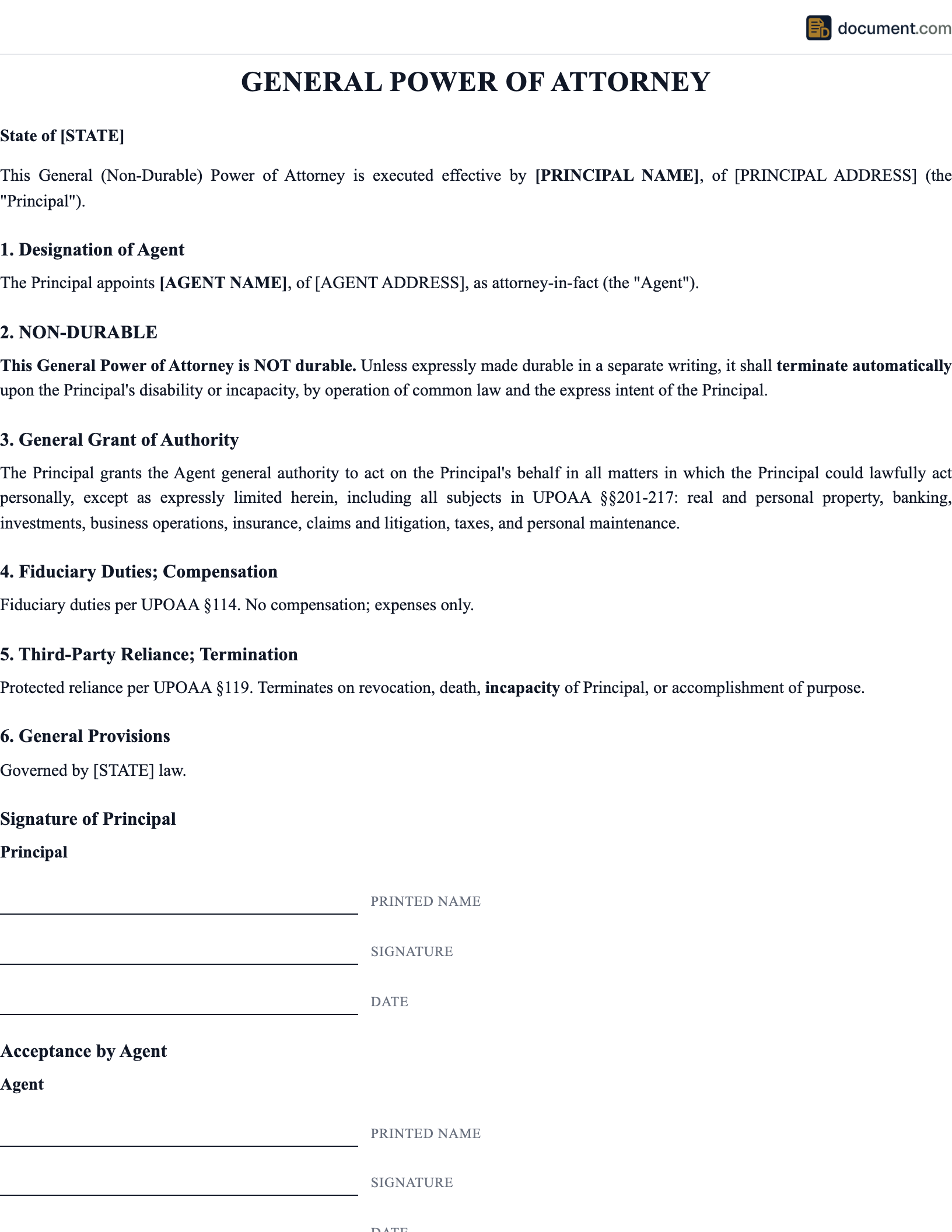
This template skeleton follows the structure required by Del. Code tit. 12, § 49A. Your completed document will reflect the specific powers, agent designations, and any business-entity provisions you choose.
STATE OF DELAWARE
POWER OF ATTORNEY
Under Del. Code Ann. tit. 12, § 49A-101 et seq.
PRINCIPAL:
Name: [Principal Name]
Address: [Principal Address]
County: [New Castle / Kent / Sussex]
AGENT (Attorney-in-Fact):
Name: [Agent Name]
Address: [Agent Address]
GRANT OF AUTHORITY
[Powers defined by selected POA type]
Delaware's Unique Position: Where Business Law Meets Personal Planning
No other state combines the volume of registered business entities, a specialized equity court, a thriving trust industry, and a simple three-county geography the way Delaware does. A properly drafted Delaware POA is not just a personal planning document — it can be the linchpin that keeps your business entity operational, your trust funded, and your beach property managed when you cannot be there yourself. Because Delaware has not adopted the UPOAA, using a state-specific form rather than a generic template is essential for acceptance by the Division of Corporations, the Court of Chancery, and the state's financial institutions.
Delaware Power of Attorney Questions
These FAQs address the issues that make Delaware unique: managing out-of-state business entities, Court of Chancery disputes, the three-county filing system, and the interplay between POAs and Delaware's trust industry.
Delaware-Specific Considerations
Delaware statutory trusts:Delaware's trust industry manages hundreds of billions of dollars, and the state's favorable trust laws attract asset-protection planning from across the country. If you have a Delaware statutory trust or dynasty trust, your POA should explicitly address whether the agent can interact with the trustee, fund or defund the trust, exercise any reserved powers you hold as grantor, or petition the Court of Chancery regarding trust matters. Without these provisions, the agent's authority stops at the trust's boundary.
Beach-community real estate:Delaware's coastal towns — Rehoboth Beach, Lewes, Bethany Beach, and Dewey Beach in Sussex County — attract a large population of vacation-home owners from the Washington D.C., Philadelphia, and Baltimore metros. If you own a beach property managed through a POA, the agent may need authority to handle rental-management agreements, hurricane-damage insurance claims, town permit applications, and homeowner-association compliance. Record the POA with the Sussex County Recorder of Deeds before the property season begins so it's ready when needed.
Franchise tax management: Every business entity registered in Delaware owes an annual franchise tax to the Division of Corporations. LLCs pay a flat $300, while corporations pay a variable amount based on their authorized shares or assumed par value. If your agent manages a Delaware entity, ensure the POA specifically authorizes them to calculate, file, and pay franchise taxes on or before the annual deadlines (March 1 for corporations, June 1 for LLCs). Missing the deadline triggers penalties and, eventually, administrative dissolution.
Official Delaware Legal Resources
Verify Delaware's POA statutes, Division of Corporations procedures, and Court of Chancery rules through these primary sources.
Create your Delaware Power of Attorney in under 5 minutes.
Answer a few questions and download a Delaware-compliant document, ready for the state agency.