



A Clear, Modern POA Framework for Arkansas
When Arkansas adopted the Uniform Power of Attorney Act under Title 28, Chapter 68, the state gained one of the most straightforward POA systems in the region. Compared to neighboring states like Texas, which has a lengthy statutory form, or Louisiana, which layers POA rules on top of its civil-law traditions, Arkansas offers a clean and predictable framework. The rules are short enough to summarize in a paragraph: notarize the document, presume durability, grant authority by category, and give third parties a deadline to accept or explain.
That simplicity matters in a state where many residents are sole proprietors, family farmers, or small-business operators who cannot afford a protracted legal process. If a sole proprietor in Jonesboro has a heart attack and no one has authority to deposit checks, pay suppliers, or file payroll taxes, the business can collapse in weeks. A UPOAA-compliant durable POA prevents that scenario by keeping someone authorized to act from day one of the incapacity, without waiting for a court to appoint a conservator.
Arkansas also benefits from the UPOAA's mandatory acceptance provision. Before the act, Arkansas banks could — and often did — refuse a perfectly valid POA by insisting the customer use the bank's own internal form. Now, a financial institution that unreasonably rejects a properly executed POA risks a court order and an attorney-fee award. That shift alone has made POAs significantly more practical for everyday Arkansans.
Required
Notarization
None
Witnesses Required
Yes
UPOAA State
Circuit Clerk
Real Estate Recording
Power of Attorney Types Under Arkansas Law
Arkansas's UPOAA framework supports nine POA categories. Pick the one that matches your circumstances — from farm management to healthcare decision-making.
General Power of Attorney
Covers financial, contractual, and legal dealings. Under Arkansas UPOAA, this is durable by default — it survives incapacity unless the document says otherwise.
Durable Power of Attorney
Explicitly labeled durable for extra clarity, though Arkansas already presumes durability. Reinforces the principal's intent and discourages third-party rejection.
Limited / Special Power of Attorney
Scoped to a single transaction or period. Arkansas farmers use this during harvest season when they cannot leave the operation to handle a closing or bank matter in person.
Medical / Healthcare Power of Attorney
Names a healthcare proxy to make medical decisions. Arkansas distinguishes this from a living will; the medical POA covers broader decision-making beyond end-of-life care.
Financial Power of Attorney
Banking, tax filings, retirement accounts, and insurance claims. Small business owners in Arkansas commonly grant this to a trusted partner or family member as a continuity measure.
Springing Power of Attorney
Stays dormant until a triggering event, usually physician-certified incapacity. Arkansas UPOAA accommodates springing POAs, but the triggering criteria must be clear and verifiable.
Minor Child Power of Attorney
Temporary delegation of parental authority. Common in Arkansas when a parent works out-of-state construction or seasonal jobs and the child stays with grandparents.
Real Estate Power of Attorney
Must be recorded with the circuit clerk in the county where the property sits. Arkansas uses circuit clerks — not county recorders — for land records.
Vehicle Power of Attorney
Enables title transfers and registration with the Arkansas Department of Finance and Administration. Frequently paired with a bill of sale for private vehicle transactions.
Agricultural & Business Use Cases
Arkansas ranks among the top rice, poultry, and cotton producers in the country. Agriculture and small business form the backbone of the state's economy, and both create scenarios where a power of attorney is not optional — it is essential.
Farm & Ranch Management
When a farm owner is hospitalized during planting or harvest, decisions cannot wait. A durable POA lets an agent sell crops at the grain elevator, negotiate with buyers, pay equipment loans, submit USDA conservation program paperwork, and manage hired labor. Recording the POA with the circuit clerk also allows the agent to sign farm leases or easements affecting the land. Without this authority, the operation can miss critical market windows that determine the year's profitability.
Small Business Continuity
Arkansas has one of the highest rates of sole proprietorships per capita in the country. If you operate a sole proprietorship — whether a contracting company in Fort Smith, a restaurant in Hot Springs, or a retail shop in Bentonville — a durable financial POA is a continuity plan. Your agent can sign contracts, make payroll, pay vendors, manage the business bank account, and file state and federal tax returns. For LLCs, make sure your operating agreement and your POA work together so the agent's authority is clear to banks and the Arkansas Secretary of State.
Timber & Mineral Rights
Arkansas's Ouachita and Ozark regions are rich in timber and natural gas. If you own mineral rights or timberland, a POA with real estate authority lets your agent negotiate timber sale contracts, sign mineral lease agreements, and collect royalties. This authority must be recorded with the circuit clerk in the relevant county. Timber sales in particular are time-sensitive — lumber markets shift quickly, and a missed window can cost thousands.
Title 28, Chapter 68 Execution Requirements
Arkansas keeps execution simple. Notarize, distribute, and record when real property is involved. Here are the specifics.
- Sound Mind and Voluntary Act: The principal must understand what they are signing and do so without coercion
- Notarization: Mandatory. The principal must acknowledge the document before an Arkansas notary public
- Witnesses: Not required by statute, though adding one is inexpensive insurance against future challenges
- Durability Default: Presumed durable unless the document explicitly states it terminates upon incapacity
- Circuit Clerk Recording: Required for any POA involving real property — file in the county where the land is located
- Mandatory Acceptance: Third parties must accept a valid POA within a reasonable time or provide a written refusal
Creating Your Arkansas Power of Attorney
Three steps and a trip to a notary. Arkansas's UPOAA makes the process about as painless as legal document creation gets.
Identify the Purpose and Pick Your Agent
Are you preparing for potential incapacity, handing off a farm operation during an illness, or setting up business continuity? The answer determines the type and scope of your POA. Choose an agent who understands the relevant domain — a family member who can manage farmland is different from a business partner who can handle payroll. Under the UPOAA, the agent accepts fiduciary duties by acting, so make sure they understand the responsibility. Name at least one successor.
Grant Authority by Category
Arkansas's UPOAA organizes powers into statutory categories: real property, tangible personal property, banking, business operations, insurance, government benefits, taxes, and more. You can grant all categories broadly or limit the agent to specific tasks. Certain sensitive powers — like making gifts, creating trusts, or changing beneficiary designations — require a separate, express grant with the principal's initials under the UPOAA. Decide now whether the POA should be immediately effective or springing (activated by a future event).
Notarize, Record, and Distribute
Visit any Arkansas notary public and sign the document in their presence. If the POA covers real property, record it at the circuit clerk's office in the relevant county — do this before the agent needs to act. Distribute copies to your agent, successor agents, every bank or financial institution that holds your accounts, your healthcare providers (if a medical POA is involved), and any business partners. Keep the original in a secure location and let your agent know where it is.
Sample Arkansas Power of Attorney
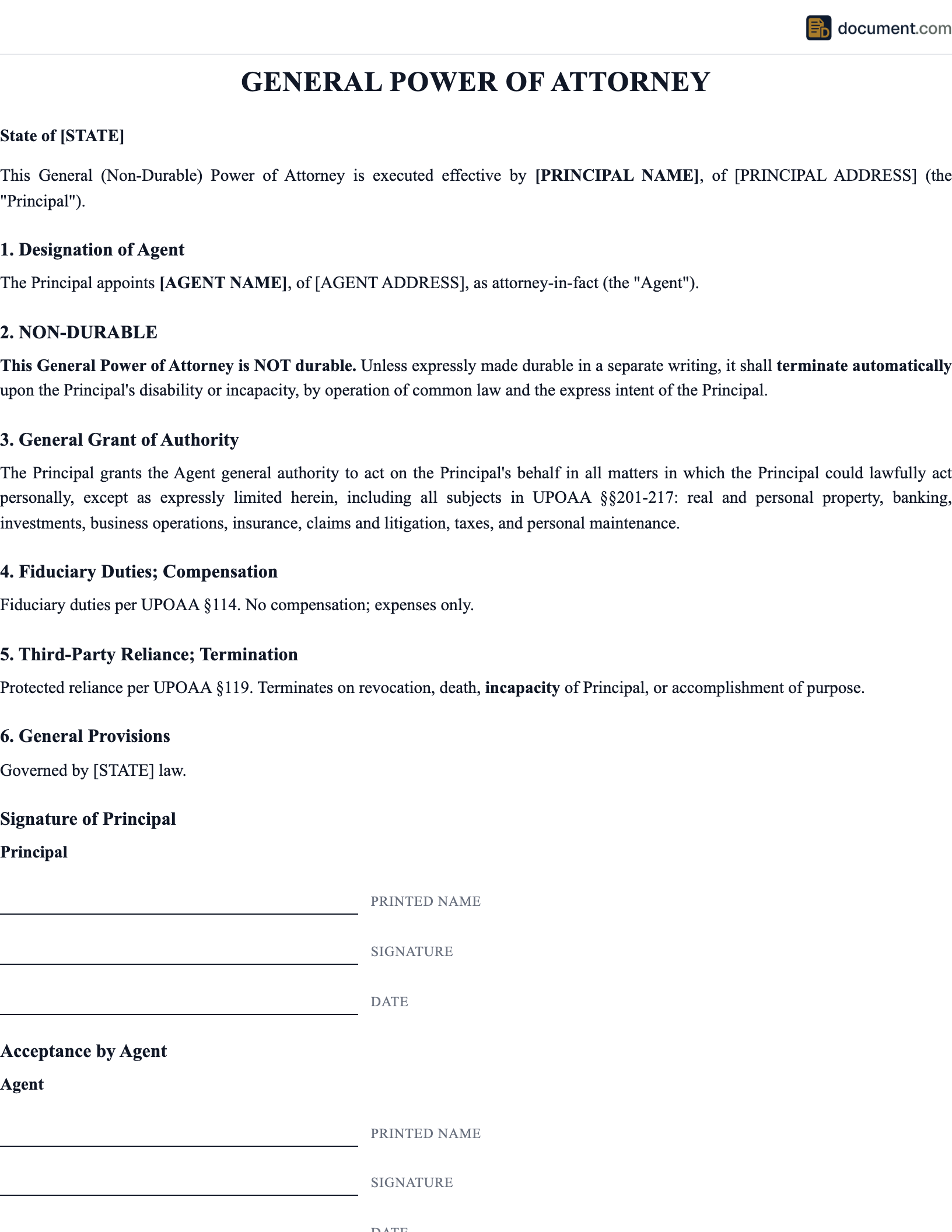
Below is a preview of our Arkansas-specific template aligned with Title 28, Chapter 68. The final document will reflect the POA type, powers, and durability preferences you select.
STATE OF ARKANSAS
POWER OF ATTORNEY
Under Arkansas Code Title 28, Chapter 68 (UPOAA)
PRINCIPAL:
Name: [Principal Name]
Address: [Arkansas Address]
AGENT (Attorney-in-Fact):
Name: [Agent Name]
Address: [Agent Address]
CATEGORIES OF AUTHORITY GRANTED
[Selected categories per UPOAA]
DURABILITY
This power of attorney is durable pursuant to Arkansas Code §28-68-104 and shall not be affected by the principal's subsequent incapacity.
Arkansas Power of Attorney FAQ
Questions Arkansas residents actually ask — from farming operations and small businesses to the circuit clerk recording process.
Official Arkansas Resources
Look up the full text of the Arkansas UPOAA, find your county circuit clerk, and review the national uniform act through these sources.
Create your Arkansas Power of Attorney in under 5 minutes.
Answer a few questions and download a Arkansas-compliant document, ready for the state agency.