
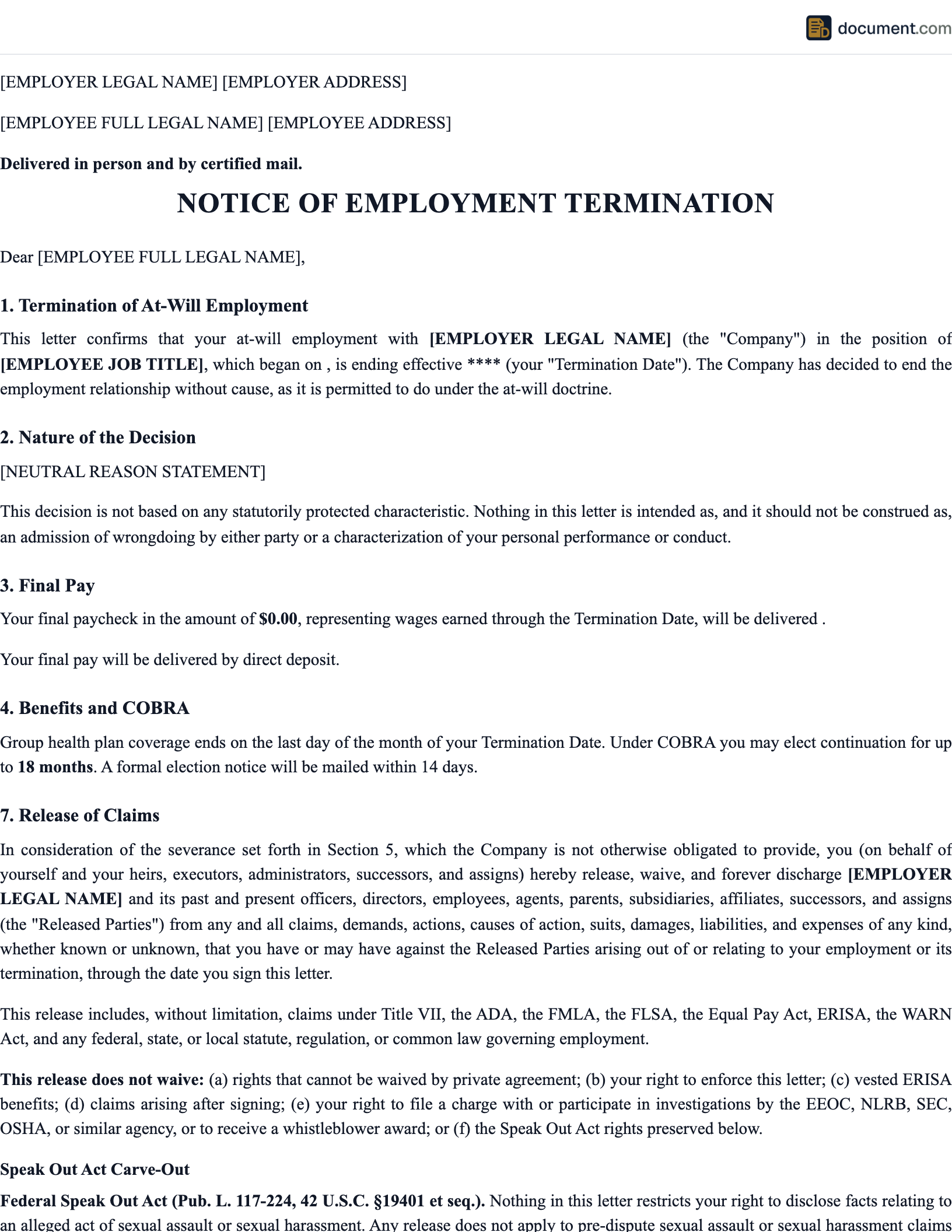



What Is a Contract Termination Letter?
A contract termination letter is a written notice from one party to another formally ending a contractual relationship. It is the document that makes a termination legally effective: most contracts require written notice in a specific form, delivered to a specific address, by a specific method, within a specific timeframe, and for specific reasons. Skipping any one of these requirements can render the termination invalid and expose the terminating party to a wrongful termination claim and damages.
Termination letters come in several flavors. A termination for convenience letter ends the contract without alleging any wrongdoing — the terminating party simply exercises a contractual right to walk away on the required notice. A termination for cause letter ends the contract because the counterparty has materially breached its obligations and either failed to cure or committed a breach for which no cure is possible. A non-renewal letter declines to renew an automatically renewing contract before the next renewal window closes. A mutual termination letter (or mutual release) documents an agreement between the parties to end the contract on negotiated terms.
The legal framework around termination is one of the most heavily litigated areas of contract law. Whether a particular termination is valid often turns on close reading of the contract — what notice was required, whether a cure period applied, whether the breach was material, whether the notice was delivered properly. Courts construe termination provisions strictly, and minor non-compliance can defeat an otherwise valid termination. A well-drafted termination letter follows the contract's exact requirements and creates a record that will hold up if the dispute ends up in court or arbitration.
Beyond the question of validity, the termination letter has substantive consequences for the parties' ongoing rights. It triggers the running of statutes of limitations, fixes the damages recoverable by each side, identifies the obligations that survive termination (confidentiality, IP, indemnity, dispute resolution), and starts the clock on transition activities. A poorly drafted letter can waive remedies, create unintended releases, or be construed as an invitation to negotiate rather than an actual termination.
Whether you are exiting a vendor relationship that is no longer working, terminating a non-paying customer, declining to renew a software subscription, ending a service contract for cause, or documenting a mutual parting of ways, our attorney-reviewed termination letter templates give you a legally sufficient framework that addresses notice, cure, surviving obligations, delivery, and the practical steps needed to make the termination stick.
Formal Notice
Satisfies the contractual notice requirement and creates a defensible record
Triggers Deadlines
Starts cure periods, transition windows, and statutes of limitations
Preserves Remedies
Keeps your damages claims alive without waiving rights or creating releases
Termination Letter Preview
The structure of our standard termination letter template, customized to your termination type.
Notice of Contract Termination
Sent via Certified Mail
Section 1: Sender & Recipient
Section 2: Contract Reference
Section 3: Termination Type
Section 4: Grounds & Effective Date
Types of Termination Letters
Different termination scenarios call for different language. Pick the one that matches your situation.
Termination Letter vs Other Notice Letters
A termination letter is one of several notice documents used in commercial disputes. Pick the right tool for the right stage of escalation.
Termination Letter vs Notice of Breach
Termination Letter
- - Ends the contract
- - Sent after cure period (if any)
- - Triggers transition obligations
- - Final action
Notice of Breach
- - Identifies the breach
- - Demands cure
- - Starts the cure period clock
- - Precondition to termination
Sequence: Notice of breach first, then if not cured, termination letter.
Termination Letter vs Demand Letter
Termination Letter
- - Goal: end the contract
- - Forward-looking (relationship over)
- - May reserve damages claims
Demand Letter
- - Goal: get paid or get performance
- - Pre-litigation, relationship may continue
- - Threatens further action
Termination Letter vs Settlement Agreement
Termination Letter
- - Unilateral notice from one party
- - Does not release claims
- - May lead to litigation
Settlement Agreement
- - Bilateral, signed by both parties
- - Includes mutual releases
- - Final and binding
How to Write a Termination Letter: 8 Steps
A defensible termination letter is the result of careful preparation. Work through these eight steps before sending.
Read the Termination Provisions Carefully
Pull the original contract and read the termination, notice, and cure provisions word by word. Note the required notice period, the addresses for delivery, the acceptable methods of delivery, the form of the notice, and any specific language the contract requires (e.g., 'this notice is given pursuant to Section 12.3'). Strict compliance is required — minor deviations can invalidate the termination.
Decide Whether You Have Grounds and What Type
Determine whether you are terminating for cause, for convenience, for non-payment, for non-renewal, or by mutual agreement. Termination for cause requires a material breach and (in most contracts) a written notice of breach plus cure period. Termination for convenience requires only the contractual notice period. Each type has its own template language.
Send a Notice of Breach First if Required
If terminating for cause, the contract almost certainly requires you to give a notice of breach and a cure period before termination. Send this notice first, document it, wait the cure period, and only then send the termination letter referencing the unremedied breach. Skipping the notice of breach is the most common reason for-cause terminations are invalidated.
Draft the Letter with Specific Facts
Identify the contract by name and date, identify the parties, state the type of termination, cite the specific contract provision authorizing the termination, describe the grounds (with dates, dollar amounts, and specific facts for cause terminations), state the effective date, and address surviving obligations. Avoid emotional language, accusations beyond the necessary facts, or admissions of your own breach.
Address Surviving Obligations and Final Accounting
Identify the obligations that will survive termination — confidentiality, IP, indemnity, dispute resolution — and request a final accounting of any open invoices, returns, or transition items. Specify deadlines for the counterparty to return property, deliver final work product, and pay outstanding amounts. Reserve all rights and remedies.
Set the Effective Date
Calculate the effective date carefully. For termination for cause, it is usually a fixed date after the cure period expires. For termination for convenience, it is the contractual notice period after delivery. For non-renewal, it is the end of the current term. Build in a buffer if delivery may be delayed.
Deliver Using the Required Method
Use the delivery method specified in the contract — usually certified mail with return receipt, overnight courier, or hand delivery. If the contract permits email, send by email AND a backup physical method for high-stakes terminations. Send to all addresses listed in the contract notice provision, including any 'with copy to' counsel addresses. Save proof of delivery.
Document Everything and Calendar Follow-Up
Save the original letter, all delivery confirmations, the certified mail receipt and return receipt, the FedEx/UPS tracking, any email read receipts, and a memo to the file describing the chain of events. Calendar key dates: cure period expiration, effective date, transition deadlines, statute of limitations milestones. The paper trail you create now will be the foundation of your defense if a wrongful termination claim is filed later.
Key Components
Every effective termination letter contains the following elements.
| Component | Description |
|---|---|
| Date and Sender Information | Date of letter, sender's full name, title, company, and address |
| Recipient Information | Recipient's name, title, company, and address from the contract notice clause |
| Subject Line | Clear identification: 'Notice of Termination of [Contract Name]' |
| Contract Identification | Contract title, effective date, and any reference number |
| Statement of Termination | Express statement that the contract is being terminated |
| Type of Termination | For cause, for convenience, for non-payment, mutual, or non-renewal |
| Authorizing Provision | Citation to the contract section authorizing termination |
| Grounds (if cause) | Specific facts supporting material breach and prior cure failure |
| Effective Date | Date on which the termination takes effect |
| Surviving Obligations | Identification of provisions that survive (confidentiality, IP, indemnity) |
| Transition Requirements | Return of property, final invoices, deliverables, data export |
| Final Accounting Demand | Request for final billing, refunds, or settlement of open items |
| Reservation of Rights | Statement that all rights and remedies are reserved |
| Delivery Method Reference | Note that the letter is being delivered per the contract notice clause |
| Signature | Authorized signature, printed name, and title |
| Copies and CC | Copies to counsel, key personnel, or other addresses required by contract |
Legal Requirements and Best Practices
Termination is one of the most legally fraught actions in contract performance. The rules vary by contract, by state, and by industry, but several principles apply across the board.
Strict Compliance with Notice Provisions
Courts construe contract notice provisions strictly. A termination delivered to the wrong address, sent by the wrong method, or signed by an unauthorized person can be invalidated even if the underlying termination was justified. Always read the notice provision carefully and follow it exactly. When in doubt, use the most formal method available — certified mail with return receipt plus an overnight courier with tracking.
Material Breach Doctrine
Courts apply a multi-factor test to determine whether a breach is material enough to justify termination — looking at the extent of deprivation of the expected benefit, the adequacy of money damages, the breaching party's good faith, and the likelihood of cure. Restatement (Second) of Contracts § 241 lists these factors. Borderline breaches should not be the basis for termination unless the contract expressly makes them material breaches.
Duty to Mitigate
The non-breaching party has a duty to mitigate damages — to take reasonable steps to limit losses after termination. This typically means promptly procuring substitute performance, finding a replacement vendor, or otherwise reducing the financial impact of the breach. Failure to mitigate reduces recoverable damages, sometimes substantially. Document mitigation efforts in real time.
Wrongful Termination Risk
A termination that is procedurally defective (wrong method, wrong address, missed cure period) or substantively unjustified (no material breach, no contractual right) can be reclassified as a breach by the terminating party — exposing them to damages that may exceed the value of the original contract. Long-term distributor, franchise, and dealer relationships are particularly risky to terminate without clear cause.
Industry-Specific Termination Statutes
- Franchise relationships: Most states have franchise relationship statutes (the Petroleum Marketing Practices Act for gasoline dealers and state-specific franchise acts) that limit termination grounds, require longer notice, and impose substantial damages for wrongful termination.
- Auto and motor vehicle dealers: All 50 states regulate termination of motor vehicle dealer agreements, requiring good cause, notice, and often state agency review.
- Commercial leases: Real property and equipment leases have their own termination rules, including notice and right of redemption.
- Federal contracts: FAR Part 49 governs termination for default and termination for convenience of federal prime contracts.
- Consumer contracts: State and federal consumer protection laws (including the FTC's ROSCA rule) regulate termination of subscription and recurring-charge consumer contracts.
Sample Termination Letter
Condensed preview of our standard termination letter.
[Date]
VIA CERTIFIED MAIL, RETURN RECEIPT REQUESTED
[Recipient Name]
[Title]
[Company]
[Address]
Re: Notice of Termination of [Contract Name] dated [Contract Date]
Dear [Recipient]:
This letter serves as formal notice that[Sender Company]is terminating the[Contract Name]dated [Contract Date](the "Agreement") between us, pursuant to Section[X] of the Agreement.
Type of Termination: This termination is for [cause / convenience / non-renewal].
Grounds (if for cause): [Detailed description of the material breach, including specific facts, dates, and reference to the contract provisions breached. Reference any prior notice of breach and confirm the cure period has expired without remedy.]
Effective Date: The termination shall be effective as of[Effective Date].
Surviving Obligations: Notwithstanding this termination, the parties' obligations under Sections [list surviving sections — typically confidentiality, indemnity, intellectual property, limitation of liability, and dispute resolution] shall survive in accordance with their terms.
Transition: Please return all of [Sender]'s property, deliver any final work product, provide a final invoice for services rendered through the Effective Date, and cooperate with the orderly transition of services to a replacement vendor.
Reservation of Rights: [Sender] reserves all rights and remedies under the Agreement and applicable law, including the right to recover damages for breach. Nothing in this letter constitutes a waiver of any right or claim.
Sincerely,
____________________________
[Authorized Signatory]
[Title]
[Company]
Frequently Asked Questions
Common questions about contract termination, notice, cure periods, and damages.
Official Resources
Authoritative sources on contract termination, breach, and damages.
UCC § 2-610 - Anticipatory Repudiation
Official text of the Uniform Commercial Code provision on anticipatory breach
UCC § 2-609 - Adequate Assurance
Right to demand adequate assurance of future performance under sales contracts
FAR Part 49 - Termination
Federal Acquisition Regulation provisions for termination of federal prime contracts
FTC ROSCA Rule
Federal Trade Commission rules on consumer subscription cancellation
Cornell LII - Breach of Contract
Free legal encyclopedia overview of breach, material breach, and remedies
Uniform Law Commission
State adoption of uniform contract law statutes including the UCC
ABA Business Law Section
American Bar Association resources on commercial contract law
SBA - Contract Resources
Small Business Administration guidance on contract management and termination
Create your Notice of Contract Termination in under 10 minutes.
Answer a few questions and download a compliant, attorney-drafted document ready for your state.