
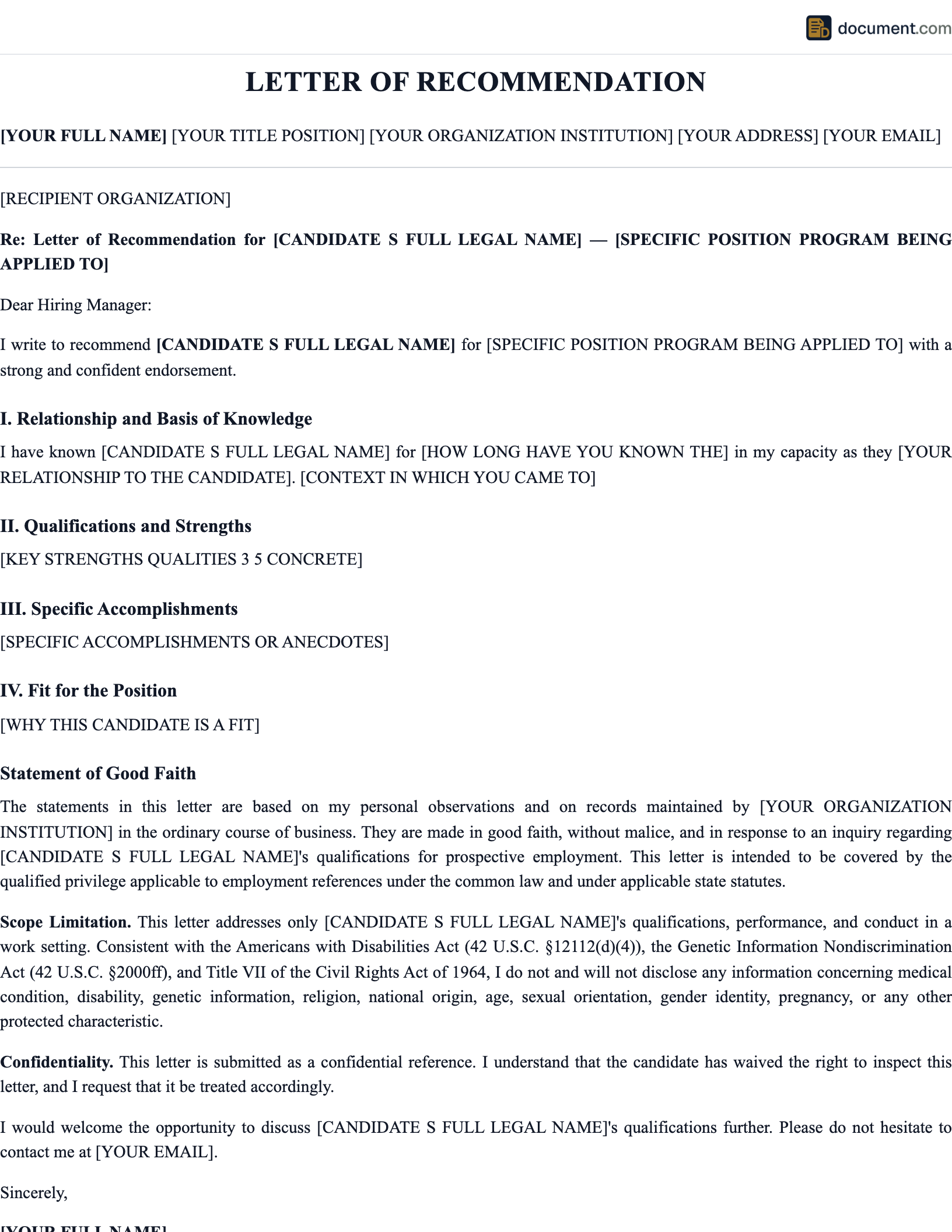



What Is a Teacher Letter of Recommendation?
A teacher letter of recommendation is a professional endorsement written by a principal, department head, curriculum supervisor, fellow educator, or professor who can speak to a teacher's instructional effectiveness, classroom management skills, professional development, and contributions to the school community. These letters play a critical role in the teaching profession because they provide hiring committees, certification boards, and graduate admissions panels with evaluative detail that resumes and credentials alone cannot convey — particularly the quality of a teacher's daily practice, their impact on student learning, and their potential for growth in a new role or environment.
Unlike recommendations for other professions where the work product is tangible and quantifiable, teaching effectiveness is fundamentally relational and contextual. A teacher's ability to reach a disengaged student, to adapt a lesson in real time when comprehension checks reveal confusion, or to build a classroom culture where students take intellectual risks cannot be captured on a resume or certification transcript. The recommendation letter is the document that translates observed classroom practice into narrative evidence that helps decision-makers understand what this teacher actually does — and how well they do it — when the classroom door closes and instruction begins.
The weight a teacher recommendation carries depends heavily on the recommender's credibility and the specificity of their observations. A letter from a principal who has conducted multiple formal evaluations and can describe specific instructional strategies, student engagement techniques, and growth over time holds far more weight than a generic letter from an acquaintance who has never observed the teacher in a classroom setting. Hiring committees in education are sophisticated readers of recommendation letters — they know what genuine classroom observation language sounds like and can detect letters that rely on secondhand impressions or boilerplate phrasing.
Instructional Skill
Documents the teacher's ability to plan, deliver, and assess effective instruction.
Student Rapport
Demonstrates the teacher's ability to build meaningful relationships with diverse learners.
Professional Growth
Shows commitment to continuous improvement and contributions to the broader school community.
Teacher Recommendation Letter Form Preview
Professional Letter of Recommendation
For Teaching Position Consideration
TO THE HIRING COMMITTEE
Dear Members of the Hiring Committee, I am writing to recommend for the position of .
SUPERVISORY RELATIONSHIP
I have supervised this teacher for years in my role as .
INSTRUCTIONAL EFFECTIVENESS
Based on my observations, demonstrates exceptional skill in and consistently achieves .
RESPECTFULLY SUBMITTED
Signature / Date
Key Components
An effective teacher recommendation letter must include these essential elements to meet hiring committee expectations and provide meaningful evaluation:
| Component | Purpose | Key Details |
|---|---|---|
| Recommender Credentials | Establishes evaluative authority | Administrative title, school, years supervising teachers |
| Supervisory Context | Shows basis for evaluation | Number of observations, evaluation framework used, duration |
| Instructional Practice | Demonstrates teaching quality | Lesson planning, differentiation, assessment strategies, engagement |
| Classroom Management | Addresses operational competence | Routines, behavior systems, transitions, student autonomy |
| Professional Contributions | Shows school-wide impact | Committee work, mentoring, coaching, curriculum development |
| Student Impact | Provides outcome evidence | Learning gains, student feedback, parent satisfaction, growth data |
| Definitive Endorsement | Delivers clear recommendation | Comparative ranking, enthusiasm level, willingness to rehire |
How to Write a Teacher Letter of Recommendation
Establish Your Evaluative Authority
Open by identifying your administrative or supervisory role, the school or district you serve, and your experience evaluating teaching professionals. A principal who has observed hundreds of teachers over two decades brings a different evaluative perspective than a department chair in their second year. State the teacher's name, current role, and the specific position or opportunity they are pursuing, so the reader knows this is a targeted recommendation.
Describe Your Observation of the Teacher
Explain how and when you observed the teacher's practice — formal evaluations using frameworks like Danielson or Marzano, walkthroughs, co-planning sessions, team meetings, or informal classroom visits. The number and type of observations you reference directly affects the credibility of your assessment. A principal who has conducted six formal observations and dozens of walkthroughs over three years has a far richer observational base than someone who visited the classroom once.
Evaluate Instructional Effectiveness
This is the core of any teacher recommendation. Describe specific instructional strategies you observed: how the teacher differentiated instruction for diverse learners, how they used formative assessment to adjust pacing, how they structured lessons to maximize student engagement, and how they incorporated technology, project-based learning, or collaborative structures. Use professional education vocabulary that signals to hiring committees that you are making an informed evaluation, not just offering general impressions.
Address Classroom Culture and Management
Describe the classroom environment the teacher has created — not just the absence of misbehavior, but the presence of a learning-focused culture. How do students interact with each other and the teacher? Is there evidence of mutual respect, intellectual risk-taking, and student ownership of learning? Do routines and transitions run smoothly? Hiring committees know that even the most brilliant lesson plan fails without strong classroom management, so evidence of a well-functioning classroom is essential.
Highlight Professional Contributions and Growth
Schools hire teachers to contribute beyond their own classroom. Describe the teacher's involvement in curriculum development, professional learning communities, mentoring of new teachers, parent communication, extracurricular advising, or school improvement initiatives. Also address professional growth — has the teacher pursued additional certifications, attended conferences, incorporated new research into their practice, or sought feedback proactively? Evidence of a growth mindset signals that this teacher will continue developing in their new role.
Close with a Definitive Endorsement
End with an unambiguous statement of your recommendation. Many principals use the benchmark of whether they would rehire the teacher — 'I would hire this teacher again without hesitation' — or provide a comparative ranking among all teachers they have supervised. If you can honestly say the teacher is among the most effective you have worked with, say so explicitly with a timeframe for context. Offer your phone number and email for follow-up questions, and sign on school letterhead to reinforce your institutional authority.
When Teachers Need Recommendation Letters
Teachers require recommendation letters at several key career milestones. The most common need arises when applying for new teaching positions at different schools or districts, where hiring committees typically require two to four letters from supervisors who have directly observed the candidate's classroom practice. Teachers transferring from one state to another face particularly high standards for recommendation quality because the hiring district has no institutional knowledge of the candidate and relies heavily on written evaluations to assess instructional competence and professional character.
Beyond job applications, teachers need recommendation letters for graduate program admissions (master's degrees in education, educational leadership, curriculum and instruction, or specialized certifications), National Board Certification portfolios, Teacher of the Year nominations, fellowship applications such as the Fund for Teachers or NEA Foundation grants, and applications for leadership roles including department chair, instructional coach, or assistant principal positions. Each of these contexts requires a different emphasis — a graduate school letter should highlight intellectual curiosity and research potential, while a leadership position letter should emphasize mentoring skills and school-wide impact.
Request Letters Before Leaving a School
Teachers should request recommendation letters from supervisors while they are still employed at the school, not after departing. Once a teacher leaves, principals may be reassigned, retire, or simply lose the fresh memory of classroom observations that makes a letter compelling. Building a portfolio of strong recommendation letters from each school where you teach ensures you always have current, detailed endorsements available when opportunities arise.
Frequently Asked Questions
Official Resources
Authoritative resources on teacher certification, professional development, and education career advancement.
National Board for Professional Teaching Standards
Organization administering National Board Certification for teachers, the profession's highest credential and a common occasion for recommendation letters.
National Education Association
Largest professional organization for educators providing resources on career development, certification, and professional advocacy.
American Federation of Teachers
Union and professional organization offering career resources, professional development guidance, and teacher advocacy tools.
TEACH.org
U.S. Department of Education initiative providing resources on teaching careers, certification requirements, and state-by-state licensing information.
BLS - Education Occupations
Bureau of Labor Statistics data on teaching career outlook, salary information, and education requirements across all 50 states.
Danielson Group - Framework for Teaching
Professional teaching evaluation framework used by many school districts, providing vocabulary and standards for assessing teacher effectiveness.
Create Your Teacher Recommendation Letter
Draft a professional teacher recommendation that showcases instructional effectiveness, classroom management, and professional dedication in a format hiring committees expect.
Create DocumentNo account required. Free to create and preview.