
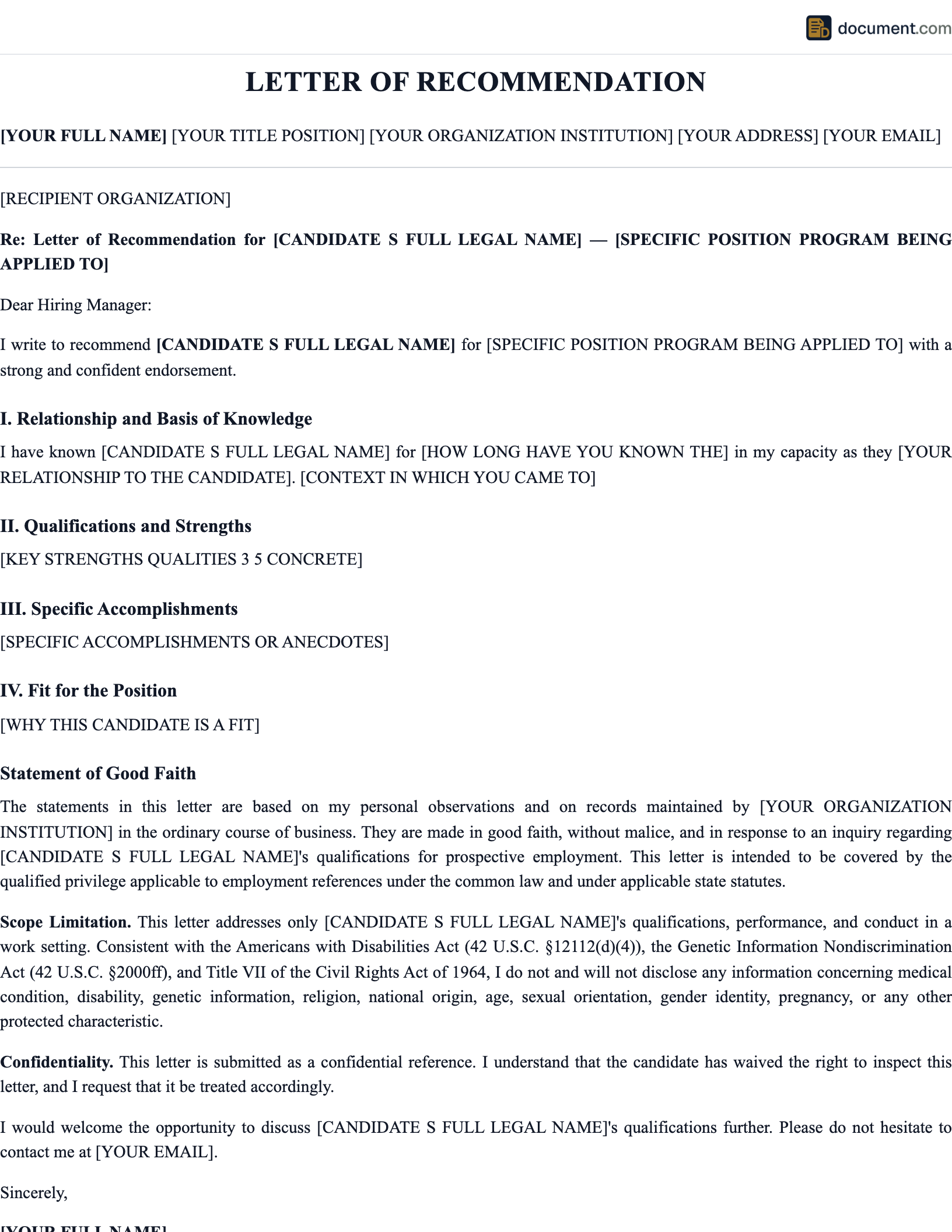



What Is an Employee Letter of Recommendation?
An employee letter of recommendation is a formal professional reference that provides a substantive assessment of an individual's job performance, professional capabilities, work ethic, and character in the workplace. Unlike an employment verification — which merely confirms dates of employment, title, and sometimes salary — a recommendation letter offers the writer's personal evaluation of the employee's contributions, skills, and potential based on direct professional observation. These letters serve as a critical component of the hiring process because they provide prospective employers with an independent, credible assessment from someone who has actually worked with the candidate and can speak to their capabilities in real working conditions.
The value of a professional recommendation letter lies in its specificity and credibility. Hiring managers routinely review resumes that list accomplishments and interviews where candidates present their best selves, but a recommendation letter from a credible source provides corroboration — independent confirmation that the candidate actually possesses the skills and qualities they claim. Research by the Society for Human Resource Management (SHRM) consistently finds that reference checks and recommendation letters are among the most valued tools in the hiring decision process, particularly for mid-level and senior positions where the cost of a bad hire is substantial.
Professional recommendation letters serve multiple purposes beyond standard job applications. They support promotions within an organization, transfers between departments or locations, professional licensing and certification applications, security clearance investigations, industry awards and recognitions, and immigration employment-based visa petitions. Each context requires different emphasis — a recommendation for a project management certification should highlight project leadership and delivery, while a recommendation supporting a visa application should emphasize the employee's specialized skills and the employer's inability to find equivalent domestic talent.
Performance Assessment
Provides credible evaluation of the employee's job performance with specific achievements and results.
Professional Character
Attests to the employee's interpersonal skills, team collaboration, and workplace conduct.
Career Advancement
Supports job applications, promotions, licensing, and professional development goals.
Employee Recommendation Letter Form Preview
Letter of Recommendation
Professional Employment Reference
TO WHOM IT MAY CONCERN
I am writing to recommend who worked under my supervision as at from to .
PERFORMANCE AND CONTRIBUTIONS
During their tenure, consistently demonstrated and made significant contributions to .
RECOMMENDATION
I strongly recommend for any position that requires .
SINCERELY
Name / Title / Date
Key Components
A strong employee recommendation letter must include these essential elements to be credible and persuasive:
| Component | Purpose | Key Details |
|---|---|---|
| Writer Credentials | Establishes professional authority | Name, title, company, relationship to employee, duration of supervision |
| Employment Context | Provides professional backdrop | Employee's role, responsibilities, team size, department, duration |
| Performance Examples | Demonstrates capability with evidence | Specific projects, quantifiable results, achievements, impact |
| Skills Assessment | Identifies transferable strengths | Technical skills, soft skills, leadership, problem-solving, communication |
| Work Ethic and Character | Addresses cultural fit and reliability | Reliability, initiative, collaboration, integrity, professionalism |
| Growth Trajectory | Shows development potential | Promotions earned, skills acquired, increasing responsibilities |
| Clear Endorsement | Provides unambiguous recommendation | Explicit recommendation, contact information for follow-up |
How to Write an Employee Recommendation Letter
Confirm the Purpose and Audience
Before writing, ask the employee what position or opportunity they are pursuing and who will read the letter. A recommendation for a management position should emphasize leadership and strategic thinking, while a recommendation for a technical role should highlight specific technical capabilities and project outcomes. Understanding the audience allows you to tailor the letter's emphasis and examples to what the reader values most. Also confirm whether the letter should be addressed to a specific person or written as a general 'To Whom It May Concern' reference.
Establish Your Professional Credibility
Open the letter by identifying yourself — your name, title, organization, and your professional relationship to the employee. State how long you supervised or worked with them and in what capacity. This section establishes why your assessment should be trusted: 'As Director of Engineering at TechCorp, I directly supervised Maria for three years on our core product development team, where I had daily visibility into her technical work, collaboration with cross-functional partners, and professional growth.'
Describe Specific Achievements and Impact
The core of the letter should contain two to three paragraphs with concrete, specific examples of the employee's contributions. Use quantifiable metrics whenever possible: revenue generated, costs saved, projects delivered, team members managed, customer satisfaction scores improved, or processes optimized. Name specific projects and describe the employee's role and impact. For example: 'David led the migration of our legacy billing system to a cloud-based platform, managing a team of six engineers and completing the project $50,000 under budget while reducing processing time by 40%.'
Assess Professional Skills and Character
Beyond specific achievements, address the employee's professional qualities that make them effective: communication skills, ability to work under pressure, initiative in identifying and solving problems, reliability in meeting deadlines, mentoring of junior staff, adaptability to changing priorities, and integrity in handling sensitive information. These qualitative assessments are particularly valuable to hiring managers because they address the employee's working style and cultural fit — factors that are difficult to evaluate from a resume or interview alone.
Address Growth and Potential
Describe how the employee grew during their time working with you. Did they earn promotions? Take on increasing responsibility? Develop new skills? Overcome challenges? A narrative of professional growth demonstrates that the employee is not static — they are someone who will continue to develop and add value in future roles. If the employee is transitioning to a new field or role type, address how their existing skills transfer and why you believe they will succeed in the new context.
Close with an Unequivocal Recommendation
End with a clear, unambiguous endorsement: 'I recommend [name] without reservation for [position/opportunity]' or 'I give [name] my highest recommendation.' Provide your phone number and email address and state your willingness to discuss the candidate further. If your company requires a disclaimer, include it. Sign the letter with your full name, title, and date. On company letterhead if permitted; otherwise, use a professional personal format that includes your company affiliation.
Legal Considerations for Employment References
Writing employee recommendation letters involves legal considerations that vary by state and employer policy. Most states provide some form of qualified privilege or statutory immunity to employers who provide truthful, good-faith employment references. These protections generally shield the reference writer from defamation claims as long as the statements are truthful, made without malice, and shared with parties who have a legitimate interest (such as a prospective employer). However, the scope of protection varies significantly — some states protect only factual statements (dates, title, salary), while others extend protection to good-faith opinions about performance and character.
Many large employers have adopted policies restricting employment references to basic verification information (dates of employment, title, and rehire eligibility) provided only through the human resources department. These policies exist to minimize litigation risk, but they can be frustrating for employees who want substantive references. If your company has such a policy, you have several options: write the recommendation in your personal capacity with a disclaimer, provide a verbal reference rather than a written letter, or write a LinkedIn recommendation that supplements the formal verification. Always be truthful — false positive statements in a recommendation letter can create liability if the employee harms a third party in their new role and the harmed party can show the reference writer knowingly misrepresented the employee's qualifications or conduct.
Truthfulness Requirement
All statements in an employee recommendation letter must be truthful. Knowingly false statements — whether positive or negative — can expose the writer to defamation liability, and false positive statements about a dangerous or incompetent employee can create negligent referral liability if the employee causes harm in their new position. If you cannot provide an honest positive reference, decline to write the letter rather than fabricating praise or omitting material facts about serious performance or conduct issues.
Frequently Asked Questions
Official Resources
Authoritative resources on employment references, workplace law, and professional recommendation best practices.
SHRM - Managing Employee References
Society for Human Resource Management guidance on employment reference policies, legal considerations, and best practices for HR professionals.
U.S. DOL - Hiring Resources
Department of Labor resources on the hiring process, including guidance on employment references and workplace regulations.
EEOC - Pre-Employment Inquiries
Equal Employment Opportunity Commission guidance on lawful pre-employment inquiries, including reference checks and recommendation letters.
Bureau of Labor Statistics - Occupational Outlook
Labor market data and occupational information useful for tailoring recommendation letters to specific career fields.
ABA Section of Labor and Employment Law
American Bar Association resources on employment law, including reference immunity statutes and employer liability for references.
Nolo - Giving References for Former Employees
Practical legal guide for employers on providing employment references, including state-by-state immunity law summaries.
Create Your Employee Recommendation Letter
Draft a professional employment reference highlighting job performance, skills, and career achievements that supports your employee's next career opportunity.
Create DocumentNo account required. Free to create and preview.