
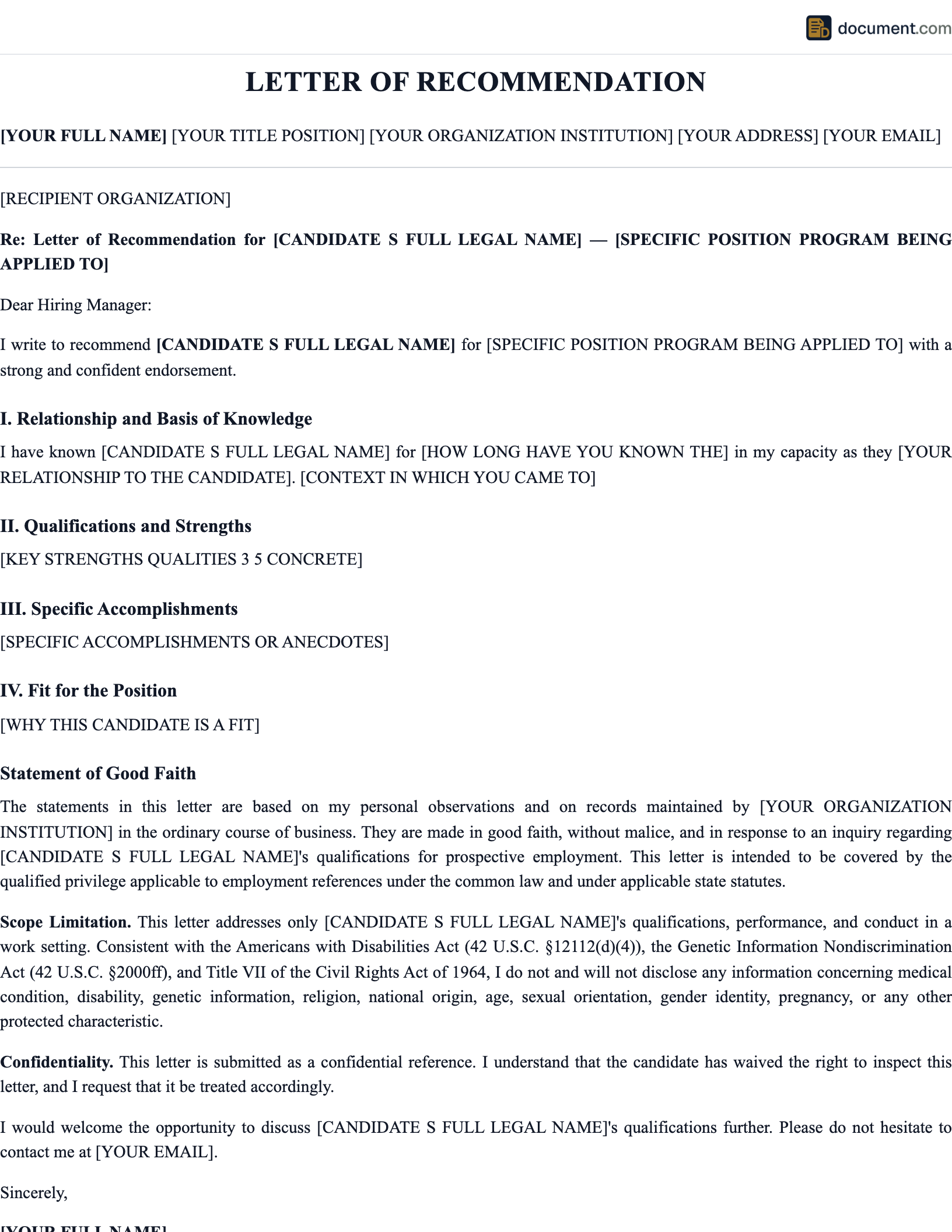



What Is a Graduate School Letter of Recommendation?
A graduate school letter of recommendation is an academic reference that evaluates a candidate's fitness for advanced study at the master's or doctoral level. Unlike undergraduate recommendations, which assess general academic potential, graduate school letters must demonstrate that the applicant possesses the specialized skills, intellectual maturity, and scholarly disposition required for graduate-level work in a specific discipline. The letter writer — typically a professor who supervised the applicant's coursework, thesis, or research — provides the admissions committee with a faculty-to-faculty assessment of the applicant's potential to succeed in an environment that demands independent research, rigorous analytical thinking, sustained intellectual effort, and the ability to contribute original knowledge to the field.
The weight of recommendation letters in graduate admissions decisions is substantial and, for many programs, decisive. At doctoral programs in the sciences, humanities, and social sciences, recommendation letters are consistently ranked as the most important or second-most important factor in admissions decisions (after the applicant's research experience). The reason is practical: graduate programs are investing significant resources — tuition waivers, stipends, laboratory space, faculty mentoring time — in each admitted student, and they need confidence that the student will complete the program, produce quality scholarship, and contribute positively to the intellectual community. A recommendation from a respected scholar who can speak with authority about the applicant's research capabilities and scholarly potential provides the strongest evidence for this assessment.
The expectations for graduate recommendation letters vary by discipline and program type. STEM doctoral programs prioritize evidence of laboratory skills, experimental design capability, data analysis proficiency, and the applicant's ability to work independently on long-term research projects. Humanities doctoral programs emphasize analytical writing, theoretical sophistication, archival or textual research skills, and the applicant's ability to formulate and pursue original research questions. Professional master's programs (MBA, MPA, MPH) value letters that demonstrate professional competence, leadership, and the applicant's readiness to bridge academic study and practical application. Understanding these disciplinary differences helps recommenders tailor their letters to what the specific admissions committee values most.
Research Aptitude
Evaluates the applicant's ability to design, execute, and analyze independent research projects.
Scholarly Maturity
Assesses intellectual depth, theoretical understanding, and readiness for advanced academic work.
Academic Writing
Documents the quality of the applicant's written scholarship and analytical communication skills.
Graduate School Recommendation Form Preview
Academic Letter of Recommendation
For Graduate Program Admissions
TO THE GRADUATE ADMISSIONS COMMITTEE
I am writing to recommend for admission to your program. I have supervised this student in and can speak directly to their research capabilities and scholarly potential.
RESEARCH AND ACADEMIC PERFORMANCE
In my years in this department, ranks among the top % of students I have supervised at this level.
RECOMMENDATION
I give my strongest recommendation for graduate study and am confident they will make significant contributions to your program.
SINCERELY
Professor / Department / Institution
Key Components
An effective graduate school recommendation must address these elements to satisfy admissions committee expectations:
| Component | Purpose | Key Details |
|---|---|---|
| Faculty Credentials | Establishes authority | Name, rank, department, institution, research area, years in field |
| Supervisory Context | Shows depth of knowledge | Courses taught, research supervised, thesis advised, duration |
| Research Assessment | Evaluates scholarly potential | Methodology skills, experimental design, data analysis, independent thinking |
| Intellectual Character | Predicts graduate success | Curiosity, persistence, response to criticism, capacity for ambiguity |
| Writing Quality | Assesses communication ability | Analytical writing, literature review, thesis quality, publications |
| Comparative Ranking | Provides calibration | Top percentile among students supervised, comparison to successful graduates |
| Program Fit | Addresses specific match | Connection to program strengths, faculty research interests, department culture |
How to Write a Graduate School Recommendation Letter
Evaluate Whether You Can Write a Strong Letter
Graduate school recommendation letters require genuine knowledge of the applicant's academic work. Before agreeing, consider: Can you compare this student to others you have mentored at the same stage? Can you describe specific research or coursework that demonstrates their capabilities? Can you honestly rank them in the top tier of students you have supervised? If not, it is better to decline — a lukewarm letter from a prominent faculty member is more damaging than a strong letter from a less-known instructor. If you agree, request the applicant's CV, personal statement, writing samples, and program list.
Establish Your Faculty Credentials and Context
Open by identifying yourself — your academic rank, department, institution, and area of specialization. Then describe the context of your relationship with the applicant: what courses they took with you, what grade they earned, what research they conducted under your supervision, and the duration and depth of your interaction. This establishes the basis for your assessment: 'As Professor of Molecular Biology and director of the Genomics Research Laboratory, I supervised Diana's two-year undergraduate honors thesis on CRISPR-mediated gene editing in zebrafish and taught her in Advanced Genetics and Bioinformatics Methods.'
Assess Research Ability with Specific Evidence
For doctoral and research-focused master's programs, this is the most critical section. Describe specific research projects the applicant undertook: What was the research question? What methods did they use? What was their contribution to the project? How independently did they work? Did they troubleshoot problems creatively? Were there any publications, conference presentations, or awards? Provide evidence of the applicant's methodological skills: 'David independently designed a multi-variate regression model to analyze the relationship between trade policy and manufacturing employment in 12 OECD countries, demonstrating statistical sophistication beyond what I typically see in master's-level students.'
Evaluate Intellectual Character and Scholarly Temperament
Graduate school success depends on qualities beyond raw intelligence: persistence through setbacks, tolerance for ambiguity, constructive response to criticism, intellectual courage to challenge established thinking, and the sustained focus required for dissertation-level work. Describe these qualities with specific examples: 'When her initial experimental approach failed to produce meaningful results, rather than abandoning the project, Priya reviewed the literature extensively, identified an alternative methodology from a related field, and redesigned the experiment — demonstrating the resilience and creative problem-solving that distinguishes successful doctoral candidates.'
Provide a Comparative Ranking
Admissions committees need calibration — they want to know how this applicant compares to others you have supervised who went on to successful graduate careers. Provide an explicit ranking: 'In my twenty-two years supervising undergraduate research, I rank Michael in the top 5% of students I have mentored. His closest comparison is [former student name], who completed a PhD at [institution] and is now a tenure-track assistant professor at [institution].' If such comparisons are possible and honest, they are extraordinarily valuable to the committee because they provide a concrete benchmark from a known evaluator.
Address Program Fit and Close Strongly
If you are familiar with the specific program the applicant is targeting, explain why they are a good fit — connecting their skills and interests to specific faculty, labs, or research initiatives. Close with an unequivocal endorsement: 'I give [name] my highest recommendation for your doctoral program and am confident they will make meaningful contributions to your department.' Provide your institutional email and phone number for follow-up. Submit promptly through the designated portal — late letters can delay admissions decisions and disadvantage the applicant.
Master's vs Doctoral Recommendation Letters
The expectations for recommendation letters differ meaningfully between master's and doctoral programs. Doctoral program committees are evaluating whether the applicant can produce original research over a five-to-seven-year timeline, so they prioritize evidence of research ability, methodological sophistication, intellectual independence, and the resilience needed to navigate the challenges of dissertation research. The ideal doctoral recommendation comes from a research supervisor who can provide detailed evidence of the applicant's capacity for independent scholarly work, their ability to formulate research questions, their methodological skills, and their response to the inevitable setbacks of the research process.
Master's program recommendations, by contrast, emphasize academic readiness for advanced coursework and, depending on the program, professional potential. Course-based master's programs want evidence that the applicant can handle graduate-level reading loads, analytical writing, and theoretical complexity. Thesis-based master's programs look for early research potential but with lower expectations for independent research experience than doctoral programs. Professional master's programs (MBA, MPA, MPH, MFA) often welcome a mix of academic and professional references and value evidence of leadership, practical skills, collaborative ability, and the applicant's capacity to apply academic knowledge to real-world contexts.
Confidentiality and Candor
Graduate school recommendation letters are expected to be confidential. Most application portals ask recommenders to confirm that the letter will not be shared with the applicant, and applicants are asked to waive their right to view the letter. This confidentiality is essential because it allows recommenders to be candid — admissions committees heavily discount letters they suspect were written with the applicant looking over the recommender's shoulder. If an applicant asks to see your letter before submission, explain that confidential letters carry more weight and that maintaining confidentiality is in their best interest.
Frequently Asked Questions
Official Resources
Authoritative resources on graduate admissions, recommendation practices, and academic career development.
Council of Graduate Schools
National organization providing guidance on graduate admissions practices, enrollment data, and best practices for graduate education.
ETS - GRE Program
Graduate Record Examinations resource center with guidance on the graduate admissions process and application components.
NSF Graduate Research Fellowship
National Science Foundation fellowship program with guidance on recommendation letter expectations for competitive graduate awards.
U.S. Department of Education - FERPA
Federal guidance on student privacy rights including the right to access or waive access to graduate school recommendation letters.
Duke Graduate School - Admissions Guide
Example of a leading graduate school's admissions process, including detailed guidance on recommendation letter expectations.
APA - Applying to Graduate School
American Psychological Association guide to the graduate admissions process, including advice on requesting and writing recommendation letters.
Create your Graduate School Letter of Recommendation in under 10 minutes.
Answer a few questions and download a compliant, attorney-drafted document ready for your state.