



What Is a College Letter of Recommendation?
A college letter of recommendation is a written assessment submitted by a teacher, school counselor, or mentor as part of a student's undergraduate admissions application. These letters serve a unique function in the admissions process: they provide the admissions committee with an informed third-party perspective on the student's academic abilities, intellectual character, and personal qualities that cannot be captured through transcripts, standardized test scores, or the student's own application essays. While grades show what a student accomplished, and essays show how a student presents themselves, recommendation letters reveal how the student is perceived by people who have taught and mentored them — offering insights into classroom engagement, intellectual curiosity, collaborative skills, and character under pressure.
The weight admissions offices place on recommendation letters varies by institution but is consistently significant at selective colleges. According to the National Association for College Admission Counseling (NACAC), teacher and counselor recommendations are rated as having "considerable importance" or "moderate importance" by the majority of selective colleges — ranking alongside essays and extracurricular activities as qualitative factors that differentiate applicants with similar academic profiles. At the most selective institutions (sub-15% acceptance rates), where the majority of applicants have strong grades and test scores, recommendation letters often provide the qualitative distinction between admit and deny decisions.
The structure of college recommendation requests has been standardized through application platforms. The Common Application, used by over 1,000 institutions, provides specific forms for teacher evaluations and counselor recommendations with rating grids and open-ended response sections. Teachers are asked to rate students on qualities like academic achievement, intellectual promise, quality of writing, creative or original thought, productive class discussion, respect for classmates, maturity, motivation, leadership, and integrity. These standardized ratings are supplemented by a free-form letter section where the recommender provides narrative context — and it is this narrative portion that admissions officers find most valuable.
Intellectual Character
Reveals how the student thinks, questions, and engages with challenging academic material.
Personal Qualities
Illustrates character traits like integrity, resilience, kindness, and leadership through specific examples.
Academic Potential
Provides a teacher's expert assessment of the student's readiness for college-level academic work.
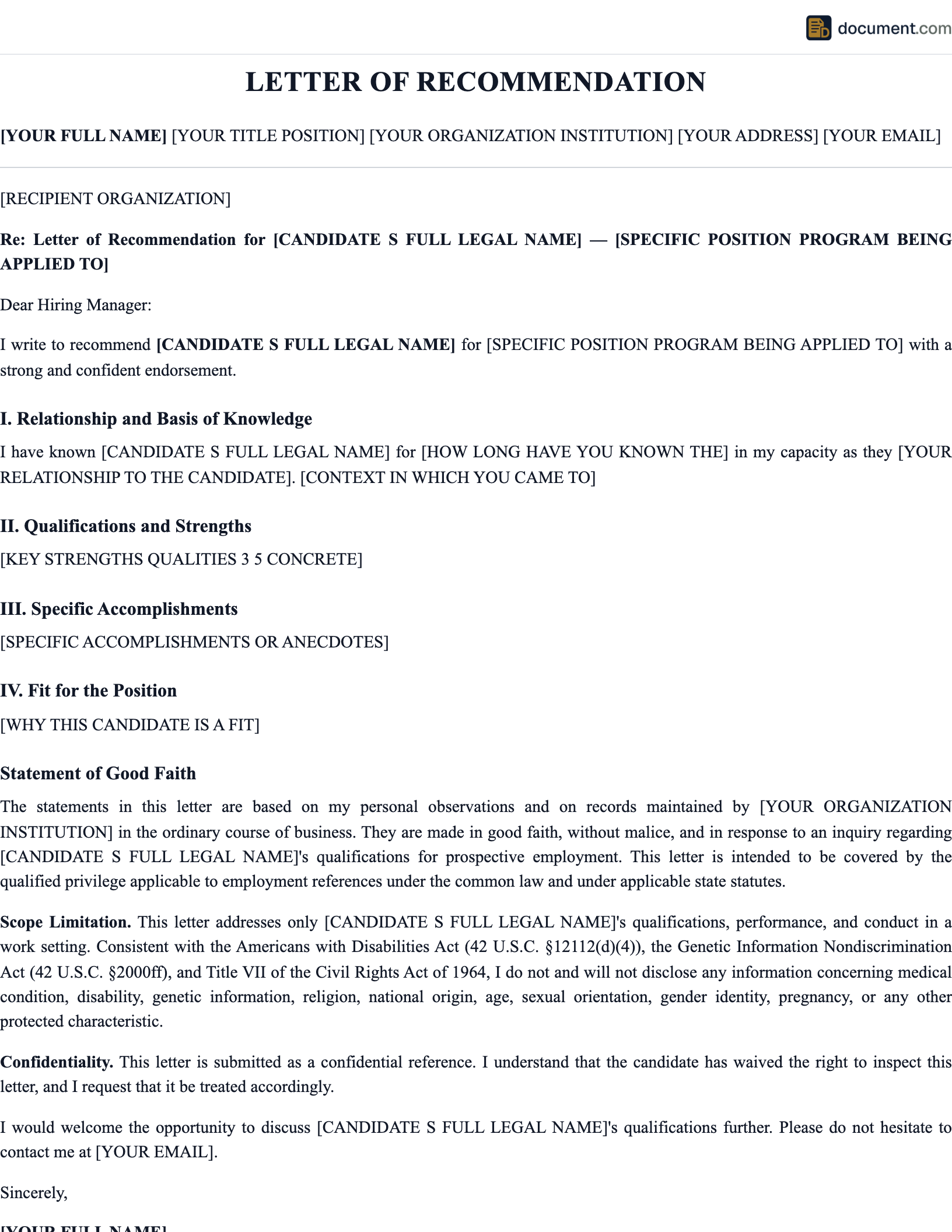
College Recommendation Letter Form Preview
Letter of Recommendation
For Undergraduate Admissions
TO THE ADMISSIONS COMMITTEE
I am writing to recommend for admission to your university. I have had the privilege of teaching this student in during the academic year.
ACADEMIC PERFORMANCE AND CHARACTER
In my years of teaching, stands out as a student who demonstrates exceptional .
RECOMMENDATION
I give my highest recommendation for admission to your institution.
SINCERELY
Teacher / Subject / School
Key Components
An effective college recommendation letter must include these essential elements to meet admissions committee expectations:
| Component | Purpose | Key Details |
|---|---|---|
| Teacher Context | Establishes expertise | Subject taught, years teaching, how well you know the student |
| Academic Assessment | Evaluates intellectual ability | Class performance, quality of work, analytical thinking, writing ability |
| Intellectual Curiosity | Shows genuine love of learning | Questions asked, independent exploration, engagement beyond requirements |
| Character Examples | Reveals personal qualities | Specific anecdotes showing integrity, kindness, resilience, leadership |
| Classroom Contribution | Shows community impact | Discussion participation, peer support, collaborative work, mentoring |
| Growth Narrative | Demonstrates development | Challenges overcome, skills developed, maturity gained over time |
| Comparative Assessment | Provides calibration | Ranking among peers, top percentile placement over teaching career |
How to Write a College Recommendation Letter
Assess Whether You Can Write a Strong Letter
Before agreeing to write a recommendation, honestly evaluate whether you know the student well enough and view them positively enough to write a genuinely supportive letter. A lukewarm or generic recommendation can actively harm an application — admissions officers read between the lines and interpret faint praise as a red flag. If you cannot write enthusiastically, it is kinder and more helpful to tell the student: 'I think you would benefit from a recommendation from a teacher who knows your work more closely.' If you can write a strong letter, confirm the student's deadlines, schools, and any materials they will provide to help you write.
Gather Information from the Student
Ask the student to provide: a resume or activity sheet listing extracurriculars, awards, and work experience; a list of colleges they are applying to (so you can tailor the letter); specific achievements or moments from your class they would like highlighted; their planned major or area of academic interest; and any personal circumstances that may be relevant (family challenges, health issues, socioeconomic context). Many teachers provide a questionnaire or brag sheet for students to complete. This information helps you write a specific, personalized letter rather than a generic one.
Open with Context and Enthusiasm
Begin by identifying yourself — your name, subject, years of teaching experience, and school. State the context in which you know the student: 'I taught Maya in AP United States History during her junior year and supervised her independent research project on the Civil Rights Movement.' Then signal the strength of your recommendation: 'In my eighteen years of teaching, Maya stands among the top five students I have encountered in terms of historical thinking and analytical writing.' This kind of comparative statement gives admissions officers the calibration they need.
Provide Specific Academic and Character Examples
The heart of the letter should contain two to three vivid, specific anecdotes that illustrate the student's intellectual and personal qualities. Instead of 'James is a curious student,' describe a moment: 'When we studied the Treaty of Versailles, James raised a question connecting the punitive reparations to contemporary sovereign debt crises that sparked a thirty-minute discussion I had not planned — and that the class later voted as their most engaging moment of the year.' These specific stories are what admissions officers remember and discuss in committee.
Address the Student's Growth and Resilience
Admissions committees value students who demonstrate growth, not just consistently high performance. If the student overcame a challenge — struggled with a concept but persevered, improved significantly over the course, or adapted to a difficult personal circumstance — describe that trajectory. Growth narratives demonstrate the grit and self-awareness that predict college success. Be honest but constructive: frame challenges as context for the student's development rather than as weaknesses.
Close with a Clear Comparative Recommendation
End with an explicit, enthusiastic endorsement that includes a comparative assessment: 'I recommend Sarah without reservation — she is among the top 2% of students I have taught in my career and I am confident she will thrive at your institution.' Avoid hedging language ('I think she might do well') and provide a clear signal of the strength of your recommendation. Include your contact information for follow-up and note that you are available to discuss the student further. Submit through the designated portal promptly.
The Role of Recommendations in College Admissions
In holistic admissions — the review methodology used by most selective colleges — recommendation letters serve as one of several qualitative factors that distinguish applicants with comparable academic credentials. At institutions where 80% or more of applicants meet the academic threshold for admission, the qualitative factors (essays, recommendations, extracurricular depth, and demonstrated interest) determine who is admitted and who is not. A strong recommendation letter can tip the balance for a borderline applicant by providing evidence of qualities that predict college success: intellectual engagement, resilience, community contribution, and personal maturity.
The counselor recommendation serves a different function from teacher recommendations. While teachers speak to the student's academic abilities and classroom character, the counselor provides an overview of the student's entire high school experience — academic trajectory (including course rigor relative to what the school offers), extracurricular involvement, school leadership, and any personal or family circumstances that may have affected the student's performance. At schools with large counselor caseloads (some public schools assign 400+ students per counselor), the counselor letter may be more formulaic, making the teacher recommendations even more important for providing specific, personalized insight.
FERPA Waiver
The Family Educational Rights and Privacy Act (FERPA) gives students the right to access recommendation letters submitted as part of their education records. However, the Common Application and most institutional applications give students the option to waive their right to view recommendation letters. Admissions officers generally give more weight to letters submitted under a FERPA waiver because the recommender can be confident they are writing candidly. Students should waive their FERPA rights unless they have specific concerns — waiving access signals trust in the recommender and maturity to the admissions committee.
Frequently Asked Questions
Official Resources
Authoritative resources on college admissions, recommendation letter best practices, and application procedures.
Common Application
Application platform used by 1,000+ colleges, with guidance on recommendation letter submission procedures and requirements.
National Association for College Admission Counseling
Professional organization providing research and guidance on college admissions practices, including the role of recommendation letters.
College Board - For Professionals
Resources for counselors and teachers on supporting students through the college admissions process, including recommendation writing.
U.S. Department of Education - FERPA
Federal guidance on student privacy rights under FERPA, including the right to access or waive access to recommendation letters.
Coalition for College Access
Alternative application platform with recommendation letter submission tools and guidance for counselors and teachers.
NACAC - State of College Admission Report
Annual report on admissions trends including how institutions weight recommendation letters and other qualitative factors.
Create your College Letter of Recommendation in under 10 minutes.
Answer a few questions and download a compliant, attorney-drafted document ready for your state.