
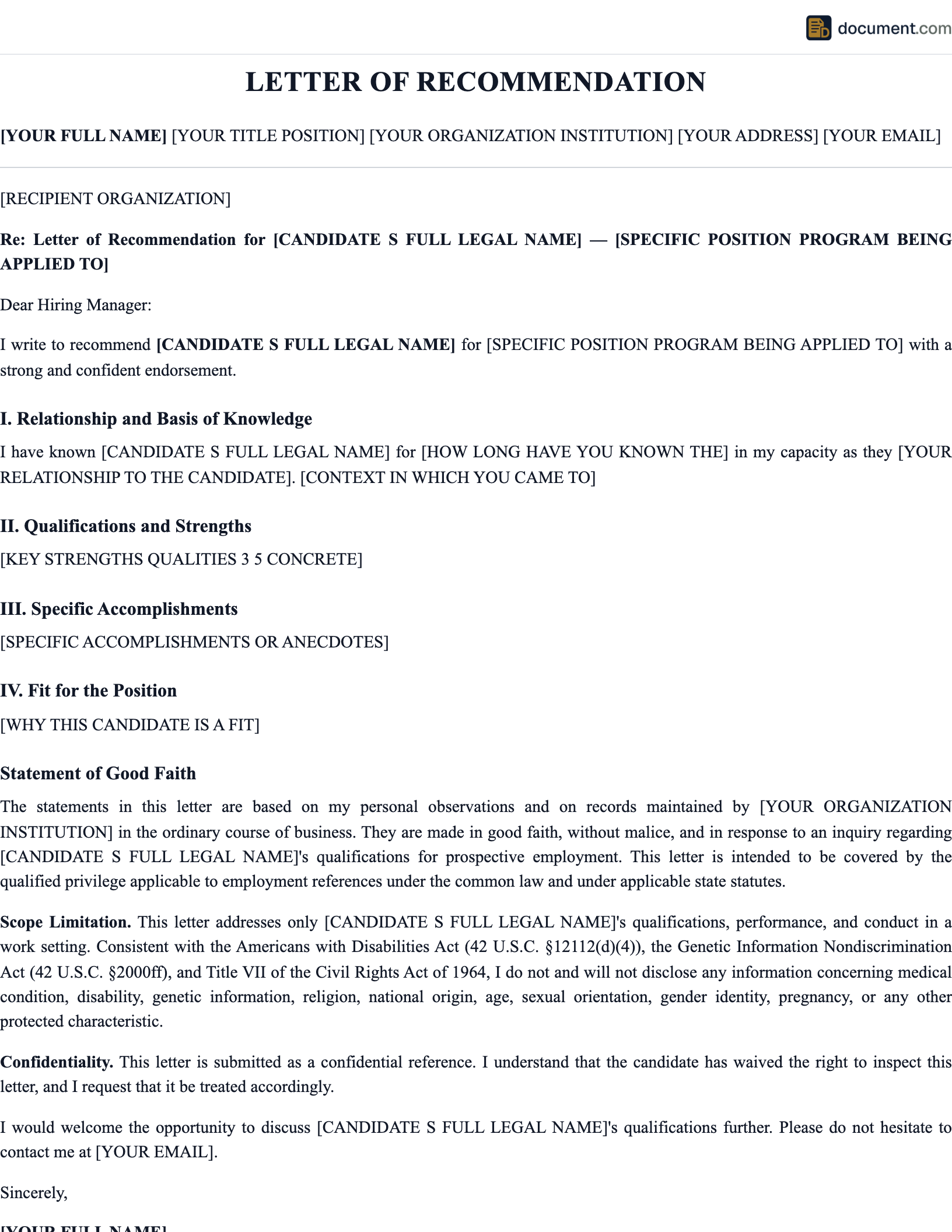



What Is a Student Letter of Recommendation?
A student letter of recommendation is a formal document written by a teacher, professor, guidance counselor, employer, or mentor who can provide an informed assessment of a student's academic capabilities, personal character, and readiness for the next stage of their educational or professional journey. These letters serve a fundamentally different purpose than transcripts, test scores, or activity lists — they offer a human perspective on who the student is as a learner, thinker, and member of a community, drawn from direct observation over a meaningful period of time.
The modern college admissions process places substantial weight on recommendation letters because holistic review requires qualitative evidence that quantitative metrics cannot provide. A student's GPA may indicate consistent effort, but it cannot reveal whether they asked the kinds of questions that pushed an entire class discussion in a new direction, or whether they volunteered to tutor struggling classmates without being asked. Recommendation letters fill these gaps by translating a recommender's firsthand observations into a narrative that helps admissions officers, scholarship committees, and program directors understand the student as a complete person — not just a set of numbers.
The most impactful student recommendations achieve three things simultaneously: they establish the recommender's credibility and basis for evaluation, they provide specific evidence of the qualities being endorsed, and they place the student in a comparative context that helps the reader understand where this applicant ranks among peers the recommender has observed. A letter that accomplishes all three gives the reader confidence that the endorsement is both informed and reliable, which is the foundation of an effective recommendation.
Academic Insight
Provides qualitative evidence of intellectual ability and classroom engagement beyond grades.
Character Portrait
Reveals personal qualities like integrity, resilience, and empathy through observed behavior.
Growth Trajectory
Demonstrates the student's development over time and their potential for continued growth.
Student Recommendation Letter Form Preview
Letter of Recommendation
Student Academic Recommendation
TO THE ADMISSIONS COMMITTEE
Dear Admissions Committee, I am pleased to recommend who has been my student in .
ACADEMIC PERFORMANCE
In my years of teaching, I would rank this student among the top percent of students I have instructed.
CHARACTER AND CONTRIBUTIONS
Beyond academics, has demonstrated remarkable through their involvement in .
RESPECTFULLY SUBMITTED
Signature / Date
Key Components
An effective student recommendation letter must include these essential elements to provide admissions committees with a complete and credible portrait:
| Component | Purpose | Key Details |
|---|---|---|
| Recommender Introduction | Establishes credibility | Name, title, subject taught, years of experience |
| Relationship Context | Shows depth of knowledge | Course or activity, duration, frequency of interaction |
| Academic Assessment | Evaluates intellectual ability | Analytical skills, curiosity, classroom contributions, work quality |
| Personal Character | Reveals the student as a person | Integrity, maturity, empathy, resilience, leadership |
| Specific Examples | Provides concrete evidence | Anecdotes, projects, moments of initiative or insight |
| Comparative Context | Benchmarks the student | Ranking among peers, percentile placement, career comparison |
| Clear Endorsement | Delivers the recommendation | Enthusiasm level, confidence in student's success, contact info |
How to Write a Student Letter of Recommendation
Introduce Yourself and Your Evaluative Context
Open by establishing who you are, what subject you teach or what program you supervise, and how many years you have been working with students. This context matters because an admissions officer reading your letter needs to know whether you are a first-year teaching assistant or a department chair with thirty years of experience evaluating student potential. State the student's name and the specific purpose of the letter — college admission, scholarship, transfer, or graduate program — so the reader knows the letter was written intentionally for this application.
Define Your Relationship with the Student
Explain precisely how you know the student: which course they took with you, what grade level, whether they were in an honors or AP section, whether you also supervised them in an extracurricular activity, and how frequently you interacted. The depth of the relationship directly affects the credibility of your assessment. A teacher who had the student in class daily for an entire school year and also advised their debate team has a richer observational base than one who taught a one-semester elective.
Assess Academic Abilities with Specific Evidence
Rather than stating that the student is 'smart' or 'hardworking,' describe what their intellectual engagement actually looked like. Did they ask questions that revealed they had done outside reading? Did they produce an essay or project that demonstrated original analysis? Did they struggle with a concept, seek help proactively, and ultimately master it — showing resilience? Admissions committees want to understand the student's thinking process and intellectual character, not just their ability to earn high grades.
Describe Personal Qualities and Character
Address the student's character by describing behavior you observed directly. If they were kind to classmates, give a specific example. If they showed leadership, describe the situation and its outcome. If they faced personal challenges and persevered, share what you observed (with the student's permission). The personal qualities section of a recommendation letter is where many writers default to vague adjectives — resist this temptation and let concrete observations speak for themselves.
Place the Student in Comparative Context
Admissions officers read hundreds of letters that describe students as 'one of the best.' To make your assessment meaningful, provide a comparative framework: 'In twenty-two years of teaching AP Chemistry, I have recommended fewer than ten students with this level of unreserved enthusiasm — she is among that group.' This kind of benchmark gives the reader a concrete sense of where the student falls among the many students you have evaluated over your career, and it carries far more weight than uncontextualized superlatives.
Close with a Definitive Recommendation
End the letter with a clear statement of your recommendation. Avoid hedged language like 'I think the student would probably do well' — instead, state directly: 'I recommend this student without reservation and am confident they will make meaningful contributions to your campus community.' Offer to provide additional information, include your contact details, and sign on school or institutional letterhead. The closing should reinforce the overall tone of the letter and leave the reader with a strong, positive final impression.
When Students Need Recommendation Letters
Students encounter the need for recommendation letters at several pivotal points in their academic and professional development. The most common context is undergraduate college admissions, where virtually all four-year institutions require at least one teacher recommendation and one counselor recommendation as part of the holistic review process. The Common Application, Coalition Application, and institutional applications each have their own submission protocols, but the fundamental purpose is the same: to provide the admissions committee with a trusted adult's assessment of the student's readiness for college-level work and community life.
Beyond college admissions, students frequently need recommendation letters for scholarship applications, summer academic programs, research internships, study abroad programs, honor society nominations, transfer applications, and graduate school admissions. Each context carries different expectations — a scholarship letter should emphasize qualities aligned with the award's criteria, a research internship letter should highlight analytical skills and intellectual curiosity, and a transfer application letter should address the student's academic growth and readiness for a more challenging environment. Students who build strong relationships with teachers and mentors throughout their academic career find it easier to secure strong recommendations at each of these milestones.
Start Building Relationships Early
The strongest recommendation letters come from recommenders who have observed the student over an extended period. Students should actively participate in class, attend office hours, and engage meaningfully with teachers and professors long before they need to request a letter. A recommender who has months or years of genuine interaction to draw from will write a far more compelling letter than one who is working from a limited acquaintance.
Frequently Asked Questions
Official Resources
Authoritative resources on college admissions, recommendation letter guidelines, and student application best practices.
Common Application
Application platform used by 1,000+ institutions with detailed guidelines for teacher and counselor recommendation submissions.
National Association for College Admission Counseling
Professional organization providing standards and best practices for the college admissions process including recommendation protocols.
College Board
Resources on college planning, financial aid, and application preparation including guidance on securing strong recommendations.
U.S. Department of Education
Federal education resources including FERPA guidelines that govern student educational records and recommendation letter privacy.
Coalition for College Access
College application platform serving hundreds of institutions with resources on recommendation letter requirements and submission.
College Board for Professionals
Resources for educators and counselors on writing effective recommendations and supporting students through the admissions process.
Create Your Student Recommendation Letter
Draft a professional student recommendation that conveys academic strengths, character, and growth potential in a format admissions committees expect.
Create DocumentNo account required. Free to create and preview.