



What Is an Internship Letter of Recommendation?
An internship letter of recommendation is a formal endorsement written by a professor, advisor, previous supervisor, or mentor who can speak to a candidate's qualifications for a professional internship position. Unlike employment references that evaluate years of career performance, internship recommendation letters assess a candidate's potential based on academic achievement, project involvement, leadership in extracurricular activities, and observable soft skills that indicate readiness for a professional environment. The letter bridges the gap between a candidate's academic record and their untested capacity to contribute meaningfully in a workplace setting.
Internship programs receive far more applications than available positions — competitive programs at major corporations, government agencies, and nonprofit organizations routinely see acceptance rates below 10%. In this environment, recommendation letters serve as critical differentiators because they provide the only third-party perspective on a candidate's character, work ethic, and interpersonal skills that transcripts and resumes cannot capture. A hiring manager reading fifty applications with similar GPAs and coursework will rely heavily on recommendation letters to identify candidates who demonstrated initiative, overcame obstacles, collaborated effectively, and showed genuine intellectual curiosity beyond minimum requirements.
The structure and tone of an internship recommendation must balance professional formality with authentic personal observation. The most effective letters open by establishing the recommender's credibility and relationship with the candidate, move into specific anecdotes that illustrate key competencies, and close with an unambiguous endorsement that places the candidate in comparative context — for example, ranking them among the top students the recommender has taught or supervised over a defined period. Generic praise without supporting evidence actually weakens an application, because experienced reviewers interpret vague language as a signal that the recommender does not know the candidate well enough to provide meaningful commentary.
Potential Assessment
Evaluates workplace readiness based on academic and extracurricular performance.
Skill Validation
Confirms specific abilities through concrete examples and observed performance.
Growth Trajectory
Demonstrates the candidate's development arc and capacity for continued learning.
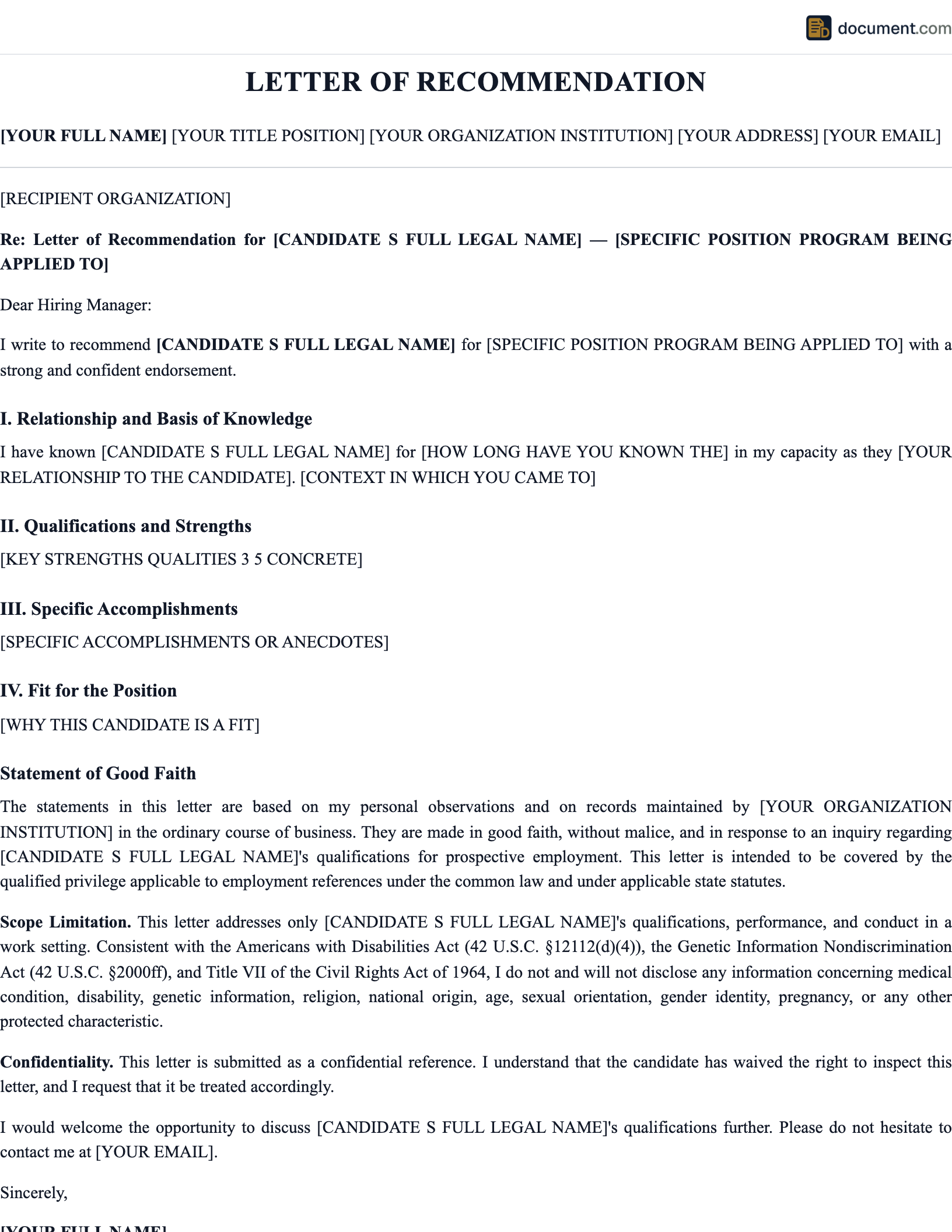
Internship Recommendation Letter Form Preview
Letter of Recommendation
Internship Application
TO WHOM IT MAY CONCERN
I am writing to recommend for the internship position at .
RELATIONSHIP TO CANDIDATE
I have known the candidate for in my capacity as .
QUALIFICATIONS AND CHARACTER
During this time, I have observed the candidate demonstrate exceptional and consistent .
RECOMMENDER
DATE
Key Components
An effective internship letter of recommendation addresses these core elements to give hiring managers a complete picture of the candidate:
| Component | Purpose | Key Details |
|---|---|---|
| Recommender Introduction | Establishes credibility and context | Professional title, institution, relationship duration, capacity of observation |
| Academic Performance | Demonstrates intellectual capability | Course performance, class ranking, research quality, analytical ability |
| Professional Skills | Shows workplace readiness | Communication, time management, problem-solving, technical proficiency |
| Character Assessment | Evaluates interpersonal qualities | Initiative, integrity, teamwork, response to feedback, maturity |
| Specific Examples | Substantiates general claims | Concrete anecdotes, quantifiable achievements, project outcomes |
| Comparative Ranking | Provides evaluative context | Top percentage, comparison cohort, years of reference, strength of endorsement |
| Closing Endorsement | Delivers unambiguous recommendation | Level of recommendation, offer to provide additional information, contact details |
How to Write an Internship Letter of Recommendation
Establish Your Relationship and Credibility
Open the letter by stating your name, title, institution, and the specific capacity in which you know the candidate — professor for a particular course, faculty advisor for a student organization, research supervisor, or previous internship manager. Specify the duration of the relationship and the frequency of your interactions, because a recommender who met with the student weekly for two semesters carries more weight than one who supervised a single group project.
State the Purpose and Position
Clearly identify the internship position, company, or program the candidate is applying to. If you know details about the role from the candidate or your own research, reference them briefly to show the letter was written with this specific opportunity in mind. This immediately signals to the reader that the recommendation is targeted rather than recycled from a generic template.
Provide Specific Examples of Competence
Dedicate two to three paragraphs to concrete examples that illustrate the candidate's strengths. Describe a project where the student took initiative beyond the assignment requirements, a situation where they demonstrated effective problem-solving, or a collaborative experience that revealed their leadership and communication skills. Each example should include enough context for the reader to understand what the candidate did, why it was impressive, and what the outcome was.
Connect Skills to the Internship Requirements
Draw explicit connections between the competencies you've described and the skills the internship demands. If the position requires data analysis, reference the candidate's quantitative coursework and research methodology experience. If it emphasizes client interaction, describe the candidate's communication style and interpersonal effectiveness. This connection-making helps the reader see the candidate as a practical fit, not just a good student.
Provide a Comparative Assessment
Place the candidate in context by comparing them to peers you've observed in similar roles or academic settings. Statements like 'among the top five students I've taught in fifteen years' or 'the strongest undergraduate researcher in our lab this academic year' give the reader a calibration point that GPA alone cannot provide. Be honest — overstating a candidate's rank damages your credibility if the reader contacts you.
Close with an Unambiguous Endorsement
End the letter with a clear, strong recommendation statement. Avoid hedging language or qualifications that could be interpreted as reluctance. Offer to provide additional information by phone or email, and include your direct contact details. The closing should leave no doubt that you believe the candidate will succeed in the internship and that you are personally invested in supporting their candidacy.
Who Should Write the Internship Recommendation
Selecting the right recommender is arguably the most important decision in the internship application process. The ideal recommender combines direct, sustained observation of the candidate with enough professional standing to lend credibility to the endorsement. A professor who supervised the candidate through a semester-long research project will produce a far more persuasive letter than a dean who signed a generic commendation certificate. Hiring managers and program coordinators read hundreds of recommendation letters and can immediately distinguish between writers who know the candidate intimately and those who are working from a resume and a brief conversation.
For students without previous internship experience, the strongest recommenders are typically professors in courses relevant to the internship field, faculty advisors for student organizations where the candidate held a leadership role, research supervisors, teaching assistants who worked closely with the candidate in lab sections, or community service coordinators who observed the candidate managing responsibilities. Students with prior work experience — even part-time or seasonal employment — should also consider former supervisors who can speak to reliability, customer interaction, and professional conduct, provided the supervisor can write articulately and with specific examples.
Recommender Selection Tip
Always ask a potential recommender if they can write a "strong" recommendation, not just whether they are willing. This gives them a graceful out if they feel they cannot provide the level of endorsement your application needs, and it ensures you receive a letter that genuinely helps rather than one that merely fulfills a requirement.
Frequently Asked Questions
Official Resources
Authoritative resources for internship applications and recommendation letter guidance.
U.S. Department of Labor - Internships
Federal guidance on internship programs, including legal requirements, wage and hour considerations, and program structure standards.
NACE - Internship Resources
National Association of Colleges and Employers resources on internship best practices, employer guidelines, and career readiness competencies.
Bureau of Labor Statistics - Occupational Outlook
Career outlook data to help match internship recommendations with industry growth areas and in-demand skills.
USA.gov - Government Internships
Federal government internship programs directory with application requirements and recommendation letter guidelines.
NSF - Research Experiences for Undergraduates
National Science Foundation REU program information for research-focused internship applications requiring faculty recommendations.
AAC&U - High-Impact Practices
Association of American Colleges and Universities resource on internships as high-impact educational practices.
Create Your Internship Recommendation Letter
Build a professional internship recommendation that showcases specific competencies, provides compelling examples, and delivers the endorsement your candidate deserves.
Create DocumentNo account required. Free to create and preview.