



Indiana Rent-to-Own Agreement Overview
Indiana does not have a dedicated rent-to-own statute for real property. These transactions are governed by Indiana's Landlord-Tenant statute (IC 32-31) for the lease component, general contract law for the purchase option, and the Seller's Residential Real Estate Sales Disclosure requirements (IC 32-21-5) for property conditions. Indiana's forfeiture protections (IC 32-30-10) may apply if the arrangement is characterized as an installment land contract.
Indiana's housing market offers relatively affordable home prices compared to coastal states, making rent-to-own accessible to a broader range of buyers. The Indianapolis metropolitan area, Fort Wayne, Evansville, and South Bend each present distinct market conditions. A significant advantage of Indiana closings is the absence of a state transfer tax on real property conveyances, reducing closing costs when the purchase option is exercised.
Indiana's property tax circuit breaker caps limit the property tax bill to 1% of assessed value for homesteads, 2% for other residential, and 3% for commercial property. This cap only applies to the owner's primary residence, so the tenant-buyer will benefit from the homestead cap only after exercising the option and taking title.
No
Specific RTO Statute
1-5%
Option Fee Range
$0
Transfer Tax
Race-Notice
Recording System
Indiana Rent-to-Own Laws & Regulations
Indiana regulates rent-to-own transactions through its landlord-tenant statute, property disclosure requirements, recording system, and forfeiture protections.
- Landlord-Tenant Relations (IC 32-31): Governs the lease component. No statutory cap on security deposits. Deposit return within 45 days. Landlord must maintain habitable premises. Requires proper notice before eviction.
- Seller's Disclosure (IC 32-21-5): Requires comprehensive property disclosure covering structural condition, systems, environmental hazards (radon, lead, mold), flooding history, water/sewer, and known defects. Must be provided before the buyer is bound.
- Recording Statutes (IC 32-21-4): Indiana is a race-notice recording state. Record with the county recorder. Indiana has 92 counties. Recording fees are typically $25 for the first page.
- Forfeiture Protections (IC 32-30-10): If the arrangement is reclassified as an installment land contract, Indiana provides forfeiture protections requiring judicial process rather than summary forfeiture for buyers who have made substantial payments.
- No State Transfer Tax: Indiana does not impose a state transfer tax on real property conveyances, reducing closing costs when the purchase option is exercised. The Sales Disclosure Form must be filed with the county auditor.
Installment Contract Reclassification Risk
Indiana courts carefully scrutinize rent-to-own arrangements to determine whether they are genuine lease-options or disguised installment land contracts. If the tenant-buyer bears the risks of ownership (paying taxes, insurance, maintenance), makes payments resembling principal and interest, or is obligated to purchase, a court may reclassify the arrangement as an installment sale. This triggers Indiana's forfeiture protections under IC 32-30-10, which can work in the buyer's favor by preventing summary forfeiture. To maintain lease-option characterization, structure the agreement so the tenant has the right — but not the obligation — to purchase.
How Rent-to-Own Works in Indiana
Indiana rent-to-own transactions follow a straightforward process, with the notable advantage of no state transfer tax at closing.
Property Inspection and Disclosure Review
Hire a licensed Indiana home inspector. Review the Seller's Disclosure form. For rural properties, test well water and inspect septic systems. Check flood maps and radon levels
Negotiate and Execute the Agreement
Agree on purchase price, option fee, rent, rent credits, option period, property tax responsibility, and maintenance obligations. Structure as a lease-option (not lease-purchase) to avoid installment contract reclassification
Pay Option Fee and Record with County Recorder
Pay the option fee and record a memorandum of option with the county recorder where the property is located. Indiana has 92 counties
Lease Period — Build Equity Through Rent Credits
During the 1-3 year lease, pay rent with credits toward the purchase price. Explore IHCDA (Indiana Housing and Community Development Authority) first-time buyer programs and down payment assistance
Exercise the Option and Close
Notify the seller in writing, secure mortgage financing, and close through an Indiana title company. No state transfer tax applies. File the Sales Disclosure Form with the county auditor. Apply for the homestead property tax cap (1%)
Key Indiana Rent-to-Own Agreement Terms
Indiana's absence of state transfer taxes and property tax circuit breaker caps make it financially attractive, but the agreement must still address all material terms.
| Term | Indiana Details |
|---|---|
| Option Fee | Typically 1-5% of purchase price. Non-refundable but credited at closing. No statutory cap in Indiana |
| Purchase Price | Set at signing or by appraisal. Indiana's affordable market means lower option fees and down payments compared to coastal states |
| Option Period | Usually 1-3 years. Must include specific expiration date. Structure as option (not obligation) to avoid installment contract reclassification |
| Monthly Rent | No rent control in Indiana (preempted by IC 32-31-11). Lock rent for the full option period |
| Rent Credits | Not required. When included, typically 10-25% of rent. Keep credits modest to avoid installment contract reclassification |
| Security Deposit | No statutory cap. Must be returned within 45 days. Separate from option fee |
| Property Taxes | Circuit breaker caps: 1% homestead, 2% residential, 3% commercial. Homestead cap available only after buyer takes title |
| Default & Forfeiture | Indiana forfeiture protections may apply if reclassified as installment contract. Address option fee and rent credit treatment clearly |
Indiana Consumer Protections for Tenant-Buyers
Indiana provides meaningful consumer protections through its property disclosure requirements, forfeiture protections, and consumer protection statutes.
Seller's Disclosure (IC 32-21-5)
Indiana's comprehensive disclosure requirement covers structural, systems, environmental hazards, flooding, and material defects. The seller must complete the form in good faith. Failure to disclose known defects can result in liability for damages and potential rescission.
Indiana Deceptive Consumer Sales Act (IC 24-5-0.5)
The DCSA prohibits deceptive acts in consumer transactions. Predatory rent-to-own schemes using misleading advertising, hidden fees, or deceptive terms may violate this Act. The Indiana Attorney General enforces the statute, and consumers can bring private actions for treble damages and attorney fees.
Indiana Housing and Community Development Authority (IHCDA)
IHCDA offers first-time homebuyer programs including the Next Home program with down payment assistance (up to 3.5% of the purchase price) and the Mortgage Credit Certificate (MCC) program providing a federal tax credit. Tenant-buyers should explore IHCDA programs during the lease period.
Forfeiture Protections (IC 32-30-10)
If the rent-to-own arrangement is reclassified as an installment land contract, Indiana's forfeiture protections prevent the seller from summarily forfeiting the buyer's interest. The seller must follow judicial procedures, giving the buyer an opportunity to cure defaults and protect their investment.
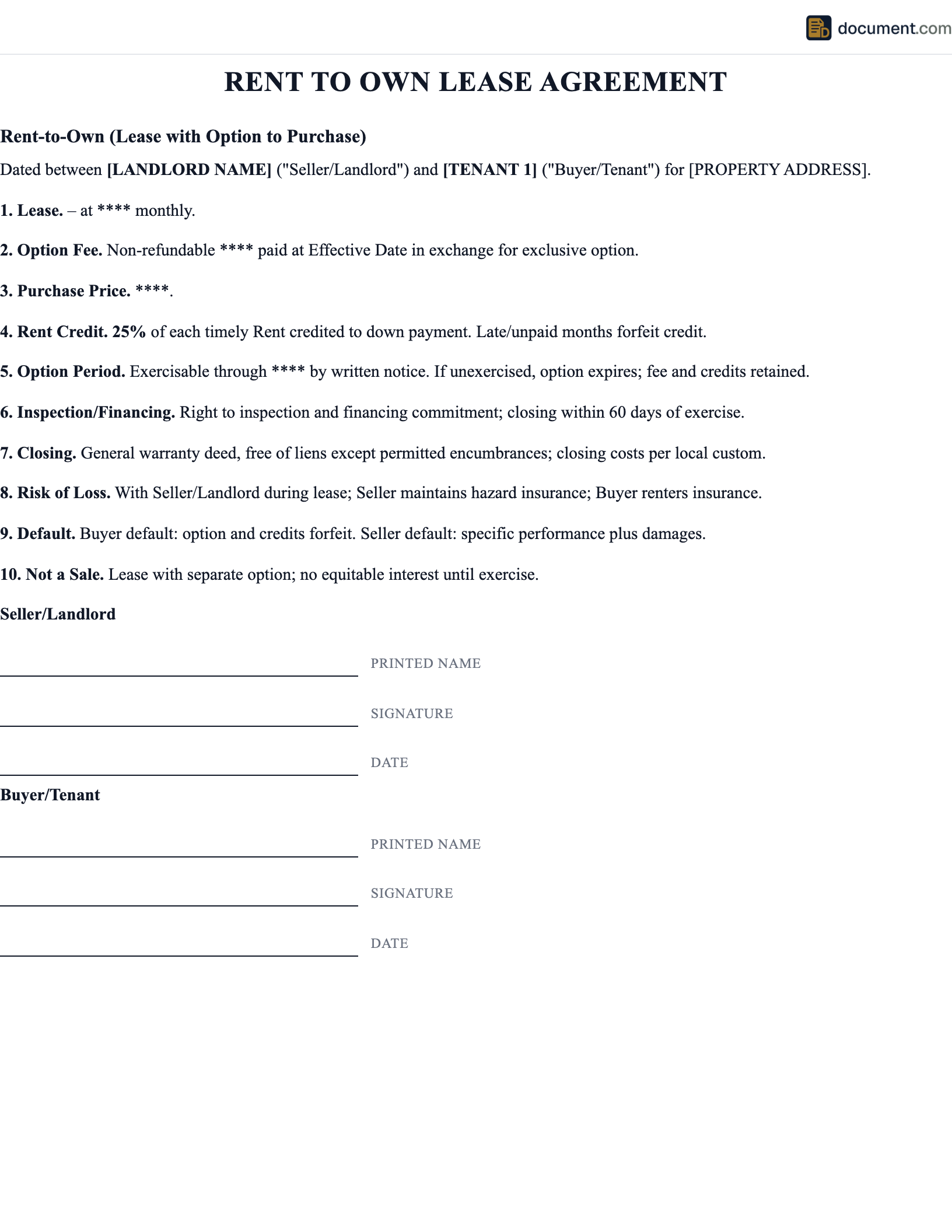
Sample Indiana Rent-to-Own Agreement
Below is a preview of our Indiana-specific rent-to-own agreement addressing seller disclosure, property tax caps, forfeiture protections, and recording requirements.
STATE OF INDIANA
RESIDENTIAL LEASE WITH OPTION TO PURCHASE
Governed by IC 32-31 & Indiana Contract Law
PROPERTY OWNER / OPTIONOR:
Name: [Owner Name]
Address: [Indiana Address]
TENANT-BUYER / OPTIONEE:
Name: [Tenant Name]
Address: [Current Address]
PROPERTY & TERMS
Property: [Indiana Property Address]
County: [County]
Option Fee: $[Amount] Purchase Price: $[Amount]
Monthly Rent: $[Amount] Rent Credit: [%]%
Indiana Rent-to-Own FAQ
Common questions about rent-to-own agreements in Indiana, including forfeiture protections, property tax caps, disclosure requirements, and closing procedures.
Official Indiana Resources
Government and legal resources for Indiana rent-to-own transactions.
Indiana Attorney General — Consumer Protection
File complaints about deceptive rent-to-own practices
Indiana Real Estate Commission
Real estate licensing, regulation, and consumer resources
Indiana Housing and Community Development Authority
First-time homebuyer programs and down payment assistance
HUD — Indiana Housing Resources
Federal housing assistance, counseling, and complaint filing
Create your Indiana Rent To Own Lease Agreement in under 5 minutes.
Answer a few questions and download a Indiana-compliant document, ready for the state agency.