



Illinois Rent-to-Own Agreement Overview
Illinois does not have a dedicated rent-to-own statute for real property. These transactions are governed by the Illinois Landlord and Tenant Act (765 ILCS 705/) statewide, Chicago's Residential Landlord and Tenant Ordinance (RLTO) for properties within the city, general contract law for the purchase option, and the Illinois Residential Real Property Disclosure Act (765 ILCS 77/) for property condition disclosures.
Illinois presents a split regulatory environment. Properties in Chicago are subject to the RLTO, one of the most tenant-protective ordinances in the country, while properties outside Chicago are governed by less restrictive state law. Cook County has its own residential tenant ordinance as well. This means the applicable rules for a rent-to-own agreement depend significantly on where the property is located.
Illinois has some of the highest property taxes in the nation — effective rates in Cook County often exceed 2% of market value. The rent-to-own agreement must address property tax responsibility during the lease period and budget for potential tax changes when ownership transfers. Illinois's Installment Sales Contract Act (765 ILCS 67/) also creates a reclassification risk if the agreement is structured as a lease-purchase rather than a lease-option.
No
Specific RTO Statute
2-5%
Option Fee Range
765 ILCS 77
Disclosure Required
Race-Notice
Recording System
Illinois Rent-to-Own Laws & Regulations
Illinois regulates rent-to-own transactions through multiple overlapping state and local laws, with particularly strong protections in Chicago.
- Illinois Landlord and Tenant Act (765 ILCS 705/): Statewide baseline for landlord-tenant relations. Security Deposit Return Act (765 ILCS 710/) requires return within 30 days for properties with 5+ units. No statewide deposit cap.
- Chicago RLTO (Municipal Code § 5-12): Applies to Chicago properties. Strict security deposit rules (escrow, annual interest, receipt requirements). Penalties of 2x deposit for violations. Specific lease disclosure requirements. Just cause eviction protections.
- Residential Real Property Disclosure Act (765 ILCS 77/): Requires comprehensive property disclosure covering defects, systems, environmental hazards, and material changes. Radon disclosure separately required under 420 ILCS 46/.
- Recording Statutes (765 ILCS 5/30): Illinois is a race-notice recording state. Record with the county recorder of deeds. Cook County fees are higher (~$80 for first 4 pages) than downstate counties (~$16 for first page). 3-inch top margin required.
- Installment Sales Contract Act (765 ILCS 67/): Applies if the arrangement is reclassified as a contract for deed. Provides 180-day right to cure for buyers who have paid 20%+ or occupied 5+ years. Structure the agreement as a lease-option (not lease-purchase) to minimize reclassification risk.
Chicago RLTO Compliance Is Critical
If the property is in the City of Chicago, the RLTO imposes strict requirements on the lease component. Failure to comply with the RLTO's security deposit rules (escrow account, annual interest payment, written receipt with bank details) can result in penalties of two times the deposit amount plus attorney fees. The RLTO also requires specific disclosures in every lease, limits late fees, and restricts the landlord's ability to require renter's insurance above certain amounts. Non-compliance can give the tenant significant leverage, including the right to terminate the lease. Always verify whether the property falls within Chicago city limits.
How Rent-to-Own Works in Illinois
Illinois rent-to-own transactions require attention to the split regulatory environment between Chicago and the rest of the state, property tax implications, and property disclosure requirements.
Property Inspection, Disclosure, and Tax Review
Hire a licensed Illinois home inspector. Review the property disclosure report and radon test results. Research the property's current tax bill and assessment history — Illinois property taxes can be a significant ongoing cost
Negotiate and Execute the Agreement
Agree on purchase price, option fee, rent, rent credits, option period, property tax responsibility, and default remedies. If in Chicago, ensure full RLTO compliance including deposit escrow and mandatory disclosures
Pay Option Fee and Record with County Recorder
Pay the option fee and record a memorandum of option with the county recorder of deeds. In Cook County, ensure the document meets specific formatting requirements and budget for higher recording fees
Lease Period — Build Equity Through Rent Credits
During the 1-3 year lease, pay rent with credits toward the purchase price. Explore IHDA (Illinois Housing Development Authority) first-time buyer programs including IHDAccess and SmartBuy down payment assistance
Exercise the Option and Close
Notify the seller in writing, secure mortgage financing, and close through an Illinois title company. Illinois transfer taxes apply at closing (state, county, and municipal). Option fee and rent credits are credited at closing
Key Illinois Rent-to-Own Agreement Terms
Illinois's split regulatory environment and high property taxes require that the agreement address both statewide and local requirements.
| Term | Illinois Details |
|---|---|
| Option Fee | Typically 2-5% of purchase price. Non-refundable but credited at closing. Not subject to security deposit rules |
| Purchase Price | Set at signing or by appraisal. Factor in high property tax burden when determining affordability |
| Monthly Rent | No statewide rent control. Chicago has just cause eviction protections. Lock rent for the full term. Address property tax pass-through |
| Rent Credits | Not required by Illinois law. When included, typically 10-25% of rent. Specify forfeiture conditions clearly |
| Security Deposit | No statewide cap. In Chicago: must be in escrow with interest. Return within 30 days. RLTO penalties for non-compliance = 2x deposit |
| Property Taxes | Among highest in U.S. (2%+ effective rate in Cook County). Specify who pays during lease. Budget for reassessment at ownership change |
| Maintenance | Landlord must maintain habitable premises. Address snow removal, HVAC maintenance, and older-home issues common in Illinois housing stock |
| Default & Forfeiture | Illinois requires 5-day notice for non-payment (10-day in Chicago RLTO). Address option fee and rent credit treatment upon default |
Illinois Consumer Protections for Tenant-Buyers
Illinois provides strong consumer protections, particularly for tenant-buyers in Chicago where the RLTO creates extensive rights and remedies.
Residential Real Property Disclosure Act (765 ILCS 77/)
Illinois requires comprehensive property disclosures covering structural defects, environmental hazards (radon, lead, asbestos, underground tanks), flooding, and material changes. The separate Radon Awareness Act (420 ILCS 46/) requires radon disclosure. Failure to disclose known defects can result in liability for damages and rescission.
Illinois Consumer Fraud and Deceptive Business Practices Act (815 ILCS 505/)
The ICFA prohibits unfair or deceptive acts in the conduct of trade or commerce. Predatory rent-to-own schemes may violate this Act. The Illinois Attorney General enforces the statute. Consumers can bring private actions for actual damages, and the court may award punitive damages and attorney fees.
Illinois Housing Development Authority (IHDA)
IHDA offers first-time homebuyer programs including IHDAccess (forgivable down payment assistance up to $6,000), SmartBuy (student debt assistance), and the 1stHomeIllinois program. Tenant-buyers should explore IHDA programs during the lease period. Income limits and homebuyer education requirements apply.
Installment Contract Protections (765 ILCS 67/)
If the rent-to-own arrangement is reclassified as an installment land contract, the buyer who has paid 20%+ of the purchase price or occupied the property for 5+ years receives a 180-day right to cure before the seller can cancel. This provides significant protection against forfeiture for long-term rent-to-own participants.
Sample Illinois Rent-to-Own Agreement
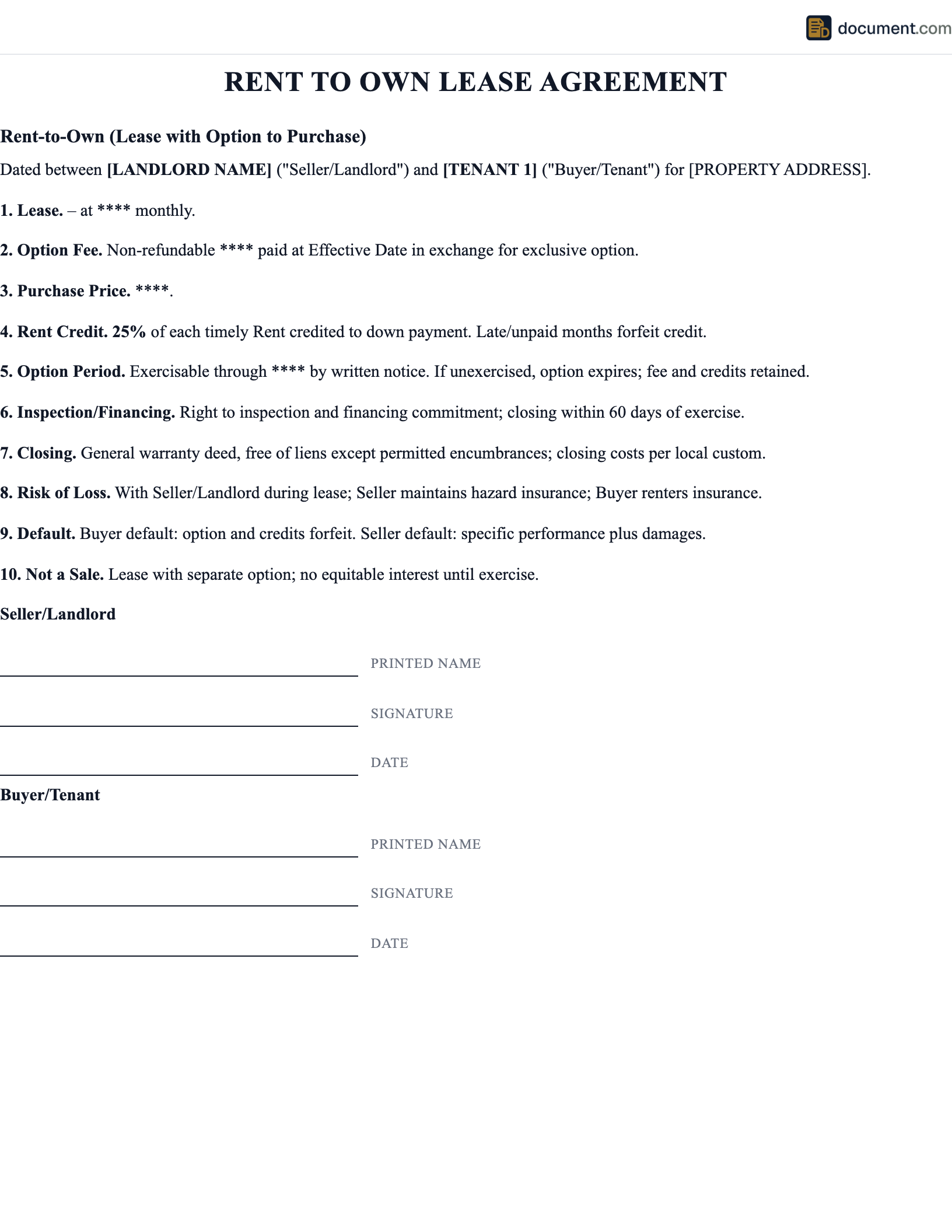
Below is a preview of our Illinois-specific rent-to-own agreement. The customized document addresses RLTO compliance (for Chicago properties), property disclosure, property tax provisions, and recording requirements.
STATE OF ILLINOIS
RESIDENTIAL LEASE WITH OPTION TO PURCHASE
Governed by 765 ILCS & Illinois Contract Law
PROPERTY OWNER / OPTIONOR:
Name: [Owner Name]
Address: [Illinois Address]
TENANT-BUYER / OPTIONEE:
Name: [Tenant Name]
Address: [Current Address]
PROPERTY & TERMS
Property: [Illinois Property Address]
County: [County] Chicago RLTO: [Yes/No]
Option Fee: $[Amount] Purchase Price: $[Amount]
Monthly Rent: $[Amount] Rent Credit: [%]%
Illinois Rent-to-Own FAQ
Common questions about rent-to-own agreements in Illinois, including Chicago RLTO compliance, property tax issues, installment contract risks, and disclosure requirements.
Official Illinois Resources
Government and legal resources for Illinois rent-to-own transactions.
Illinois Attorney General — Consumer Protection
File complaints about deceptive rent-to-own practices
Illinois Division of Real Estate
Real estate licensing, regulation, and consumer resources
Illinois Housing Development Authority (IHDA)
First-time homebuyer programs and down payment assistance
HUD — Illinois Housing Resources
Federal housing assistance, counseling, and complaint filing
Create your Illinois Rent To Own Lease Agreement in under 5 minutes.
Answer a few questions and download a Illinois-compliant document, ready for the state agency.