



Hawaii Rent-to-Own Agreement Overview
Hawaii does not have a dedicated rent-to-own statute for real property. These transactions are governed by the Hawaii Residential Landlord-Tenant Code (HRS Chapter 521) for the lease component, general contract law for the purchase option, and the Mandatory Seller Disclosures in Real Estate Transactions statute (HRS § 508D) for property conditions. Hawaii's unique land tenure system, with significant amounts of leasehold land, creates considerations found nowhere else in the United States.
Hawaii has the highest median home prices in the nation, with Honolulu consistently ranking among the most expensive housing markets. This makes rent-to-own an important pathway for Hawaii residents who need time to save for the substantial down payments required. However, the distinction between fee simple and leasehold ownership is critical — a rent-to-own on a leasehold property transfers only the leasehold interest, not the underlying land.
Hawaii uses a dual recording system: the Bureau of Conveyances (Regular System) and the Land Court (Torrens System). The system that applies depends on how the property's title is registered. You must record in the correct system to protect your option interest.
No
Specific RTO Statute
2-5%
Option Fee Range
HRS § 508D
Disclosure Required
Race-Notice
Recording System
Hawaii Rent-to-Own Laws & Regulations
Hawaii regulates rent-to-own real estate transactions through its landlord-tenant code, mandatory disclosure statute, and unique dual recording system.
- Residential Landlord-Tenant Code (HRS Ch. 521): Governs the lease component. Limits security deposits to one month's rent (§ 521-44). Must be held in trust. Return within 14 days. Establishes habitability standards, repair obligations, and eviction procedures (45-day notice for lease termination).
- Mandatory Seller Disclosures (HRS § 508D): Requires comprehensive property disclosure including structural condition, systems, environmental hazards, lava zone designation, tsunami/flood zone status, leasehold vs. fee simple tenure, and AOAO information for condominiums.
- Dual Recording System (HRS § 502-83): Hawaii is a race-notice jurisdiction with two parallel recording systems: the Bureau of Conveyances (Regular System) and the Land Court (Torrens System). Record in the correct system based on the property's title registration.
- Leasehold Conversion (HRS Ch. 516): Hawaii's Leasehold Conversion Act allows some leasehold tenants to convert to fee simple ownership. If the property is leasehold, verify whether conversion rights exist and factor this into the purchase price.
- Conveyance Tax (HRS Ch. 247): Graduated tax on real property transfers based on sale price. Rates range from $0.15 to $1.25 per $100 of value. Lower rates for owner-occupants. Paid at closing when the purchase option is exercised.
Fee Simple vs. Leasehold — Critical Distinction
Hawaii's leasehold land system is unique in the United States. Approximately 10-15% of residential properties in Hawaii are leasehold, meaning the homeowner owns the building but leases the land. In a rent-to-own transaction, a leasehold property means the purchase option only transfers the leasehold interest. The remaining lease term, ground rent amount, and renegotiation schedule dramatically affect the property's value. Leasehold properties with less than 30 years remaining on the ground lease may be very difficult to finance. Verify the tenure type before committing to an option fee.
How Rent-to-Own Works in Hawaii
Hawaii rent-to-own transactions require special attention to land tenure, natural hazard zones, the dual recording system, and AOAO restrictions for condominiums.
Verify Land Tenure, Inspect, and Review Disclosures
Determine whether the property is fee simple or leasehold. Hire a licensed Hawaii home inspector. Review the HRS § 508D seller disclosure, lava zone designation, tsunami/flood zone maps, and AOAO documents if applicable. Check termite history (critical in Hawaii's tropical climate)
Negotiate and Execute the Agreement
Agree on purchase price (accounting for leasehold discount if applicable), option fee, rent, rent credits, option period, maintenance (including tropical climate maintenance), and default remedies. The agreement must be in writing per Hawaii's Statute of Frauds
Pay Option Fee and Record in the Correct System
Pay the option fee and record a memorandum of option with either the Bureau of Conveyances (Regular System) or the Land Court (Torrens System) depending on the property's title registration. Verify which system applies before filing
Lease Period — Build Equity Through Rent Credits
During the 1-3 year lease, pay rent with credits toward the purchase price. Explore HHFDC (Hawaii Housing Finance and Development Corporation) first-time buyer programs and down payment assistance
Exercise the Option and Close
Notify the seller in writing, secure mortgage financing, and close through a Hawaii escrow company. Pay the conveyance tax. The option fee and rent credits are applied to the purchase price
Key Hawaii Rent-to-Own Agreement Terms
Hawaii's unique land tenure, tropical climate, and high housing costs require specialized agreement provisions that go beyond standard rent-to-own templates.
| Term | Hawaii Details |
|---|---|
| Option Fee | Typically 2-5% of purchase price. In Hawaii's high-cost market, this can be $15,000-$50,000+. Non-refundable but credited at closing |
| Land Tenure | Must specify fee simple or leasehold. If leasehold, include ground lease term remaining, ground rent, and renegotiation schedule |
| Purchase Price | Set at signing or by appraisal at exercise. Leasehold properties valued 20-40% below comparable fee simple |
| Monthly Rent | No statewide rent control in Hawaii, though Honolulu has considered local measures. Lock rent for the full term |
| Rent Credits | Not required by Hawaii law. When included, typically 10-25% of rent. Specify forfeiture conditions |
| Security Deposit | Capped at one month's rent under HRS § 521-44. Must be held in trust. Return within 14 days. Separate from option fee |
| Maintenance | Address tropical climate concerns: termite treatment, mold prevention, hurricane preparation, and salt air corrosion for coastal properties |
| Default & Forfeiture | Hawaii requires 5-day notice for non-payment, 10-day notice for violations. 45-day notice for lease termination. Address option fee and rent credit treatment |
Hawaii Consumer Protections for Tenant-Buyers
Hawaii provides meaningful consumer protections through its disclosure requirements, landlord-tenant code, and consumer protection statute.
Mandatory Seller Disclosures (HRS § 508D)
Hawaii's comprehensive disclosure statute requires sellers to disclose all known material property conditions including structural defects, environmental hazards, natural hazard zone designations (lava, tsunami, flood), land tenure type, and community association information. Failure to disclose can give the buyer the right to rescind and recover damages.
Hawaii Unfair and Deceptive Acts or Practices (HRS § 480-2)
Hawaii's UDAP statute prohibits unfair or deceptive acts in trade or commerce. Predatory rent-to-own schemes using misleading advertising, hidden fees, or deceptive terms may violate this statute. Consumers can seek actual damages, treble damages for willful violations, and attorney fees. The Hawaii Office of Consumer Protection enforces the statute.
Hawaii Housing Finance & Development Corporation (HHFDC)
HHFDC offers programs to help Hawaii residents achieve homeownership, including below-market mortgages and assistance programs. Given Hawaii's extreme housing costs, these programs can be critical for rent-to-own tenant-buyers transitioning to mortgage financing.
Habitability Requirements (HRS § 521-42)
Hawaii law requires landlords to maintain rental premises in a habitable condition, including maintaining the structure, plumbing, electrical, and ensuring compliance with health and safety codes. The tenant-buyer retains all habitability rights during the lease period, including remedies for landlord non-compliance.
Sample Hawaii Rent-to-Own Agreement
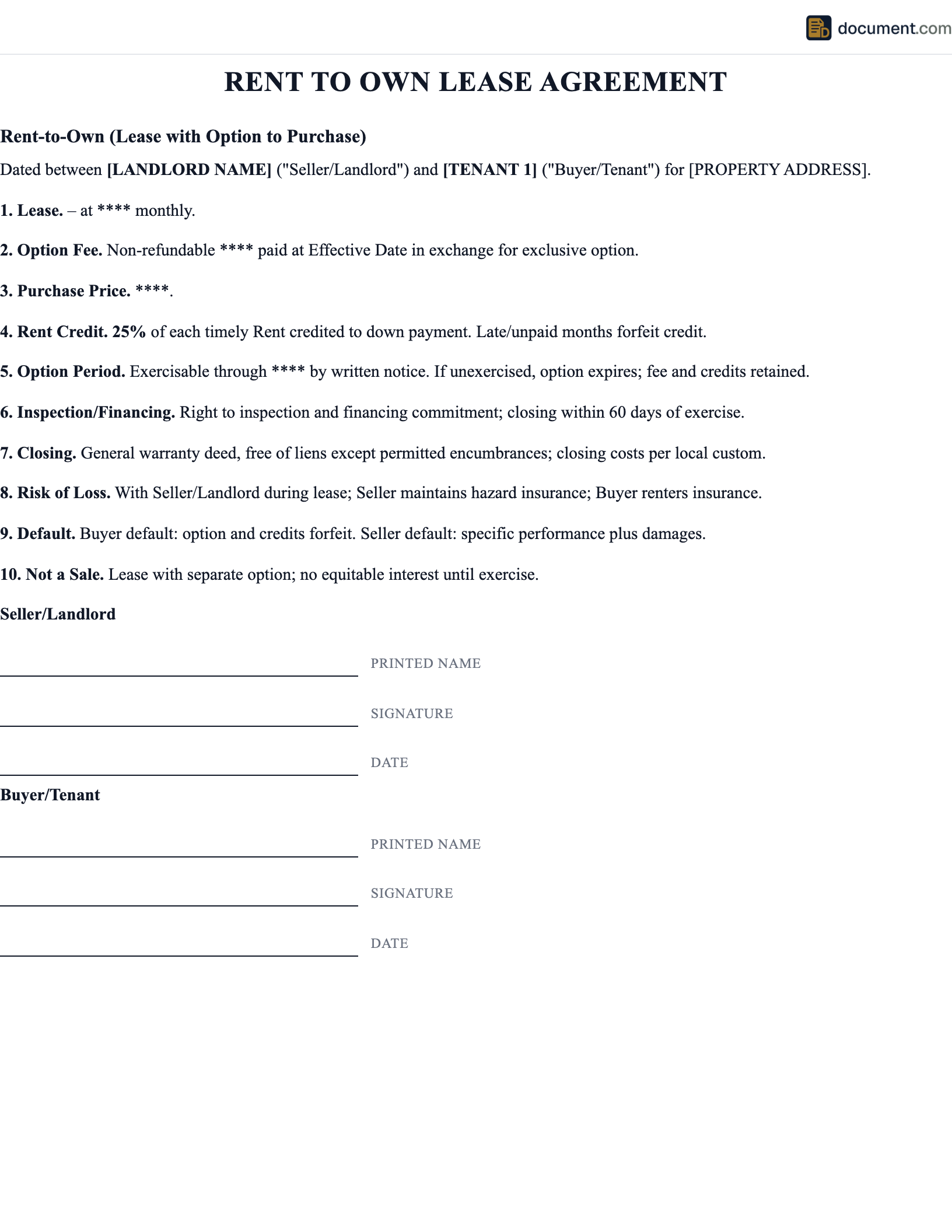
Below is a preview of our Hawaii-specific rent-to-own agreement. The customized document addresses fee simple vs. leasehold tenure, HRS § 508D disclosure, natural hazard zones, and dual recording system.
STATE OF HAWAII
RESIDENTIAL LEASE WITH OPTION TO PURCHASE
Governed by HRS Chapter 521 & Hawaii Contract Law
PROPERTY OWNER / OPTIONOR:
Name: [Owner Name]
Address: [Hawaii Address]
TENANT-BUYER / OPTIONEE:
Name: [Tenant Name]
Address: [Current Address]
PROPERTY & TERMS
Property: [Hawaii Property Address]
Island: [Island] Tenure: [Fee Simple/Leasehold]
Option Fee: $[Amount] Purchase Price: $[Amount]
Monthly Rent: $[Amount] Rent Credit: [%]%
Hawaii Rent-to-Own FAQ
Common questions about rent-to-own agreements in Hawaii, including fee simple vs. leasehold, lava zone hazards, dual recording, and AOAO restrictions.
Official Hawaii Resources
Government and legal resources for Hawaii rent-to-own transactions.
Hawaii Office of Consumer Protection
File complaints about deceptive rent-to-own practices
Hawaii Real Estate Commission
Real estate licensing, regulation, and consumer resources
Hawaii Housing Finance & Development Corporation
Homeownership programs and housing assistance
HUD — Hawaii Housing Resources
Federal housing assistance, counseling, and complaint filing
Create your Hawaii Rent To Own Lease Agreement in under 5 minutes.
Answer a few questions and download a Hawaii-compliant document, ready for the state agency.