
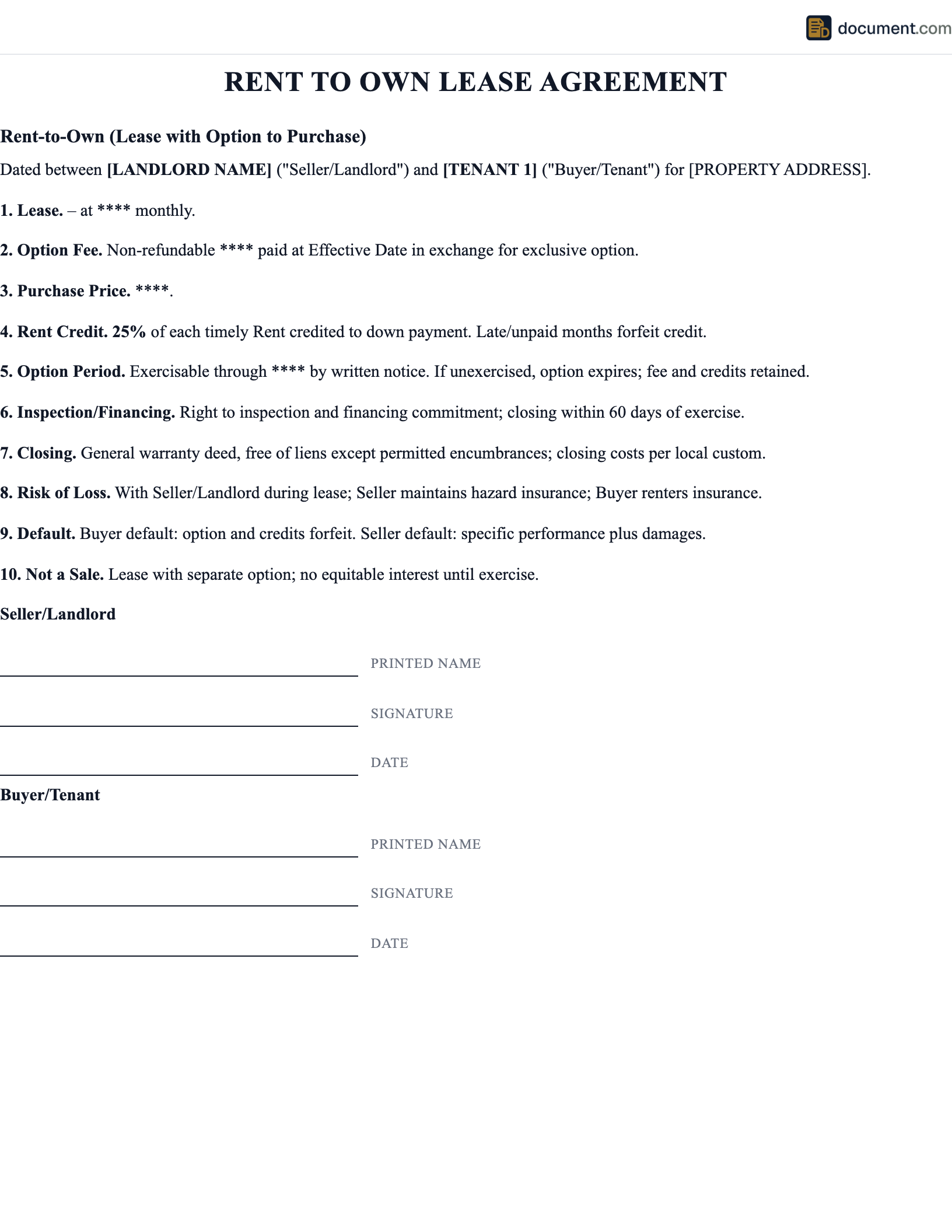



Georgia Rent-to-Own Agreement Overview
Georgia is one of a handful of states that has enacted specific legislation addressing lease-purchase agreements for residential real property. O.C.G.A. Section 44-5-186 establishes minimum requirements for these transactions, including that the agreement must be in writing, identify the property, state the purchase price, and specify how payments are allocated between rent and purchase credits. This statute exists alongside Georgia's general contract law and the Landlord and Tenant Act (O.C.G.A. Title 44, Chapter 7).
Georgia's real estate market — particularly in the Atlanta metropolitan area, Savannah, Augusta, and the fast-growing suburban counties — has seen significant rent-to-own activity. The combination of rising home prices and tighter mortgage standards has made lease-purchase agreements an attractive pathway to homeownership for many Georgians who may not yet qualify for traditional financing.
Georgia is a non-judicial foreclosure state, which has critical implications for rent-to-own transactions. If the seller has an existing mortgage, a foreclosure can occur under the power of sale clause in as few as 37 days and may extinguish the tenant-buyer's interest. Recording the option agreement with the Superior Court clerk provides essential protection against this risk.
Yes
Specific RTO Statute
2-5%
Option Fee Range
Required
Written Allocation
Recommended
Recording Option
Georgia Rent-to-Own Laws — O.C.G.A. Section 44-5-186
Georgia's legal framework for rent-to-own transactions combines a specific lease-purchase statute with general property law, landlord-tenant protections, and mandatory disclosure requirements.
- Lease-Purchase Statute (O.C.G.A. § 44-5-186): Requires lease-purchase agreements to be in writing, identify the property with legal specificity, state the purchase price, specify the amount of each payment allocated toward the purchase, and include any conditions or contingencies for exercising the purchase option. This is one of only a few state statutes nationwide that directly addresses lease-purchase residential transactions.
- Seller's Property Disclosure (O.C.G.A. § 44-1-16): The seller must provide a detailed property disclosure statement covering structural conditions, systems, environmental hazards, and known defects. This disclosure applies to rent-to-own transactions and must be provided before the agreement is signed.
- Georgia Landlord and Tenant Act (O.C.G.A. Title 44, Ch. 7): During the lease period, the landlord must maintain habitable premises, make necessary repairs, and follow proper eviction procedures. Security deposits must be held in an escrow account or secured by a surety bond and returned within 30 days of lease termination.
- Recording Statutes (O.C.G.A. § 44-2-1 et seq.): Georgia follows a race-notice recording system. Recording the option agreement with the Superior Court clerk provides constructive notice and protects against subsequent bona fide purchasers. Recording fees are $10 for the first page and $2 per additional page.
- Non-Judicial Foreclosure (O.C.G.A. § 44-14-162): Georgia allows non-judicial foreclosure under a power of sale clause, which means a lender can foreclose on the seller's property in as little as 37 days with proper notice. This is a critical risk for tenant-buyers who have not recorded their interest.
Georgia's Non-Judicial Foreclosure Risk
Georgia's power of sale foreclosure process is one of the fastest in the country. If the seller has an existing mortgage and stops making payments, the lender can foreclose in as few as 37 days. An unrecorded option may be extinguished by the foreclosure sale. Always record your option agreement with the Superior Court clerk and require the seller to provide monthly proof of mortgage payments.
How Rent-to-Own Works in Georgia
Georgia rent-to-own transactions must comply with O.C.G.A. Section 44-5-186 and the property disclosure requirements. Here is the typical process.
Seller Provides Property Disclosure
The seller completes Georgia's Seller's Property Disclosure Statement covering structural, environmental, and system conditions. The tenant-buyer should also hire a licensed Georgia home inspector
Draft the Agreement per O.C.G.A. 44-5-186
The written agreement must identify the property, state the purchase price, specify payment allocations between rent and purchase credits, and include all conditions for exercising the option
Pay Option Fee and Record with Superior Court
The tenant-buyer pays the option consideration (typically 2-5% of purchase price) and records the agreement or a memorandum of option with the county Superior Court clerk
Lease Period with Rent Credits
During the 1-3 year lease term, the tenant pays monthly rent with the specified portion credited toward the purchase price. Georgia's Landlord-Tenant Act governs the landlord's maintenance and repair obligations
Exercise the Option and Close
The tenant-buyer provides written notice of intent to purchase, obtains financing, and closes through a Georgia real estate attorney. Option fee and accumulated rent credits are applied at closing
Key Georgia Rent-to-Own Agreement Terms
O.C.G.A. Section 44-5-186 mandates certain terms. The following covers both statutory requirements and recommended contractual provisions.
| Term | Georgia Requirements |
|---|---|
| Option Fee | Typically 2-5% in Georgia markets. Atlanta metro fees tend toward the higher end. Credited toward purchase at closing |
| Purchase Price | Must be stated in the agreement per O.C.G.A. 44-5-186. Can be fixed or appraised at exercise |
| Payment Allocation | Statute requires specification of how much of each payment applies toward the purchase price |
| Property Disclosure | Georgia's Seller's Disclosure Statement is mandatory for residential property transfers |
| Security Deposit | No statutory cap, but must be held in escrow or bonded. Returned within 30 days |
| Maintenance | Landlord must maintain habitability. Additional duties can be allocated by agreement |
| Recording | Recommended. Filed with Superior Court clerk — $10 first page, $2 each additional |
Georgia Consumer Protections for Tenant-Buyers
Georgia provides several layers of protection for tenant-buyers in rent-to-own transactions.
Mandatory Property Disclosure
Unlike caveat emptor states, Georgia requires sellers to proactively disclose known property defects through the Seller's Disclosure Statement. This gives tenant-buyers essential information before committing option money and rent premiums.
Equitable Interest Protection
Georgia courts recognize that a specifically enforceable lease-purchase agreement creates an equitable interest in the property. When recorded, this interest provides standing to prevent the seller from conveying to a third party and may survive a foreclosure sale in certain circumstances.
Georgia Fair Business Practices Act
The Georgia Fair Business Practices Act (O.C.G.A. § 10-1-390 et seq.) prohibits unfair and deceptive practices in consumer transactions. Predatory rent-to-own schemes violate this Act. The Georgia Governor's Office of Consumer Protection enforces the statute.
Landlord-Tenant Act Protections
During the lease period, the tenant-buyer retains all protections under Georgia's Landlord-Tenant Act, including habitable premises, proper notice before eviction, and security deposit protections. The landlord must follow the dispossessory process — no self-help evictions.
Sample Georgia Rent-to-Own Agreement
Below is a preview of our Georgia-compliant agreement, structured to meet O.C.G.A. Section 44-5-186 and property disclosure obligations.
STATE OF GEORGIA
LEASE-PURCHASE AGREEMENT
Per O.C.G.A. § 44-5-186
SELLER / OPTIONOR:
Name: [Owner Name]
Address: [Georgia Address]
TENANT-BUYER / OPTIONEE:
Name: [Tenant Name]
Address: [Current Address]
PROPERTY & TERMS
Property: [Georgia Property Address]
County: [County]
Option Fee: $[Amount] Purchase Price: $[Amount]
Monthly Rent: $[Amount] Purchase Credit per Payment: $[Amount]
Georgia Rent-to-Own FAQ
Answers about Georgia's lease-purchase statute, property disclosures, recording requirements, and non-judicial foreclosure risks.
Official Georgia Resources
Georgia government and legal resources for rent-to-own transactions.
Georgia Governor's Office of Consumer Protection
File complaints about deceptive rent-to-own practices
Georgia Real Estate Commission
State regulatory body for real estate professionals
Georgia Legal Aid
Free legal assistance for qualifying Georgia residents
HUD — Georgia Housing Resources
Federal housing counseling and homebuyer education
Create your Georgia Rent To Own Lease Agreement in under 5 minutes.
Answer a few questions and download a Georgia-compliant document, ready for the state agency.