



Colorado Rent-to-Own Agreement Overview
Colorado does not have a dedicated rent-to-own statute for real property. These transactions are governed by the Colorado Security Deposit Act (C.R.S. § 38-12-101 et seq.) for the lease component, general contract law for the purchase option, and the Seller's Property Disclosure Act (C.R.S. § 38-35.7-101 et seq.) for property condition disclosures. Colorado's public trustee foreclosure system and prohibition on local rent control create a unique regulatory environment for lease-purchase arrangements.
Colorado's Front Range corridor — from Fort Collins through Denver to Colorado Springs — has experienced significant home price appreciation in recent years, making rent-to-own an attractive pathway for buyers who need time to build the down payment required in this competitive market. Mountain communities like Vail, Aspen, and Breckenridge present additional considerations including water rights, wildfire risk, and tourism-driven price volatility.
Colorado is an equitable distribution (common law) property state, not a community property state. This simplifies some aspects of rent-to-own transactions compared to community property states, though marital property interests should still be addressed when married parties are involved.
No
Specific RTO Statute
2-5%
Option Fee Range
Required
Property Disclosure
Race-Notice
Recording System
Colorado Rent-to-Own Laws & Regulations
Colorado regulates rent-to-own real estate transactions through several overlapping bodies of law that address the lease, the purchase option, and property disclosures separately.
- Security Deposit Act (C.R.S. § 38-12-101 et seq.): Governs security deposit handling. No statutory maximum deposit, but must be returned within one month (or 60 days if the lease so provides). Requires written itemized accounting of deductions within 30 days. Willful retention can result in treble damages.
- Seller's Property Disclosure (C.R.S. § 38-35.7-101 et seq.): Requires disclosure of known material defects, environmental hazards (including radon), insurance claims history, and HOA information. Should be provided before the tenant-buyer pays the option fee.
- Recording Statutes (C.R.S. § 38-35-109): Colorado is a race-notice recording state. Record the option agreement with the county clerk and recorder. Recording fees are typically $13 for the first page and $5 for additional pages.
- Public Trustee Foreclosure (C.R.S. § 38-38-101 et seq.): Colorado uses a unique public trustee foreclosure system. The minimum timeline is approximately 110-125 days. If the seller defaults on their mortgage, the public trustee sale can extinguish the tenant-buyer's junior option interest.
- Rent Control Preemption (C.R.S. § 38-12-301): Colorado law prohibits local governments from enacting rent control ordinances. This means no municipal rent caps apply to the lease component, giving parties full flexibility (and requiring full contractual protection) on rent terms.
Radon Disclosure Required in Colorado
Colorado has elevated levels of radon gas in many areas, particularly along the Front Range. The state requires radon disclosure as part of the Seller's Property Disclosure. Radon is the second leading cause of lung cancer in the United States, and the EPA recommends mitigation for homes with radon levels at or above 4 picocuries per liter (pCi/L). Rent-to-own tenant-buyers should request radon testing before committing to the option fee, and the agreement should address who is responsible for mitigation if elevated levels are found.
How Rent-to-Own Works in Colorado
Colorado rent-to-own transactions follow a structured process that accounts for the state's property disclosure requirements, race-notice recording system, and unique public trustee foreclosure procedures.
Property Inspection and Disclosure Review
Hire a licensed Colorado home inspector. Review the Seller's Property Disclosure form and conduct radon testing. Obtain a title commitment from a Colorado title company to verify liens, encumbrances, and the seller's mortgage status
Negotiate and Execute the Agreement
Agree on purchase price, option fee, monthly rent (fixed for the entire term since no rent control protection exists), rent credits, option period, maintenance responsibilities, and default remedies. The agreement must be in writing per the Colorado Statute of Frauds
Pay Option Fee and Record with County Clerk
Pay the option fee and record a memorandum of option with the county clerk and recorder where the property is located. Colorado has 64 counties, each with its own clerk and recorder office
Lease Period — Build Equity Through Rent Credits
During the 1-3 year lease term, pay rent with a portion credited toward the purchase price. Explore CHFA (Colorado Housing and Finance Authority) first-time buyer programs and down payment assistance
Exercise the Option and Close
Notify the seller in writing, secure mortgage financing, and close through a Colorado title company. The option fee and rent credits are applied to the purchase price. Colorado does not impose a state transfer tax
Key Colorado Rent-to-Own Agreement Terms
Colorado's lack of rent control makes contractual protections especially important. The agreement must lock in rent amounts and clearly address all material terms to protect both parties.
| Term | Colorado Details |
|---|---|
| Option Fee | Typically 2-5% of purchase price. Non-refundable but credited at closing. No statutory cap in Colorado |
| Purchase Price | Locked at signing or tied to appraisal. In Denver metro's competitive market, locking the price protects the buyer from appreciation |
| Option Period | Usually 1-3 years. Must include a specific expiration date. Colorado courts enforce time-of-the-essence clauses strictly |
| Monthly Rent | No rent control in Colorado (preempted by state law). Lock the rent amount for the full option period in the agreement |
| Rent Credits | Not required by Colorado law. When included, typically 10-25% of monthly rent. Specify forfeiture terms clearly |
| Security Deposit | No statutory maximum. Must be returned within 1 month (or 60 days if lease states). Separate from option fee. Willful retention = treble damages |
| Maintenance | Contractually allocated. Address Colorado-specific items: radon mitigation, snow removal, high-altitude HVAC, and wildfire defensible space |
| Default & Forfeiture | Colorado requires specific statutory notices before eviction. Must address what happens to option fee and rent credits upon default |
Colorado Consumer Protections for Tenant-Buyers
While Colorado lacks a specific rent-to-own consumer protection statute, several existing laws and programs provide meaningful safeguards for tenant-buyers.
Seller's Property Disclosure (C.R.S. § 38-35.7-101)
Colorado requires comprehensive property disclosures including structural condition, environmental hazards (radon is a major concern), insurance claims, and HOA information. Failure to disclose known defects can result in liability for damages and rescission. In a rent-to-own context, insist on receiving the disclosure before paying the option fee.
Colorado Consumer Protection Act (C.R.S. § 6-1-101 et seq.)
The CCPA prohibits deceptive trade practices including false advertising, misrepresentation of property condition, and unfair business practices. Predatory rent-to-own schemes may violate this Act. The Colorado Attorney General enforces the statute, and consumers can bring private actions for treble damages and attorney fees.
Colorado Housing and Finance Authority (CHFA)
CHFA offers first-time homebuyer programs including the SectionEight HomeOwnership program, down payment assistance grants, and below-market-rate mortgages. Tenant-buyers in rent-to-own agreements should explore CHFA programs during the lease period. CHFA also provides homebuyer education courses that are valuable preparation for exercising the purchase option.
Warranty of Habitability (C.R.S. § 38-12-503)
Colorado's warranty of habitability requires landlords to maintain rental property in a condition fit for human habitation. This includes maintaining the structure, plumbing, heating, electrical, and ensuring compliance with building codes. The tenant-buyer retains habitability rights during the lease period of a rent-to-own arrangement.
Sample Colorado Rent-to-Own Agreement
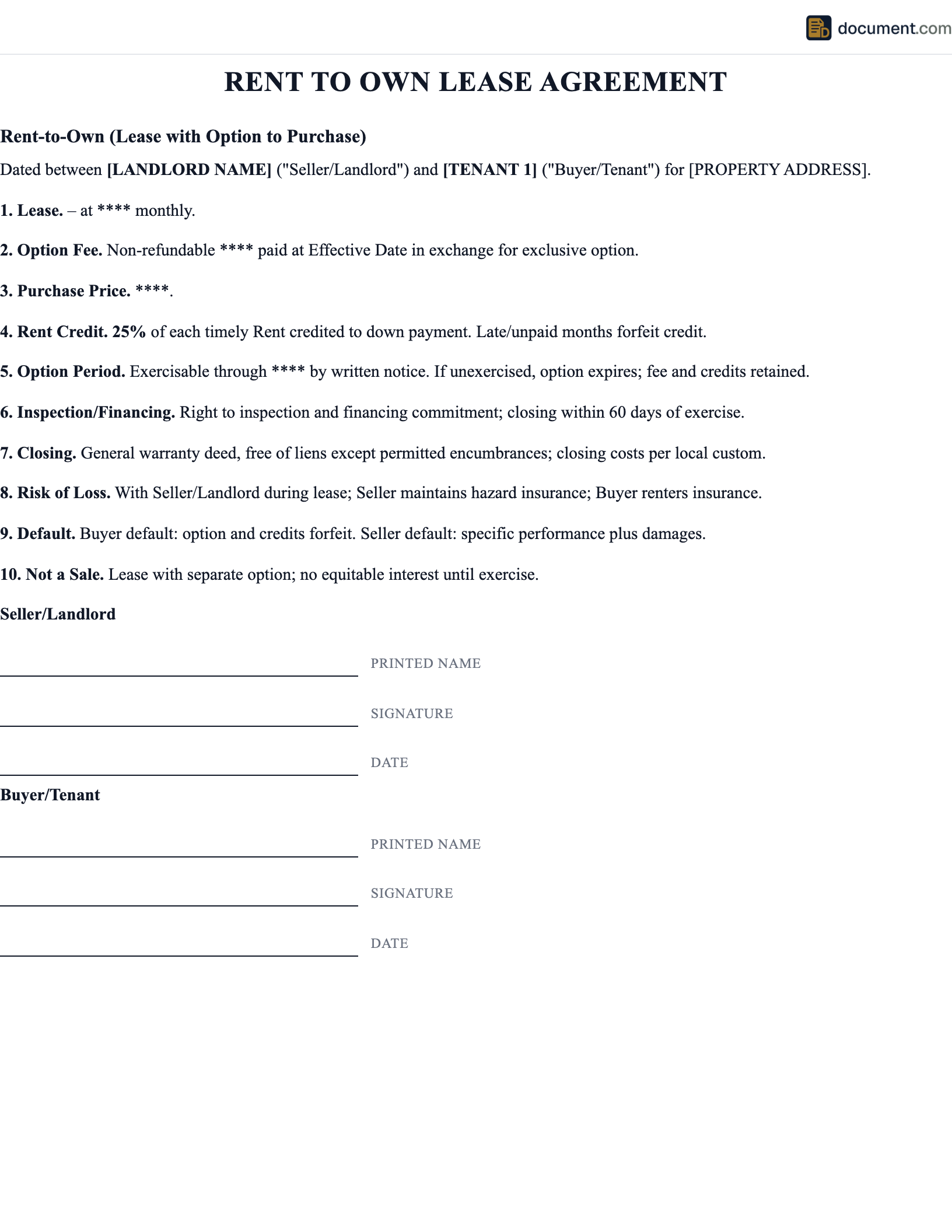
Below is a preview of our Colorado-specific rent-to-own agreement. The customized document addresses property disclosure requirements, radon considerations, and Colorado recording provisions.
STATE OF COLORADO
RESIDENTIAL LEASE WITH OPTION TO PURCHASE
Governed by C.R.S. Title 38 & Colorado Contract Law
PROPERTY OWNER / OPTIONOR:
Name: [Owner Name]
Address: [Colorado Address]
TENANT-BUYER / OPTIONEE:
Name: [Tenant Name]
Address: [Current Address]
PROPERTY & TERMS
Property: [Colorado Property Address]
County: [County] Radon Test: [Completed/Pending]
Option Fee: $[Amount] Purchase Price: $[Amount]
Monthly Rent: $[Amount] Rent Credit: [%]%
Colorado Rent-to-Own FAQ
Common questions about rent-to-own agreements in Colorado, including property disclosures, radon considerations, public trustee foreclosure, and the absence of rent control.
Official Colorado Resources
Government and legal resources for Colorado rent-to-own transactions.
Colorado Attorney General — Consumer Protection
File complaints about deceptive rent-to-own practices
Colorado Division of Real Estate
Real estate licensing, regulation, and consumer resources
Colorado Housing and Finance Authority (CHFA)
First-time homebuyer programs and down payment assistance
HUD — Colorado Housing Resources
Federal housing assistance, counseling, and complaint filing
Create your Colorado Rent To Own Lease Agreement in under 5 minutes.
Answer a few questions and download a Colorado-compliant document, ready for the state agency.