



California Rent-to-Own Agreement Overview
California does not have a dedicated rent-to-own statute, but the state's comprehensive tenant protection laws, extensive property disclosure requirements, and community property rules create a highly regulated environment for lease-purchase transactions. The lease component is governed by California Civil Code (primarily §§ 1940-1954.06) and the Tenant Protection Act of 2019 (AB 1482). The purchase option is governed by California contract law and real property statutes, with the Transfer Disclosure Statement requirements (Civil Code §§ 1102-1102.17) applying to the sale.
California's housing market — with median home prices exceeding $700,000 statewide and over $1 million in many coastal areas — makes rent-to-own an attractive option for buyers who need time to save for the substantial down payment required. Locking in a purchase price in California's historically appreciating market can create significant equity for the tenant-buyer. However, the high entry costs also mean that option fees represent a substantial financial commitment.
California's layer of local rent control and tenant protection ordinances in cities like Los Angeles, San Francisco, Oakland, Berkeley, and Santa Monica add additional complexity. Parties must verify which local ordinances apply to the specific property before entering into a rent-to-own agreement.
AB 1482
Tenant Protection Act
2-5%
Option Fee Range
TDS + NHD
Disclosures Required
Race-Notice
Recording System
California Rent-to-Own Laws & Regulations
California regulates rent-to-own transactions through an extensive web of state and local laws. Understanding the interaction between tenant protection statutes, property disclosure requirements, and real property recording rules is essential for a legally sound agreement.
- Tenant Protection Act (AB 1482, Civil Code §§ 1946.2, 1947.12): Caps annual rent increases at 5% plus local CPI (max 10%) for covered properties and requires just cause for eviction after 12 months of occupancy. Single-family homes owned by individuals may be exempt with proper notice. Applies to the lease component of rent-to-own agreements on covered properties.
- Transfer Disclosure Statement (Civil Code §§ 1102-1102.17): Requires sellers to disclose known material facts about the property. In addition, a Natural Hazard Disclosure (earthquake fault zone, flood zone, fire hazard) is mandatory. Must be provided before the buyer is contractually bound.
- Security Deposit Law (Civil Code § 1950.5): Caps security deposits at one month's rent (effective July 2024). Return within 21 days of move-out. The option fee is separate and not subject to this cap, but both must be clearly distinguished in the agreement.
- Recording Statutes (Civil Code § 1214): California is a race-notice recording state. An unrecorded option can be defeated by a subsequent bona fide purchaser who records first without notice. Record with the county recorder; fees vary by county (typically $15-25 per page). Documents must meet strict formatting requirements.
- Community Property (Family Code § 760): California is a community property state. Spousal interests in the property, option agreement, and accumulated rent credits must be addressed. Both spouses should sign the agreement to prevent title complications.
Check Local Rent Control Ordinances
Beyond the statewide AB 1482 protections, many California cities have their own rent control and tenant protection ordinances that provide additional protections. Los Angeles (LARSO), San Francisco, Oakland, Berkeley, Santa Monica, West Hollywood, East Palo Alto, and other cities impose stricter rent caps and eviction protections that override the state baseline. Before entering a rent-to-own agreement, verify which local ordinance — if any — applies to the specific property. Some local ordinances exempt single-family homes while others do not.
How Rent-to-Own Works in California
California rent-to-own transactions require careful navigation of the state's extensive disclosure requirements, tenant protection laws, and local ordinances. Here is how a typical California rent-to-own deal progresses from negotiation to closing.
Property Inspection and Comprehensive Disclosure Review
Hire a California-licensed home inspector. Review the Transfer Disclosure Statement, Natural Hazard Disclosure, preliminary title report, and all applicable local disclosures. Verify whether AB 1482 or local rent control applies to the property
Negotiate and Execute the Agreement
Agree on purchase price, option fee, rent, rent credits, option period, and maintenance responsibilities. Address community property issues if either party is married. The agreement must be in writing per the California Statute of Frauds (Civil Code § 1624)
Pay Option Fee and Record with County Recorder
Pay the option fee and record a memorandum of option with the county recorder (e.g., LA County Registrar-Recorder, SF Assessor-Recorder). Ensure the document meets California formatting requirements including the 2.5-inch top margin
Lease Period — Build Equity Through Rent Credits
During the 1-3 year lease, pay rent with credits toward the purchase price. Work on credit improvement and explore CalHFA first-time buyer programs, FHA loans, and local down payment assistance programs
Exercise the Option and Close Through Escrow
Notify the seller in writing, secure mortgage financing, and close through a California escrow company. The option fee and rent credits are applied to the purchase price. Documentary transfer tax applies at closing
Key California Rent-to-Own Agreement Terms
California's extensive tenant protection laws and disclosure requirements mean that the agreement must address many more regulatory considerations than in less regulated states.
| Term | California Details |
|---|---|
| Option Fee | Typically 2-5% of purchase price. In California's high-cost market, this can be $15,000-$50,000+. Non-refundable but credited at closing |
| Purchase Price | Set at signing or by appraisal at exercise. In California's appreciating markets, locking the price can create substantial equity for the buyer |
| Monthly Rent | Subject to AB 1482 cap (5% + CPI, max 10%) if covered. Local rent control may impose stricter limits. Rent premium for credits must comply |
| Rent Credits | Not required by California law. When included, typically 10-25% of rent. Must be clearly documented and distinguished from security deposit |
| Security Deposit | Capped at one month's rent under Civil Code § 1950.5 (effective July 2024). Return within 21 days. Legally separate from option fee |
| Disclosures | TDS, NHD, lead paint (pre-1978), Mello-Roos, supplemental tax, Megan's Law, and any HOA disclosures must all be provided |
| Maintenance | Landlord must maintain habitable premises under Civil Code § 1941. Parties can contractually allocate routine maintenance to the tenant-buyer |
| Default & Eviction | 3-day notice for non-payment, 3-day notice for lease violations. AB 1482 just cause eviction applies after 12 months. Must address option fee and rent credits |
California Consumer Protections for Tenant-Buyers
California provides some of the strongest consumer protections in the nation for both tenants and property buyers, creating a robust protective framework for rent-to-own participants.
Transfer Disclosure Statement (Civil Code §§ 1102-1102.17)
California's TDS is one of the most comprehensive property disclosure requirements in the country. The seller must disclose all known material facts about the property, including structural defects, environmental hazards, neighborhood nuisances, and pending litigation. The Natural Hazard Disclosure adds earthquake, flood, fire, and other natural hazard information. These disclosures provide critical protections for rent-to-own buyers making a significant financial commitment.
California Consumer Legal Remedies Act (Civil Code § 1750 et seq.)
The CLRA prohibits unfair and deceptive practices in transactions for property intended primarily for personal use. Predatory rent-to-own schemes that use deceptive advertising, hidden fees, or misleading terms may violate this Act. Consumers can seek injunctive relief, actual damages, and attorney fees. The CLRA provides particularly strong protections because it applies to both the lease and purchase components of the transaction.
California Housing Finance Agency (CalHFA)
CalHFA offers first-time homebuyer programs including the MyHome Assistance Program (up to 3.5% of the purchase price for down payment), the CalHFA Conventional Loan Program, and the Dream For All Shared Appreciation Loan. Tenant-buyers in rent-to-own agreements should explore these programs early in the lease period, as many have income limits and require homebuyer education courses.
Implied Warranty of Habitability (Civil Code § 1941)
California law requires landlords to maintain residential rental property in a condition fit for human habitation. This includes maintaining the structure, plumbing, electrical, heating, and compliance with building codes. The tenant-buyer retains all habitability rights during the lease period, including repair-and-deduct (Civil Code § 1942) and rent withholding remedies.
Sample California Rent-to-Own Agreement
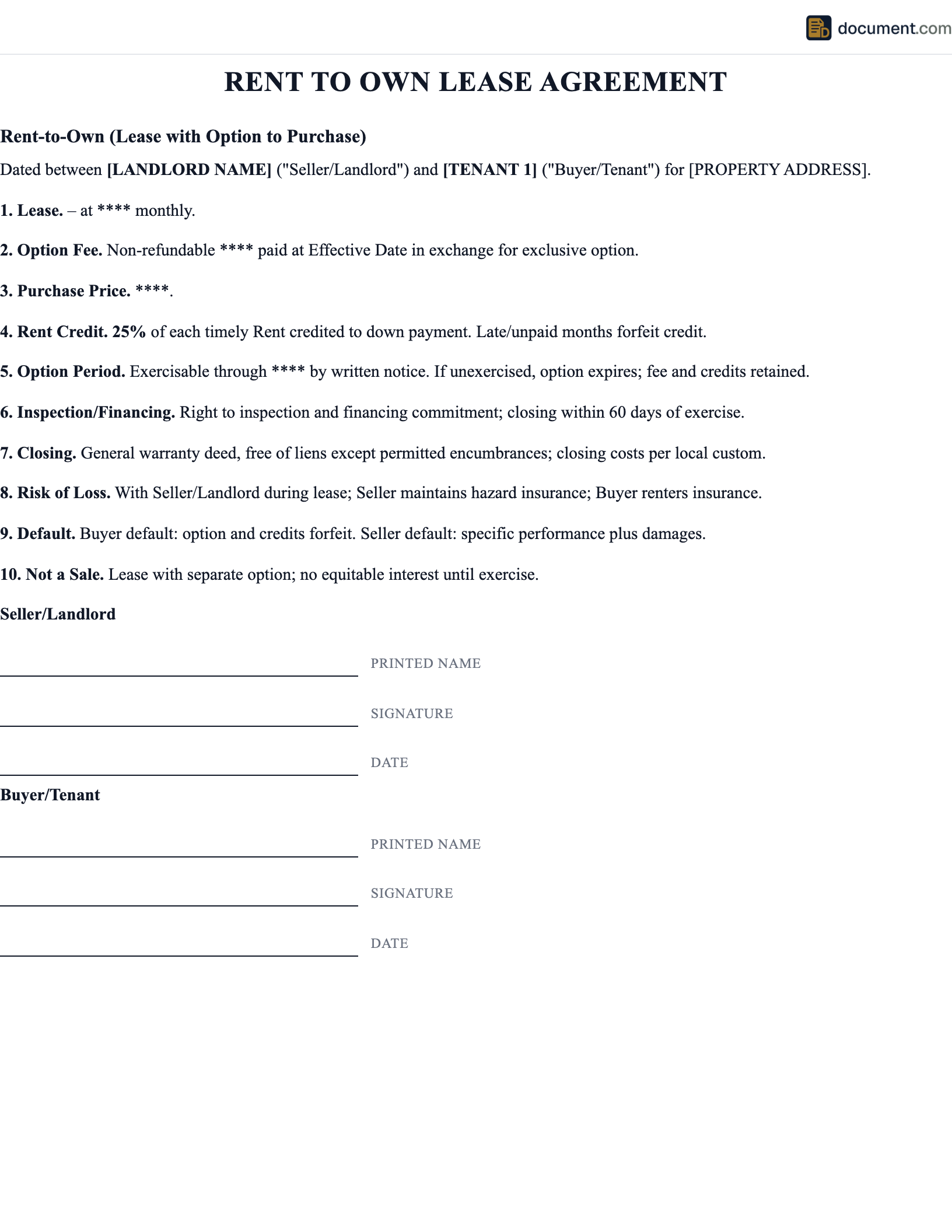
Below is a preview of our California-specific rent-to-own agreement. The customized document addresses AB 1482 compliance, TDS/NHD requirements, community property provisions, and local ordinance considerations.
STATE OF CALIFORNIA
RESIDENTIAL LEASE WITH OPTION TO PURCHASE
Governed by California Civil Code & AB 1482
PROPERTY OWNER / OPTIONOR:
Name: [Owner Name]
Address: [California Address]
TENANT-BUYER / OPTIONEE:
Name: [Tenant Name]
Address: [Current Address]
PROPERTY & TERMS
Property: [California Property Address]
County: [County] AB 1482 Covered: [Yes/No]
Option Fee: $[Amount] Purchase Price: $[Amount]
Monthly Rent: $[Amount] Rent Credit: [%]%
California Rent-to-Own FAQ
Common questions about rent-to-own agreements in California, including AB 1482 rent control, disclosure requirements, community property, and local ordinance considerations.
Official California Resources
Government and legal resources for California rent-to-own transactions.
California Attorney General — Consumer Protection
File complaints about deceptive rent-to-own practices
California Department of Real Estate
Real estate licensing, regulation, and consumer resources
California Housing Finance Agency (CalHFA)
First-time homebuyer programs and down payment assistance
HUD — California Housing Resources
Federal housing assistance, counseling, and complaint filing
Create your California Rent To Own Lease Agreement in under 5 minutes.
Answer a few questions and download a California-compliant document, ready for the state agency.