
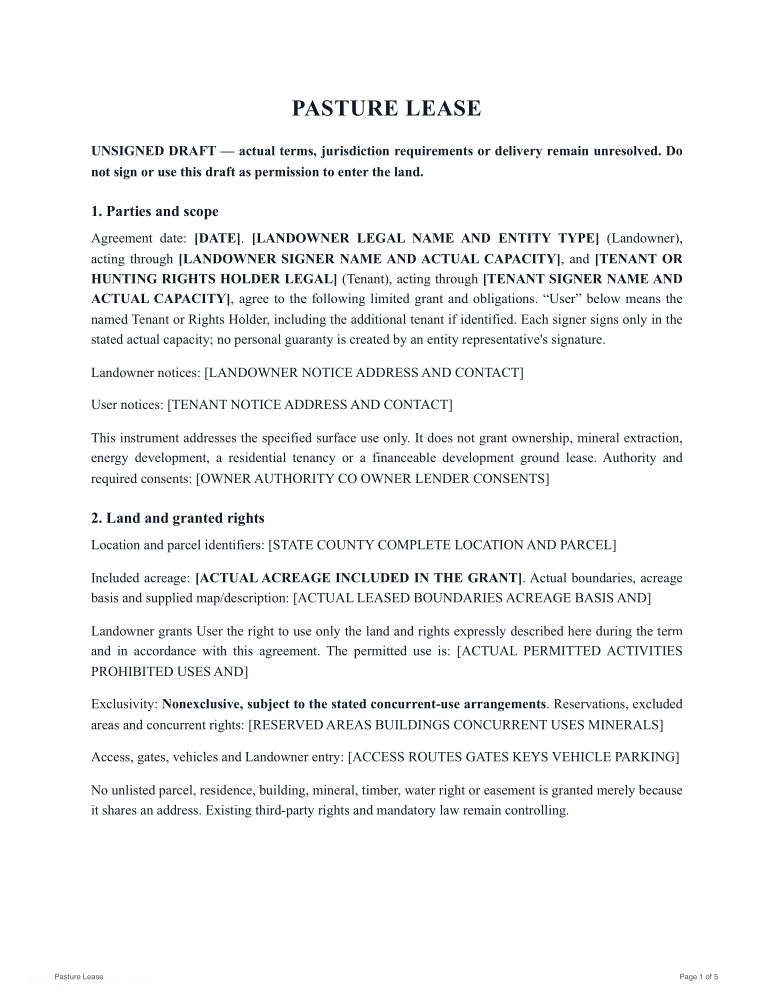



Wisconsin Pasture Lease: define the actual grant
A pasture lease needs an actual stocking plan. Specify livestock species/classes, maximum units, the animal-unit definition and time basis, rotation, monitoring, care and removal arrangements. Acreage alone does not determine a safe stocking rate.
Identify lawful water access, fence/gate responsibilities, escapes, disease, drought and forage-shortage response. Record actual insurance and liability terms without assuming a universal negligence release or automatic insurance minimum.
Name the actual owner, tenant or rights holder and authorized signers. Attach the map or legal description actually used, with included acreage, exclusions, access and reserved rights. Do not treat a sample as evidence of title, consent or a completed survey.
Specify the term, rent and accounting
Record commencement, the stated ending date, possession conditions and renewal arrangements. Distinguish termination of a tenancy from the final harvest, crop storage, livestock removal or limited retrieval rights.
Enter the agreed fixed total or complete rate/formula. For crop shares, define crops, percentages, measurement, marketing, sale proceeds and input costs. For animal units, define the unit, count and period. A fixed total is not automatically a monthly installment.
Specify actual deposit terms, deductions, return/itemization, payment deadlines, taxes and late/returned-payment charges, including none when that is the agreement. The document does not falsely acknowledge receipt of money.
Assign operations, costs and risk
Record actual condition and inspection scope. Identify water rights and limits, fence and road work, weeds, conservation, chemical use, approved improvements and ownership/removal at the end. Do not automatically give one party all improvements for free.
Farm and pasture use requires crop/harvest, livestock, conservation/program and shortage planning. Program eligibility and payment allocation need their own review; a lease cannot assign government benefits contrary to program rules.
Hunting requires the actual roster, guests/minors, lawful species/seasons/methods, access period, safety and closure rules. A lease is not a general license to hunt anywhere or a signature on behalf of every participant.
Negotiate insurance, liability, casualty, drought, access loss, assignment, default/cure, lawful possession remedies and surrender. The repaired branches do not invent a blanket guaranty, arbitration clause, negligence release, 150% holdover rent or thirty-day property forfeiture.
Wisconsin rules and notices
For the actual Wisconsin location, identify the state, county, existing tenancy and intended use. Verify agricultural notice and continuation rules, any term limits, water and access rights, livestock/fencing or hunting requirements, tax treatment and actual execution or recording formalities. Do not use a generic thirty-day notice, deed recording fee or automatic transfer-tax rate.
Review the actual county and local requirements, existing rights and any permits before use. A state dropdown does not complete a jurisdiction-specific legal review. Housing, specialized development and other excluded transactions must use separately tailored documents.
Complete the actual review and attachments
Keep an unsigned draft while substantive terms, mandatory requirements or delivery remain incomplete. The signature version requires the user to record those steps as complete; the software does not independently verify them.
Identify every map, schedule, disclosure and separate instrument and confirm actual delivery at the required time. Review the generated document as a whole, not only the interview answers. Any required notarial act must be completed separately by the notary using the appropriate certificate.
Read the sample and enter the real terms
The sample is a marked unsigned illustration. Its placeholders do not establish permission, price, acreage, title, conditions or legal compliance. The interview asks for actual facts and agreed obligations.