
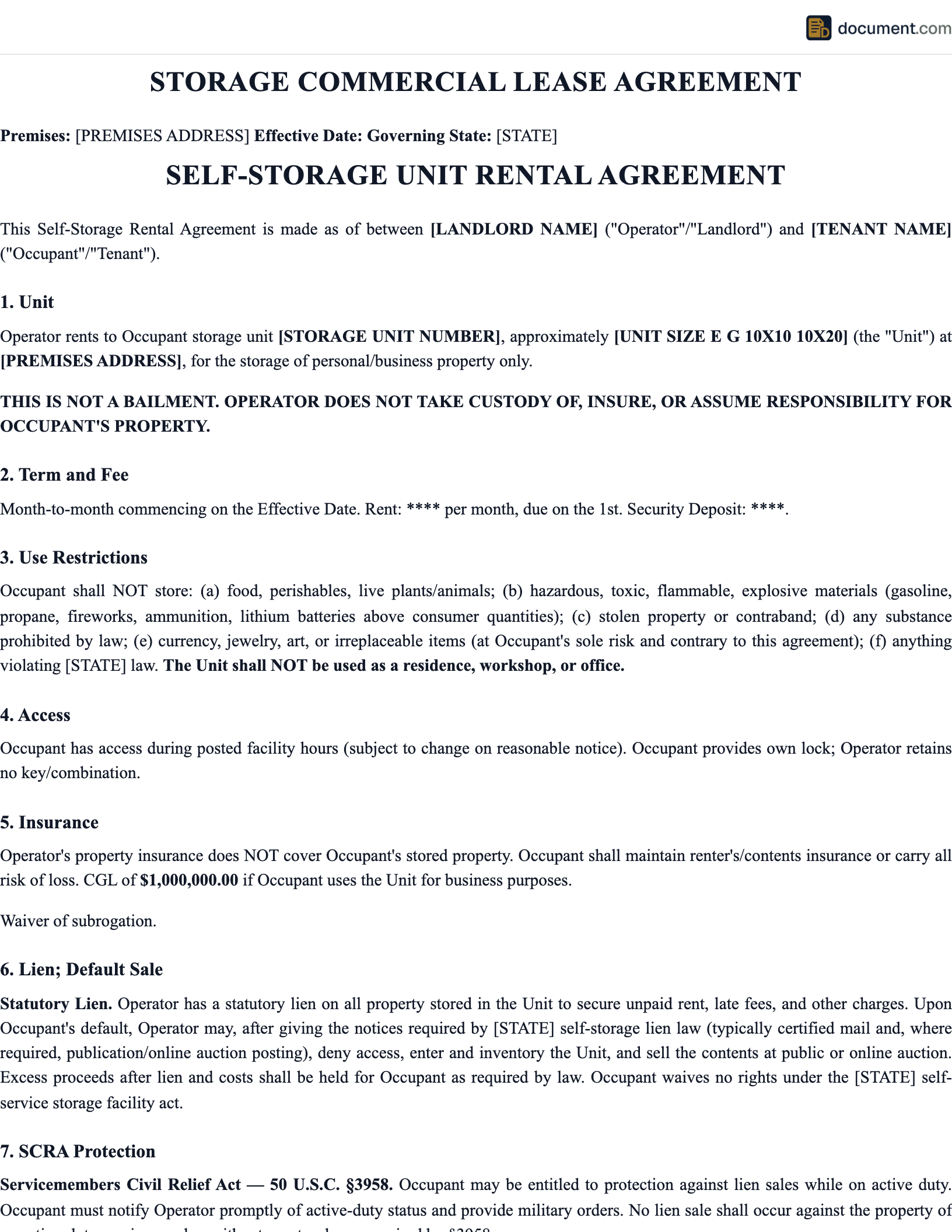



Missouri Storage Rental Agreement Overview
Missouri governs self-storage agreements through the Self-Service Storage Facility Act (Chapter 415 of the Missouri Revised Statutes), which defines the rights and responsibilities of operators and occupants. Commercial storage arrangements outside of traditional self-storage facilities, such as dedicated storage bays within industrial buildings, are governed by general contract and commercial real estate law. Understanding which legal framework applies to your agreement is the starting point for any Missouri storage lease.
The Kansas City and St. Louis markets have the largest concentration of commercial storage facilities in Missouri, but significant agricultural storage demand also drives the rural market, particularly for grain, farm equipment, and timber products near the Mark Twain National Forest region. Storage agreements across these different use cases share common structural elements, but the physical specifications, access terms, and insurance requirements vary considerably based on what is being stored.
$24
Filing fee
Required
Notarization
0
Witnesses required
Recorder
Filing office
Missouri Requirements
A Missouri commercial storage agreement must comply with the Self-Service Storage Facility Act if it involves a traditional self-storage facility. For commercial storage in other building types, general contract law governs. In either case, the agreement should be written, signed by both parties, and detailed enough to address the specific storage use.
Missouri Specific Note
Missouri's Self-Service Storage Facility Act requires specific lien enforcement procedures before an operator can auction stored goods. Any storage agreement must not conflict with these statutory notice and waiting period requirements. Attempting to waive statutory lien procedures contractually is unenforceable under Missouri law.
Key Agreement Provisions
- Unit description: Identify the storage unit by number, dimensions, floor level, and whether it is climate controlled
- Access rights: State access hours, gate or keypad code procedures, and any after-hours access fees
- Insurance obligation: Specify whether the tenant is required to carry property insurance and at what coverage amount
- Prohibited items: List all items the operator does not permit to be stored, including hazardous materials and perishables
- Default and lien rights: Reference Missouri Chapter 415 procedures for self-storage operators, or state contractual default remedies for non-statutory storage arrangements
How to Execute a Missouri Storage Agreement
Setting up a commercial storage arrangement in Missouri is straightforward, but the details in the agreement matter. These steps apply whether you are renting a self-storage unit for business inventory in Kansas City or securing a dedicated storage bay in a Springfield industrial park.
Identify Your Legal Framework
Determine whether the storage arrangement falls under Missouri's Self-Service Storage Facility Act (Chapter 415) or general contract law. Self-storage units at licensed facilities are governed by the statute; commercial storage bays in industrial buildings generally are not.
Inspect and Document the Unit
Before signing, inspect the unit for existing damage, water intrusion, pest evidence, and climate control function. Photograph the unit and note any deficiencies in writing. Attach the inspection record to the agreement so there is a baseline if a damage dispute arises.
Confirm Insurance Coverage
Verify your existing business property insurance covers goods stored off-premises. Many Missouri commercial policies exclude off-site storage unless specifically endorsed. If coverage is insufficient, obtain a storage-specific policy before moving goods in.
Execute the Agreement
Both the operator and occupant should sign. Commercial storage agreements are contracts and require no notarization unless the parties elect to record the document, which is uncommon for standard storage rentals. Retain a copy of the fully executed agreement.
Set Up Payment and Access
Confirm the payment method, due date, late fee schedule, and access credentials. Test gate codes or app-based access before moving goods in. Missouri storage operators are permitted to deny access for non-payment, so keeping payment current is essential to avoid disruption.
Missouri Fees & Costs
Below is a breakdown of the typical costs associated with filing this document in Missouri. Actual fees may vary by county.
| Fee / Cost | Amount |
|---|---|
| Filing Fee | $24 first page |
| Notarization | $5 - $25 per signature |
| Certified Copy | $1 - $10 per page |
| Attorney Review (optional) | $150 - $500 |
Sample Missouri Storage Rental Agreement
Below is a preview of our Missouri-specific template. Your customized document will include all fields and provisions required for filing in any Missouri county.
STORAGE RENTAL AGREEMENT
STATE OF MISSOURI
Legal Document Template
FACILITY OPERATOR
Company: [Storage Facility Name]
Address: [Facility Address]
Phone: [Contact Number]
License #: [Business License]
TENANT
Name: [Full Legal Name]
Address: [Mailing Address]
Phone: [Contact Number]
ID Type: [Driver's License/State ID]
UNIT DETAILS
Unit #: [Number]
Size: [Width x Depth]
Floor: [Ground/Upper]
Climate Controlled: [Yes/No]
Access Hours: [Hours]
FINANCIAL TERMS
Monthly Rent: $[Amount]
Payment Due: [Day of Month]
Late Fee: $[Amount] after [Grace Days]
Insurance: $[Amount]/month
Admin Fee: $[Amount]
Missouri Storage Rental Agreement FAQ
Answers to common questions about filing a storage rental agreement in Missouri, including requirements, fees, and procedures.
Official Missouri Resources
Use these official state resources to verify requirements, find your local filing office, and access government forms for Missouri.
Related Missouri Documents
Depending on your situation, you may need additional documents alongside your Missouri storage rental agreement.
Create your Missouri Commercial Storage Lease Agreement in under 5 minutes.
Answer a few questions and download a Missouri-compliant document, ready for the state agency.