



Louisiana Storage Rental Agreement Overview
Louisiana's commercial storage market serves a diverse business community ranging from New Orleans's tourism and hospitality industry to Baton Rouge's state government and petrochemical sector. The state's extreme subtropical climate makes climate-controlled storage essentially mandatory for most business goods, and Louisiana's Gulf Coast exposure creates hurricane risk considerations that make proper insurance and lease provisions essential.
Louisiana enacted the Self-Service Storage Facility Act (LSA-R.S. 9:4751 et seq.) under the state's civil law framework, which differs in some procedural respects from common law state equivalents. Louisiana's flood risk is a material consideration for any storage selection decision, as portions of New Orleans and coastal Louisiana face real flood exposure that affects facility selection and insurance requirements.
$55
Filing fee
Required
Notarization
2
Witnesses required
Clerk
Filing office
Louisiana Requirements
Louisiana commercial storage agreements must address flood risk provisions, hurricane damage provisions, the state's extreme climate requirements for climate control, and the Louisiana Self-Storage Act's civil law framework.
Louisiana Specific Note
Louisiana's subtropical climate makes climate-controlled storage essential for virtually all business goods. Non-climate-controlled storage in Louisiana during summer months creates extreme heat and humidity conditions that can destroy electronics, damage documents, cause mold growth on fabric and leather, and rust metal components in weeks. Climate control is not optional for serious business goods storage in Louisiana.
Document Requirements
- Written Agreement: Louisiana self-storage agreements must be in writing under the Louisiana Self-Storage Act.
- Climate Control Specifications: Document temperature and humidity specifications. Louisiana's extreme climate makes climate control critical for all business goods.
- Flood Provisions: Address what happens to goods and rental obligations if the facility is flooded.
- Hurricane Provisions: Address hurricane damage and what the operator's obligations are for alternative storage if the facility is closed.
- Insurance Requirements: Confirm insurance coverage including flood and hurricane damage for stored goods.
- Louisiana Self-Storage Act Compliance: Understand lien enforcement procedures under LSA-R.S. 9:4751 et seq.
How to File in Louisiana
Louisiana storage agreements require flood zone assessment, hurricane provisions, climate control verification for the subtropical environment, and Louisiana Self-Storage Act compliance review.
Assess Facility Flood Zone
Confirm the facility's FEMA flood zone designation and elevation before selecting a Louisiana storage location.
Negotiate Hurricane and Flood Provisions
Confirm what happens to stored goods and rental obligations if the facility is damaged or closed due to a hurricane or flood.
Verify Climate Control Performance
Louisiana's extreme heat and humidity make climate control performance critical. Test or request performance data for summer conditions.
Obtain Flood and Hurricane Insurance
Arrange property insurance for stored goods including flood and hurricane damage coverage specific to Louisiana's risk profile.
Execute Agreement
Sign the storage agreement and confirm all material terms are in writing.
Louisiana Fees & Costs
Below is a breakdown of the typical costs associated with filing this document in Louisiana. Actual fees may vary by county.
| Fee / Cost | Amount |
|---|---|
| Filing Fee | $55 first page |
| Notarization | $5 - $25 per signature |
| Certified Copy | $1 - $10 per page |
| Attorney Review (optional) | $150 - $500 |
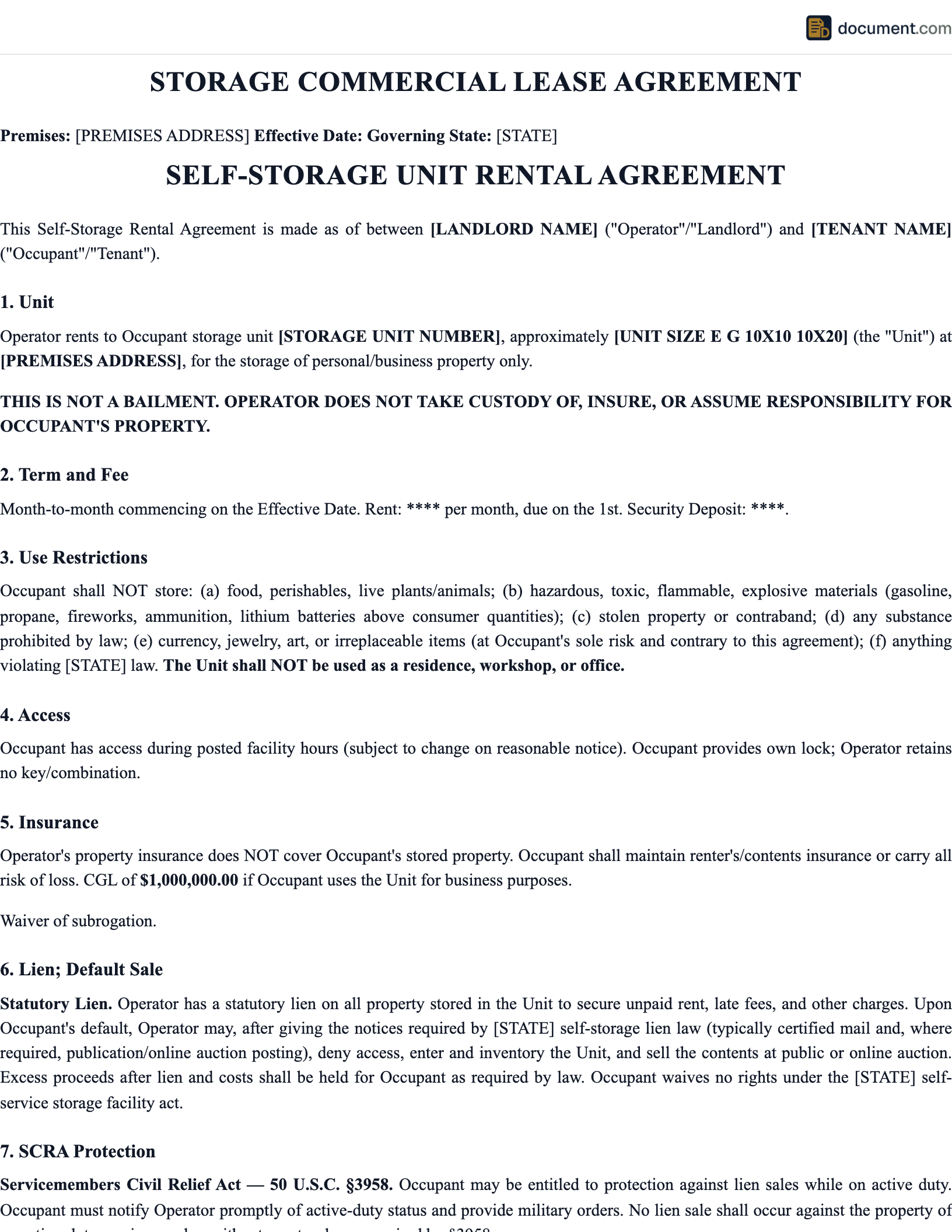
Sample Louisiana Storage Rental Agreement
Below is a preview of our Louisiana-specific template. Your customized document will include all fields and provisions required for filing in any Louisiana county.
STORAGE RENTAL AGREEMENT
STATE OF LOUISIANA
Legal Document Template
FACILITY OPERATOR
Company: [Storage Facility Name]
Address: [Facility Address]
Phone: [Contact Number]
License #: [Business License]
TENANT
Name: [Full Legal Name]
Address: [Mailing Address]
Phone: [Contact Number]
ID Type: [Driver's License/State ID]
UNIT DETAILS
Unit #: [Number]
Size: [Width x Depth]
Floor: [Ground/Upper]
Climate Controlled: [Yes/No]
Access Hours: [Hours]
FINANCIAL TERMS
Monthly Rent: $[Amount]
Payment Due: [Day of Month]
Late Fee: $[Amount] after [Grace Days]
Insurance: $[Amount]/month
Admin Fee: $[Amount]
Louisiana Storage Rental Agreement FAQ
Answers to common questions about filing a storage rental agreement in Louisiana, including requirements, fees, and procedures.
Official Louisiana Resources
Use these official state resources to verify requirements, find your local filing office, and access government forms for Louisiana.
Louisiana Tax Implications
Louisiana corporate income tax and personal income tax apply to Louisiana business operations. Storage rental payments are deductible business expenses.
Louisiana property taxes are assessed by parish and may include ITEP exemptions for qualifying operations. Storage facilities in Louisiana carry parish-level tax burdens reflected in rental rates.
Louisiana's combined state and parish sales tax rates are among the highest in the country, potentially exceeding 10% in some areas. Confirm whether storage rental payments are subject to Louisiana sales tax and the applicable combined rate.
Louisiana Storage Lease Checklist
Before signing any Louisiana storage lease, verify CAM reconciliation methodology, negotiate rent abatement for tenant improvement periods, and confirm in writing who owns improvements installed during the lease term.
Review the CAM expense pool definition carefully. Some landlords use gross-up provisions that inflate the expense pool even during partial vacancy. Request two prior years of actual CAM reconciliation statements before committing.
Louisiana Storage Tip
Louisiana's extreme climate and flood risk make storage facility selection more consequential here than in most states. Spend extra time evaluating three factors before signing: the facility's FEMA flood zone and elevation, the climate control system's performance history during peak summer heat, and the operator's experience handling insurance claims after hurricanes. A facility with excellent performance on all three factors is worth paying a premium over a cheaper option with unknown performance on any of these critical dimensions.
Louisiana Storage Lease Checklist
Before signing any Louisiana storage lease, verify CAM reconciliation methodology, negotiate rent abatement for tenant improvement periods, and confirm in writing who owns improvements installed during the lease term.
Review the CAM expense pool definition carefully. Some landlords use gross-up provisions that inflate the expense pool even during partial vacancy. Request two prior years of actual CAM reconciliation statements before committing.
Professional Recommendation
Industrial leases are not standardized. Each landlord uses their own form. A commercial real estate attorney familiar with Louisiana industrial leasing can identify provisions that create undue risk before you are committed to the space.
Related Louisiana Documents
Depending on your situation, you may need additional documents alongside your Louisiana storage rental agreement.
Create your Louisiana Commercial Storage Lease Agreement in under 5 minutes.
Answer a few questions and download a Louisiana-compliant document, ready for the state agency.