



Georgia Storage Rental Agreement Overview
Georgia's commercial storage market serves a large and growing population base centered on the Atlanta metro, where strong household growth, a diverse business community, and warm weather drive storage demand year-round. The state's self-storage market is one of the largest in the Southeast, with significant inventory concentrated in the Atlanta suburbs and growing Savannah market.
Georgia enacted the Self-Storage Facility Act (O.C.G.A. Section 10-4-210 et seq.) governing self-storage operators and providing specific lien rights and procedural requirements. Georgia's hot, humid climate creates genuine storage challenges for moisture-sensitive goods, making climate control an operational necessity rather than a luxury for most business users.
$10
Filing fee
Required
Notarization
0
Witnesses required
Superior
Filing office
Georgia Requirements
Georgia commercial storage agreements should address the Georgia Self-Storage Facility Act requirements, climate control specifications, and insurance obligations given the state's summer climate risks.
Georgia Specific Note
Georgia's summer climate creates genuine storage damage risk in non-climate-controlled facilities. August and September, the hottest and most humid months of Georgia's storage season, are when uncontrolled storage unit interiors can cause irreversible damage to electronics, documents, and many types of merchandise. Climate-controlled storage is the appropriate default for business goods in Georgia.
Document Requirements
- Written Agreement: Georgia self-storage agreements should be in writing to comply with the Georgia Self-Storage Facility Act and general contract principles.
- Climate Control Specifications: Document temperature and humidity specifications if climate control is a material term. Georgia's summer climate makes this provision important.
- Insurance Requirements: Confirm required insurance coverage for stored goods and ensure the policy covers Georgia's weather-related risks.
- Georgia Self-Storage Act Rights: Understand lien enforcement procedures under O.C.G.A. Section 10-4-210 et seq.
- Access Hours: Specify access hours and any restrictions. Georgia facilities vary in their access policies.
- Prohibited Items: Review the prohibited items list with the operator before moving goods in.
How to File in Georgia
Georgia storage agreements are governed by the state's Self-Storage Facility Act, with particular attention to climate control for the state's warm, humid climate.
Evaluate Climate Control Performance
Test or request performance data for climate-controlled units. Georgia's summer humidity is the most important climate factor for stored goods.
Review Georgia Self-Storage Act Protections
Understand the lien enforcement timeline and procedures under O.C.G.A. Section 10-4-210 et seq. before signing.
Confirm Insurance Coverage
Arrange property insurance for stored goods. Confirm coverage for weather damage including water intrusion and storm damage.
Assess Location for Port or Airport Access
If operations depend on Port of Savannah or Atlanta airport logistics, confirm proximity and access to relevant freight infrastructure.
Execute Agreement
Sign the storage agreement and confirm all material terms are documented in writing.
Georgia Fees & Costs
Below is a breakdown of the typical costs associated with filing this document in Georgia. Actual fees may vary by county.
| Fee / Cost | Amount |
|---|---|
| Filing Fee | $10 first page + $2/additional |
| Notarization | $5 - $25 per signature |
| Certified Copy | $1 - $10 per page |
| Attorney Review (optional) | $150 - $500 |
Sample Georgia Storage Rental Agreement
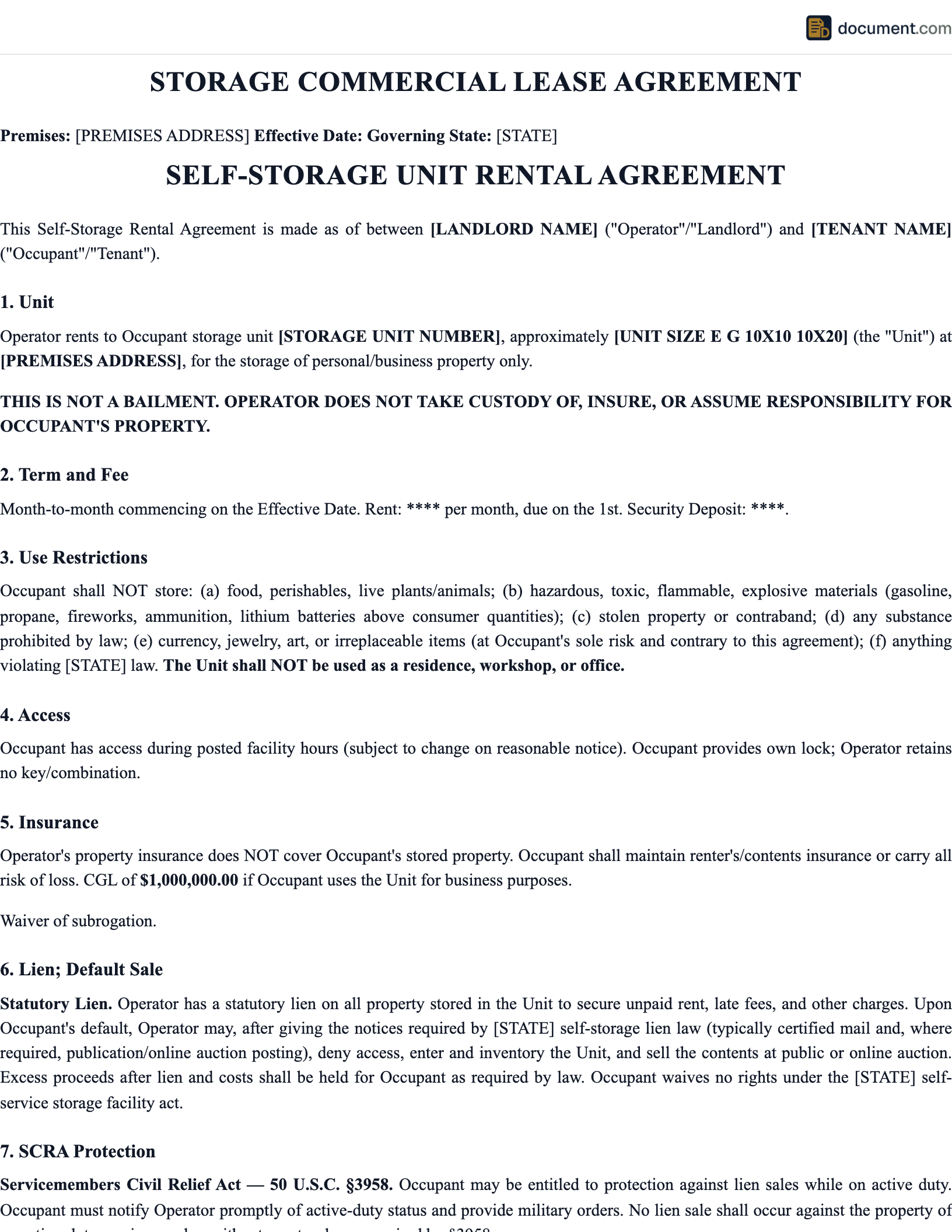
Below is a preview of our Georgia-specific template. Your customized document will include all fields and provisions required for filing in any Georgia county.
STORAGE RENTAL AGREEMENT
STATE OF GEORGIA
Legal Document Template
FACILITY OPERATOR
Company: [Storage Facility Name]
Address: [Facility Address]
Phone: [Contact Number]
License #: [Business License]
TENANT
Name: [Full Legal Name]
Address: [Mailing Address]
Phone: [Contact Number]
ID Type: [Driver's License/State ID]
UNIT DETAILS
Unit #: [Number]
Size: [Width x Depth]
Floor: [Ground/Upper]
Climate Controlled: [Yes/No]
Access Hours: [Hours]
FINANCIAL TERMS
Monthly Rent: $[Amount]
Payment Due: [Day of Month]
Late Fee: $[Amount] after [Grace Days]
Insurance: $[Amount]/month
Admin Fee: $[Amount]
Georgia Storage Rental Agreement FAQ
Answers to common questions about filing a storage rental agreement in Georgia, including requirements, fees, and procedures.
Official Georgia Resources
Use these official state resources to verify requirements, find your local filing office, and access government forms for Georgia.
Georgia Tax Implications
Georgia imposes a corporate income tax and personal income tax. Storage rental payments for business purposes are deductible expenses. Georgia's tax rates are moderate by Southeastern standards.
Georgia's 4% state sales and use tax applies to commercial transactions. Confirm with the operator whether sales tax applies to the specific storage arrangement and whether it is included in quoted rates or added separately.
Property taxes on Georgia storage facilities are assessed at the county level and reflected in operator pricing. Metro Atlanta county tax rates vary, and these costs are passed to tenants through rental rates.
Georgia Storage Lease Checklist
Before signing any Georgia storage lease, verify CAM reconciliation methodology, negotiate rent abatement for tenant improvement periods, and confirm in writing who owns improvements installed during the lease term.
Review the CAM expense pool definition carefully. Some landlords use gross-up provisions that inflate the expense pool even during partial vacancy. Request two prior years of actual CAM reconciliation statements before committing.
Georgia Storage Tip
Georgia's Self-Storage Facility Act provides meaningful protections but requires tenants to respond quickly when they receive lien notice. If you fall behind on storage payments, respond immediately to any written notice from the operator. The cure period under Georgia law is defined in the notice, and missing the deadline results in loss of your right to reclaim stored goods without paying the full outstanding balance.
Georgia Storage Lease Checklist
Before signing any Georgia storage lease, verify CAM reconciliation methodology, negotiate rent abatement for tenant improvement periods, and confirm in writing who owns improvements installed during the lease term.
Review the CAM expense pool definition carefully. Some landlords use gross-up provisions that inflate the expense pool even during partial vacancy. Request two prior years of actual CAM reconciliation statements before committing.
Professional Recommendation
Industrial leases are not standardized. Each landlord uses their own form. A commercial real estate attorney familiar with Georgia industrial leasing can identify provisions that create undue risk before you are committed to the space.
Related Georgia Documents
Depending on your situation, you may need additional documents alongside your Georgia storage rental agreement.
Create your Georgia Commercial Storage Lease Agreement in under 5 minutes.
Answer a few questions and download a Georgia-compliant document, ready for the state agency.