



Delaware Storage Rental Agreement Overview
Delaware's commercial storage market serves a mix of business users along the I-95 Northeast corridor, Port of Wilmington import logistics, and general business storage needs in the Wilmington area. The state's no-sales-tax environment provides a modest cost advantage for storage rental payments compared to neighboring states that tax storage revenues.
Delaware enacted the Self-Service Storage Facility Act (25 Del. C. Section 4901 et seq.) governing self-storage facilities and providing specific lien rights, notice procedures, and enforcement processes. Commercial storage users should clarify whether their arrangement falls under this statute or under a general commercial lease, as the procedural requirements and tenant rights differ between the two frameworks.
$33
Filing fee
Required
Notarization
0
Witnesses required
Recorder
Filing office
Delaware Requirements
Delaware commercial storage agreements should address the Self-Service Storage Facility Act requirements, Delaware's no-sales-tax advantage, and the mid-Atlantic climate's humidity considerations for stored goods.
Delaware Specific Note
Delaware's Self-Service Storage Facility Act provides meaningful procedural protections for tenants of covered facilities. Confirm that the facility is a covered self-storage facility under the act before assuming these protections apply. Facilities that operate as commercial warehouses rather than self-storage may be governed by general commercial lease law, which provides different and potentially more limited protections.
Document Requirements
- Written Agreement: Delaware self-storage agreements should be in writing. The Self-Service Storage Facility Act requires written agreements for covered facilities.
- Insurance Requirements: Confirm required insurance coverage for stored goods. Delaware facilities typically require property insurance on stored goods.
- Delaware Self-Storage Act Compliance: Confirm the facility operates under the Delaware Self-Service Storage Facility Act and understand your rights under its lien enforcement procedures.
- No-Sales-Tax Benefit: Confirm that Delaware's no-sales-tax environment applies to the storage rental payments and that no additional local tax applies.
- Climate Control for Mid-Atlantic Climate: Delaware's humid summers and cold winters make climate control advisable for many stored goods. Document specifications in writing.
- Access Hours: Specify access hours and any restrictions. Delaware storage facilities vary in their access policies.
How to File in Delaware
Delaware storage agreements are straightforward under the state's Self-Service Storage Facility Act framework, with the no-sales-tax environment providing a modest cost advantage over neighboring states.
Confirm No-Sales-Tax Treatment
Verify that the storage rental payments are not subject to Delaware sales tax and confirm whether any local taxes apply to the specific facility location.
Assess Climate Control for Mid-Atlantic Conditions
Delaware's humid summers and cold winters create temperature and moisture risks for stored goods. Evaluate climate control performance across seasonal conditions.
Review Delaware Self-Storage Act Rights
Understand the notice timeline and cure period under Delaware's Self-Service Storage Facility Act before an operator can enforce lien rights.
Obtain Property Insurance
Arrange property insurance for stored goods. Delaware's mid-Atlantic location creates weather-related risks for stored goods during summer humidity and winter storms.
Execute Agreement
Sign the storage agreement and confirm all material terms are documented in writing.
Delaware Fees & Costs
Below is a breakdown of the typical costs associated with filing this document in Delaware. Actual fees may vary by county.
| Fee / Cost | Amount |
|---|---|
| Filing Fee | $33 first page |
| Notarization | $5 - $25 per signature |
| Certified Copy | $1 - $10 per page |
| Attorney Review (optional) | $150 - $500 |
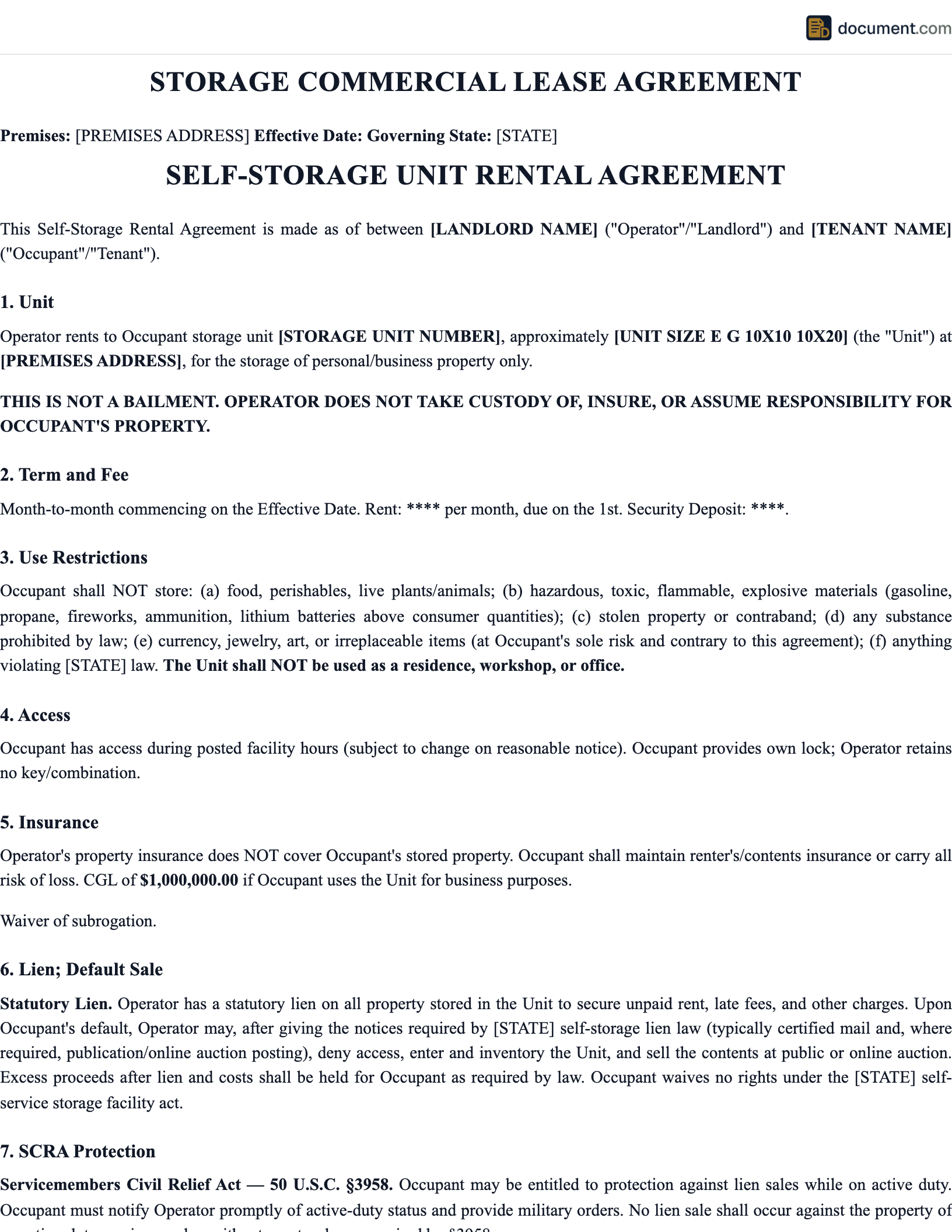
Sample Delaware Storage Rental Agreement
Below is a preview of our Delaware-specific template. Your customized document will include all fields and provisions required for filing in any Delaware county.
STORAGE RENTAL AGREEMENT
STATE OF DELAWARE
Legal Document Template
FACILITY OPERATOR
Company: [Storage Facility Name]
Address: [Facility Address]
Phone: [Contact Number]
License #: [Business License]
TENANT
Name: [Full Legal Name]
Address: [Mailing Address]
Phone: [Contact Number]
ID Type: [Driver's License/State ID]
UNIT DETAILS
Unit #: [Number]
Size: [Width x Depth]
Floor: [Ground/Upper]
Climate Controlled: [Yes/No]
Access Hours: [Hours]
FINANCIAL TERMS
Monthly Rent: $[Amount]
Payment Due: [Day of Month]
Late Fee: $[Amount] after [Grace Days]
Insurance: $[Amount]/month
Admin Fee: $[Amount]
Delaware Storage Rental Agreement FAQ
Answers to common questions about filing a storage rental agreement in Delaware, including requirements, fees, and procedures.
Official Delaware Resources
Use these official state resources to verify requirements, find your local filing office, and access government forms for Delaware.
Delaware Tax Implications
Delaware has no state sales tax, meaning storage rental payments in Delaware are not subject to Delaware sales tax. This is a genuine cost advantage compared to neighboring Maryland and Pennsylvania. Delaware does impose a corporate income tax at 8.7% on corporate income from Delaware operations.
Property taxes on Delaware storage facilities are paid by the operator and reflected in rental rates. New Castle County commercial property has higher effective tax rates than Kent and Sussex counties. These costs affect the rental rates operators charge but are not typically broken out as separate pass-through charges in self-storage agreements.
Businesses using Delaware storage for distribution to Delaware customers benefit from the state's no-sales-tax environment. Goods sold and delivered to Delaware customers by a Delaware business are not subject to Delaware sales tax, which can simplify tax compliance for certain types of distribution operations.
Delaware Storage Lease Checklist
Before signing any Delaware storage lease, verify CAM reconciliation methodology, negotiate rent abatement for tenant improvement periods, and confirm in writing who owns improvements installed during the lease term.
Review the CAM expense pool definition carefully. Some landlords use gross-up provisions that inflate the expense pool even during partial vacancy. Request two prior years of actual CAM reconciliation statements before committing.
Delaware Storage Tip
Delaware's no-sales-tax environment is a real but modest advantage for storage rental payments. For businesses comparing Delaware versus Pennsylvania or Maryland storage, the tax savings need to be weighed against the smaller inventory and potentially longer distance from primary operations. Do the math on total cost including transportation to and from the facility before selecting a Delaware location solely for the tax benefit.
Delaware Storage Lease Checklist
Before signing any Delaware storage lease, verify CAM reconciliation methodology, negotiate rent abatement for tenant improvement periods, and confirm in writing who owns improvements installed during the lease term.
Review the CAM expense pool definition carefully. Some landlords use gross-up provisions that inflate the expense pool even during partial vacancy. Request two prior years of actual CAM reconciliation statements before committing.
Professional Recommendation
Industrial leases are not standardized. Each landlord uses their own form. A commercial real estate attorney familiar with Delaware industrial leasing can identify provisions that create undue risk before you are committed to the space.
Related Delaware Documents
Depending on your situation, you may need additional documents alongside your Delaware storage rental agreement.
Create your Delaware Commercial Storage Lease Agreement in under 5 minutes.
Answer a few questions and download a Delaware-compliant document, ready for the state agency.