



Colorado Storage Rental Agreement Overview
Colorado commercial storage serves a mix of outdoor recreation industry users storing equipment and product, construction contractors managing project materials, cannabis industry operators seeking compliant storage, and general business users. The Denver metro area has a large and growing self-storage industry that supplements commercial storage options, with demand driven by population growth and the state's active outdoor recreation economy.
Colorado enacted the Colorado Self-Storage Facility Lien Act (C.R.S. 38-21.5-101 et seq.), which provides specific rights and remedies for both operators and occupants of self-storage facilities. The state's cannabis industry has created specialized storage demand that standard facilities cannot accommodate, as cannabis product storage must comply with Colorado Marijuana Enforcement Division standards for security, access control, and physical infrastructure.
$13
Filing fee
Required
Notarization
0
Witnesses required
County
Filing office
Colorado Requirements
Colorado commercial storage agreements should address the Colorado Self-Storage Facility Lien Act for applicable facilities, altitude and climate performance specifications, and any cannabis-specific requirements if applicable.
Colorado Specific Note
Colorado's cannabis industry creates unique storage requirements. Cannabis product storage must comply with Colorado MED regulations including specific security camera coverage, access logs, and physical security standards. Standard commercial storage facilities typically cannot meet these requirements. Cannabis operators must use facilities specifically licensed for cannabis product storage to avoid MED enforcement action.
Document Requirements
- Written Agreement: Storage agreements for terms over one year must be in writing under Colorado law.
- Insurance Requirements: Confirm required insurance coverage for stored goods. Colorado facilities vary in their insurance requirements and some offer optional tenant insurance.
- Colorado Self-Storage Lien Act: Understand the lien rights and notice procedures under C.R.S. 38-21.5 before signing any Colorado self-storage agreement.
- Climate Control Specifications: Colorado's dry climate and significant temperature swings make climate control important for many stored goods. Document required conditions in writing.
- Cannabis Compliance: If storing cannabis products, confirm the facility is licensed under Colorado MED requirements and that security infrastructure meets state standards.
- Flood Risk Disclosure: For facilities near mountain canyons or waterways, confirm flood zone designation and flood insurance status.
How to File in Colorado
Colorado storage agreements require attention to the state's Self-Storage Lien Act, altitude-adjusted climate control performance, and cannabis compliance requirements if applicable.
Assess Climate Control and Altitude Performance
Colorado's dry climate and altitude affect humidity levels and climate control performance. Verify system specifications and ask for performance data across the full range of seasonal temperature conditions.
Confirm Cannabis Compliance If Applicable
If storing cannabis products, confirm the facility is licensed under Colorado MED and that security infrastructure meets state standards before moving any cannabis inventory.
Review Lien Rights Under Colorado Law
Understand the Colorado Self-Storage Facility Lien Act procedures before signing. Know the notice timeline and cure period before an operator can enforce lien rights against stored property.
Obtain Property Insurance
Arrange appropriate property insurance for stored goods before move-in.
Execute the Agreement
Sign the storage agreement after confirming all material terms are accurately documented in writing.
Colorado Fees & Costs
Below is a breakdown of the typical costs associated with filing this document in Colorado. Actual fees may vary by county.
| Fee / Cost | Amount |
|---|---|
| Filing Fee | $13 first page |
| Notarization | $5 - $25 per signature |
| Certified Copy | $1 - $10 per page |
| Attorney Review (optional) | $150 - $500 |
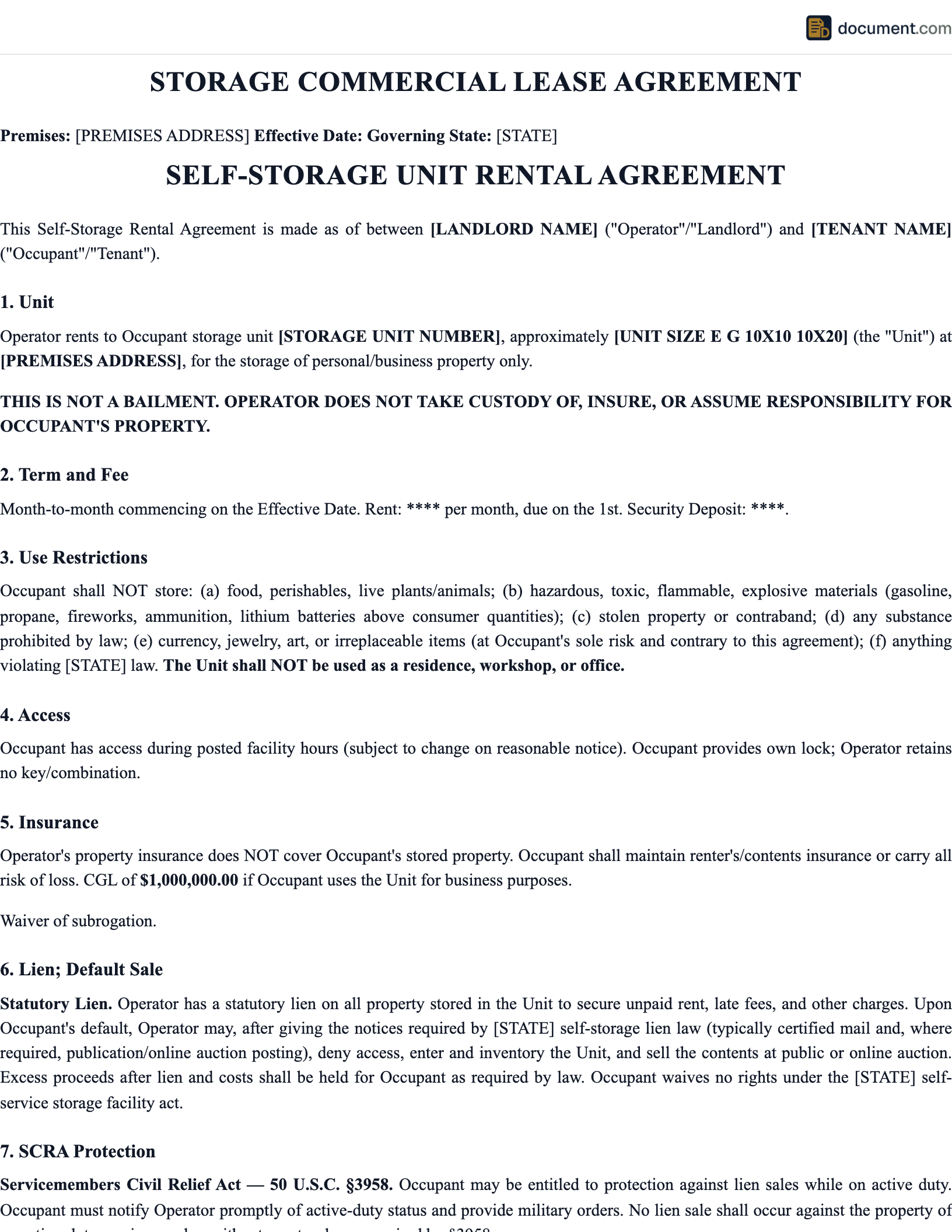
Sample Colorado Storage Rental Agreement
Below is a preview of our Colorado-specific template. Your customized document will include all fields and provisions required for filing in any Colorado county.
STORAGE RENTAL AGREEMENT
STATE OF COLORADO
Legal Document Template
FACILITY OPERATOR
Company: [Storage Facility Name]
Address: [Facility Address]
Phone: [Contact Number]
License #: [Business License]
TENANT
Name: [Full Legal Name]
Address: [Mailing Address]
Phone: [Contact Number]
ID Type: [Driver's License/State ID]
UNIT DETAILS
Unit #: [Number]
Size: [Width x Depth]
Floor: [Ground/Upper]
Climate Controlled: [Yes/No]
Access Hours: [Hours]
FINANCIAL TERMS
Monthly Rent: $[Amount]
Payment Due: [Day of Month]
Late Fee: $[Amount] after [Grace Days]
Insurance: $[Amount]/month
Admin Fee: $[Amount]
Colorado Storage Rental Agreement FAQ
Answers to common questions about filing a storage rental agreement in Colorado, including requirements, fees, and procedures.
Official Colorado Resources
Use these official state resources to verify requirements, find your local filing office, and access government forms for Colorado.
Colorado Tax Implications
Storage rental payments are deductible business expenses in Colorado. The state's flat 4.4% income tax applies to both individuals and corporations on Colorado-sourced income.
Colorado sales and use tax may apply to commercial storage rental revenues. The combined state, county, and municipal rate varies significantly by location. Denver's combined rate can exceed 8%. Confirm the applicable rate for the specific facility before finalizing cost projections.
Property taxes on storage facilities are paid by the owner and reflected in rental rates. Colorado's biennial assessment cycle means property tax bills can change significantly at reassessment, which may affect future rental rates for long-term storage tenants.
Important Considerations for Colorado Storage Tenants
Colorado's temperature extremes, from hot dry summers to cold winters, affect stored goods significantly. Even climate-controlled units should be evaluated for consistent performance across the full range of seasonal conditions at Colorado's altitude.
The cannabis storage market in Colorado has specialized requirements that standard facilities cannot meet. If you are in the cannabis industry, use only facilities specifically licensed and designed for cannabis storage rather than adapting standard commercial storage arrangements.
Colorado's active outdoor recreation industry creates seasonal storage demand spikes in fall and winter as recreation companies stock for ski season. Businesses that need reliable year-round storage should sign annual agreements rather than month-to-month arrangements to avoid losing access during peak demand periods.
Colorado Storage Tip
Colorado's dry climate is actually an advantage for storage of goods vulnerable to moisture damage. Unlike humid Southeastern states where mold and condensation can damage stored goods, Colorado's low ambient humidity reduces this risk significantly. This is a genuine benefit of Colorado storage for certain goods types like paper records, wood products, and electronics.
Related Colorado Documents
Depending on your situation, you may need additional documents alongside your Colorado storage rental agreement.
Create your Colorado Commercial Storage Lease Agreement in under 5 minutes.
Answer a few questions and download a Colorado-compliant document, ready for the state agency.