



Alaska Storage Rental Agreement Overview
Alaska's commercial storage market serves a small, concentrated business community in Anchorage, Fairbanks, and smaller communities across the state. The state's extreme subarctic and arctic climate makes climate-controlled storage an absolute requirement for virtually all business goods. Alaska storage costs reflect the state's island economics, with all building materials and operating supplies requiring expensive maritime or air shipping.
Alaska lacks a dedicated self-storage facility act, meaning commercial storage agreements are primarily governed by general contract law. The specific lien enforcement procedures depend on the agreement's terms rather than a statutory framework. Alaska's extreme winter climate, including temperatures that can reach minus 40 degrees Fahrenheit in interior Alaska, creates storage challenges that make climate control a survival requirement for stored goods, not a convenience.
$25
Filing fee
Required
Notarization
0
Witnesses required
District
Filing office
Alaska Requirements
Alaska commercial storage agreements lack a statutory framework and rely on contract terms. Climate control specifications are critical given the extreme climate, and all material terms should be explicitly documented in the agreement.
Alaska Specific Note
Alaska's extreme winter temperatures can destroy stored goods without adequate climate control. Minus 20 to minus 40 degrees Fahrenheit winter temperatures will damage electronics beyond repair, burst water pipes, destroy rubber seals, and render batteries inoperable. Climate-controlled storage in Alaska is not optional for business goods. It is a fundamental requirement. Non-climate-controlled storage should be considered unsuitable for any goods that cannot survive arctic temperatures.
Document Requirements
- Written Agreement: Alaska storage agreements must be in writing given the absence of a statutory self-storage framework.
- Climate Control Essential: Document specific minimum temperature requirements. Alaska's extreme cold makes climate control a non-negotiable requirement.
- Heating System Reliability: Confirm backup heating capability. Heating system failure in Alaska during winter is a life-safety event for stored goods.
- Insurance Requirements: Confirm insurance coverage for stored goods including cold weather and extreme temperature damage.
- Lien Enforcement Procedures: Review lien enforcement procedures carefully. Alaska lacks a dedicated self-storage statute, so contractual terms govern.
- Access Hours: Specify access hours given Alaska's extreme weather and daylight variation by season.
How to File in Alaska
Alaska storage agreements require thorough review of contract terms given the absence of a dedicated self-storage statute, climate control verification as an absolute requirement, and heating system reliability assessment.
Require Climate Control — Alaska Minimum
Climate control in Alaska must be capable of maintaining temperatures above freezing at a minimum, and ideally above 55 degrees Fahrenheit for most business goods during Alaska's coldest months.
Confirm Backup Heating Capability
Ask about the facility's backup heating infrastructure. A single heating system failure in January in Anchorage can damage stored goods within hours.
Review Storage Agreement Carefully
Alaska lacks a dedicated self-storage statute. All material terms including lien enforcement procedures must be explicitly in the agreement. Have an Alaska attorney review before signing.
Obtain Insurance Including Extreme Cold Coverage
Arrange property insurance that explicitly covers extreme cold temperature damage, which is a real and specific risk in Alaska.
Execute Agreement
Sign the storage agreement only after confirming climate control capability, backup systems, and all material terms are explicitly documented.
Alaska Fees & Costs
Below is a breakdown of the typical costs associated with filing this document in Alaska. Actual fees may vary by county.
| Fee / Cost | Amount |
|---|---|
| Filing Fee | $25 per document |
| Notarization | $5 - $25 per signature |
| Certified Copy | $1 - $10 per page |
| Attorney Review (optional) | $150 - $500 |
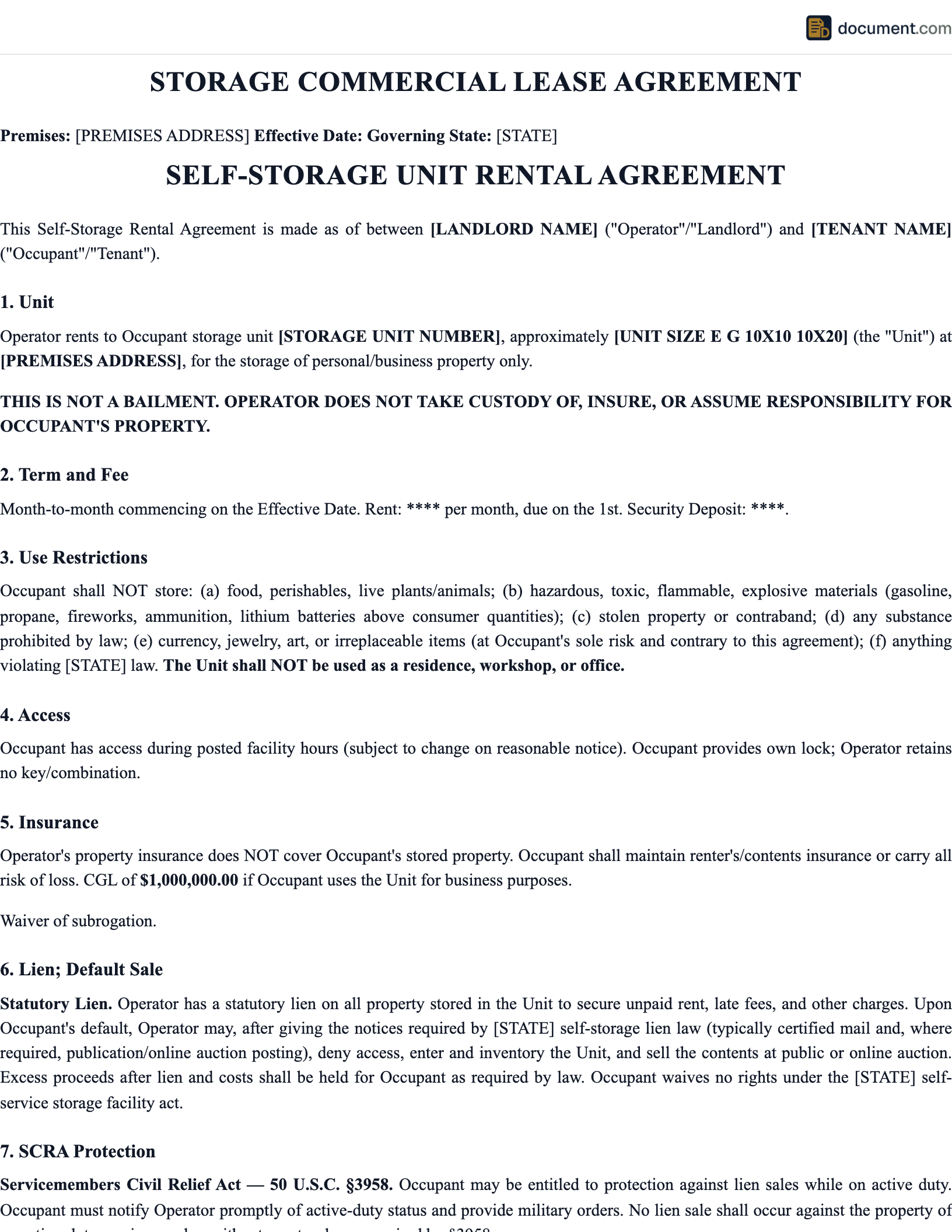
Sample Alaska Storage Rental Agreement
Below is a preview of our Alaska-specific template. Your customized document will include all fields and provisions required for filing in any Alaska county.
STORAGE RENTAL AGREEMENT
STATE OF ALASKA
Legal Document Template
FACILITY OPERATOR
Company: [Storage Facility Name]
Address: [Facility Address]
Phone: [Contact Number]
License #: [Business License]
TENANT
Name: [Full Legal Name]
Address: [Mailing Address]
Phone: [Contact Number]
ID Type: [Driver's License/State ID]
UNIT DETAILS
Unit #: [Number]
Size: [Width x Depth]
Floor: [Ground/Upper]
Climate Controlled: [Yes/No]
Access Hours: [Hours]
FINANCIAL TERMS
Monthly Rent: $[Amount]
Payment Due: [Day of Month]
Late Fee: $[Amount] after [Grace Days]
Insurance: $[Amount]/month
Admin Fee: $[Amount]
Alaska Storage Rental Agreement FAQ
Answers to common questions about filing an storage rental agreement in Alaska, including requirements, fees, and procedures.
Official Alaska Resources
Use these official state resources to verify requirements, find your local filing office, and access government forms for Alaska.
Alaska Tax Implications
Alaska has no state income tax and no state sales tax, making it one of only a handful of states with neither. Storage rental payments may still be subject to local municipal taxes depending on the specific municipality. Anchorage, Fairbanks, and other municipalities have their own local tax structures.
Alaska property taxes are administered at the borough and municipal level. Anchorage has moderate commercial property taxes. Other boroughs vary. Storage facility operators pay these taxes and reflect them in rental rates, along with the elevated construction and operating costs specific to Alaska.
Alaska's no-state-income-tax environment is a genuine business advantage. Combined with no state sales tax, Alaska's state-level tax burden on business operations is among the lowest in the country. Local municipal taxes vary and should be confirmed for the specific storage location.
Important Considerations for Alaska Storage Tenants
Alaska's extreme winter climate creates storage risks with no parallel in the continental US. Climate control failure events are not minor inconveniences in Alaska. They can destroy stored goods completely within hours.
Alaska storage rates are among the highest in the country. The cost premium reflects real operating cost differences that cannot be eliminated. Budget accordingly.
Alaska's geographic isolation from the Lower 48 creates supply chain challenges for restocking or removing goods. Plan storage logistics with the understanding that freight to and from Alaska takes days longer than continental US shipping.
Alaska Storage Tip
Alaska's climate makes heating system reliability the most important factor in storage facility selection, ahead of price, location, or any other consideration. Ask every Alaska storage facility operator: what is the backup heating system, when was it last tested, and what is the protocol if the primary heating system fails? A facility with a well-tested backup heating system that activates automatically is worth paying a premium over a cheaper facility that relies on a single heating system with no backup.
Related Alaska Documents
Depending on your situation, you may need additional documents alongside your Alaska storage rental agreement.
Create your Alaska Commercial Storage Lease Agreement in under 5 minutes.
Answer a few questions and download a Alaska-compliant document, ready for the state agency.