



Michigan Lead Paint Disclosure Overview
In Michigan, lead paint disclosures are recorded at the register of deeds. Michigan law establishes specific requirements for execution, notarization, and recording of real property documents. Understanding these MI requirements is essential to ensure your document is legally valid and properly recorded.
Michigan's transfer tax rate is $3.75 per $500, and recording fees start at $15. All documents must be notarized, and the state requires 0 additional witness(es). Our Michigan-specific template includes all required provisions for acceptance by any MI recording office.
$15
Recording fee
$3.75 per $500
Transfer tax
Required
Notarization
0
Witnesses required
Michigan Requirements
Michigan has specific requirements for recording documents. Meeting these requirements ensures acceptance by the register of deeds and provides proper legal notice of the transaction.
Michigan Specific Note
Michigan's transfer tax is $3.75 per $500. Recording fees start at $15. Confirm exact fees with your local register of deeds before filing. All documents must be properly notarized and formatted per MI requirements.
Document Requirements
- Notarization: Must be notarized by a Michigan notary public or authorized notary
- Witnesses: Michigan requires 0 additional witness(es)
- Legal Description: Complete legal description as it appears on the current deed of record
- Parcel Number: Assessor's parcel number or tax ID
- Return Address: Mailing address for returning the recorded document
- Formatting: Standard formatting with adequate margins, black ink, minimum 10-point font
How to File in Michigan
Filing in Michigan involves preparing the document, getting it notarized, and recording it. Follow these steps for a smooth process.
Prepare the Document
Complete all fields including party names, legal description, and Michigan-specific declarations
Get the Document Notarized
Sign before a Michigan notary public with valid government-issued ID. Michigan requires 0 additional witness(es)
File With the Recording Office
Take the notarized document to the register of deeds in the county where the property is located
Pay Recording Fees
Pay the recording fee ($15) and any applicable transfer tax ($3.75 per $500)
Update Records
Notify relevant parties and update property records as needed
Michigan Fees & Costs
Typical costs for filing in Michigan. Actual fees may vary by county.
| Fee / Tax | Amount |
|---|---|
| Recording Fee | $15 |
| Transfer Tax | $3.75 per $500 |
| Notarization | $5 - $25 per signature |
| Certified Copy | $1 - $10 per page |
| Attorney Review (optional) | $150 - $500 |
Michigan Tax Implications
Michigan's transfer tax rate is $3.75 per $500. Understanding the full tax picture is important for any real property transaction in Michigan.
Gift transfers may require IRS Form 709 if the value exceeds the annual gift tax exclusion. Recipients may receive the transferor's cost basis, potentially resulting in capital gains tax upon future sale.
Property tax reassessment rules vary in Michigan. Some transfers trigger reassessment while others are exempt. Contact the Michigan tax assessor's office for guidance on your specific transaction.
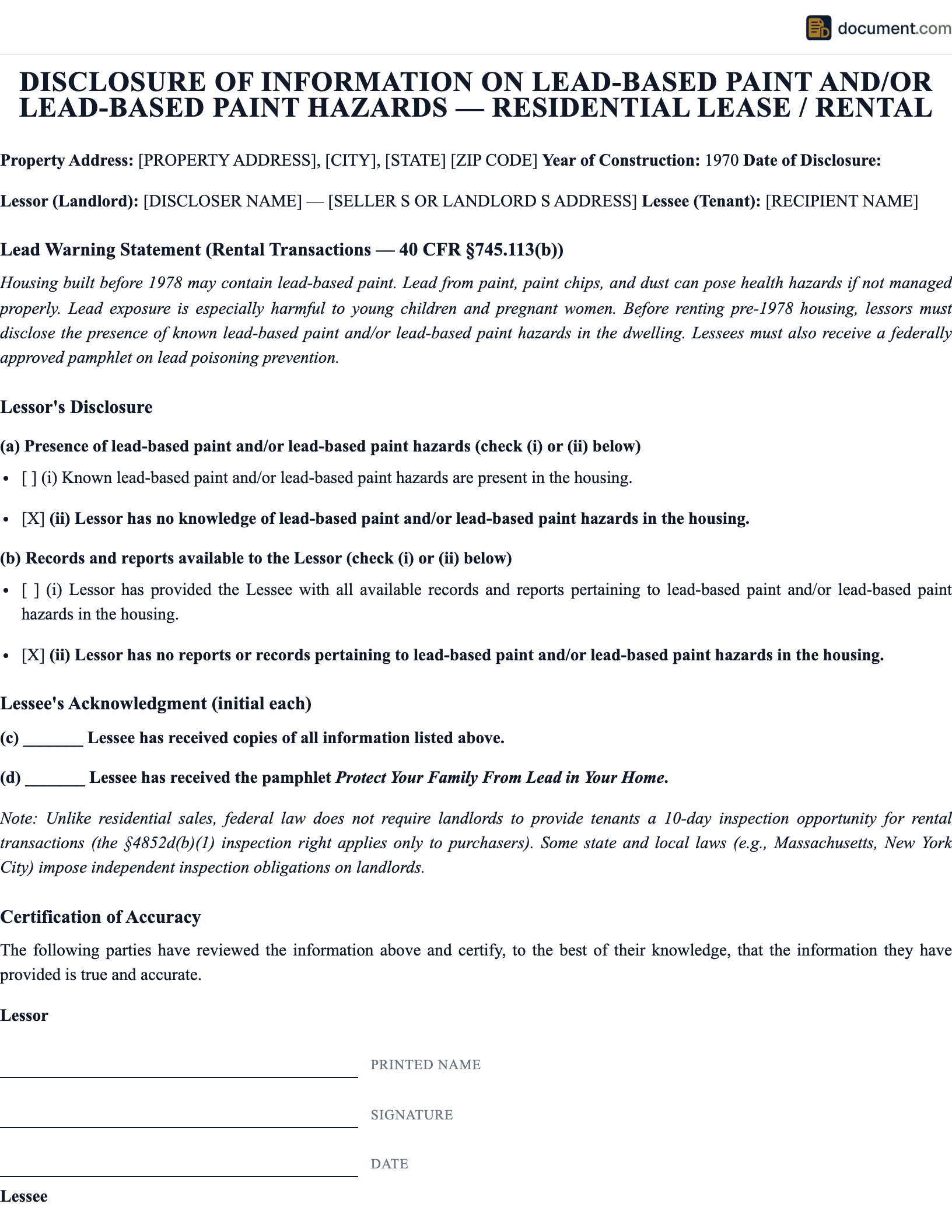
Sample Michigan Lead Paint Disclosure
Preview of our Michigan-specific template. Your document will include all fields required for recording in any Michigan county.
LEAD-BASED PAINT DISCLOSURE
STATE OF MICHIGAN
Legal Document
PARTY INFORMATION
Name: [Full Legal Name]
Address: [Michigan Address]
County: [County]
PROPERTY DESCRIPTION
County: [County] State: Michigan
Legal Description: [Per Recorded Plat]
Parcel No.: [APN]
Michigan Lead Paint Disclosure FAQ
Common questions about filing in Michigan, including requirements, fees, and tax implications.
Official Michigan Resources
Official state resources for verifying requirements and finding your local recording office.
Important Considerations
Before proceeding with your document, there are several important factors to consider. Each real estate transaction is unique, and understanding the specific requirements and implications of your situation will help ensure a smooth process.
Real estate laws and regulations are subject to change, and local requirements may differ from state-level rules. It is always advisable to verify current requirements with your local recording office before submitting any documents for recording.
If your transaction involves complex circumstances such as multiple parties, commercial properties, trusts, estates, or interstate elements, consulting with a licensed real estate attorney in your state is strongly recommended. An attorney can provide guidance specific to your situation and help you avoid potential legal issues.
Keep copies of all documents related to your real estate transaction in a safe place. Recorded documents become part of the public record, but having your own copies ensures you can reference the terms and conditions at any time. Digital copies stored securely are also recommended as a backup.
Professional Recommendation
While our templates are designed to be comprehensive and legally compliant, we recommend having your completed document reviewed by a licensed attorney before recording, especially for high-value transactions or complex situations. Many attorneys offer flat-fee document review services that provide peace of mind at a reasonable cost.
Related Documents
Depending on your situation, you may need additional documents alongside this one. Below are commonly related documents that are frequently used together in real estate transactions.
Important Considerations
Before proceeding with your document, there are several important factors to consider. Each real estate transaction is unique, and understanding the specific requirements and implications of your situation will help ensure a smooth and legally compliant process.
Real estate laws and regulations are subject to change, and local requirements may differ from state-level rules. It is always advisable to verify current requirements with your local recording office before submitting any documents for recording.
If your transaction involves complex circumstances such as multiple parties, commercial properties, trusts, estates, or interstate elements, consulting with a licensed real estate attorney is strongly recommended. An attorney can provide guidance specific to your situation and help you avoid potential legal issues.
Keep copies of all documents related to your real estate transaction in a safe place. Recorded documents become part of the public record, but having your own copies ensures you can reference the terms and conditions at any time. Digital copies stored securely are also recommended as a backup.
Professional Recommendation
While our templates are designed to be comprehensive and legally compliant, we recommend having your completed document reviewed by a licensed attorney before recording, especially for high-value transactions or complex situations. Many attorneys offer flat-fee document review services that provide peace of mind at a reasonable cost.
Related Documents
Depending on your situation, you may need additional documents alongside this one. Below are commonly related documents that are frequently used together in real estate transactions.
Create your Michigan Lead Based Paint Disclosure in under 5 minutes.
Answer a few questions and download a Michigan-compliant document, ready for the state agency.