



What Is a Lead Paint Disclosure?
A lead paint disclosure is a critical legal document used in real estate transactions across the United States. Understanding its purpose, requirements, and proper execution is essential for anyone involved in property ownership, management, or transfer. This document serves specific legal functions that vary by state but share common elements nationwide.
Every state recognizes lead paint disclosures, though specific requirements for execution, notarization, witnesses, and recording vary. Our templates are designed to meet the requirements of all 50 states, with state-specific provisions automatically included based on your selection. Whether you are a property owner, buyer, tenant, or real estate professional, having a properly prepared lead paint disclosure protects your interests and ensures legal compliance.
The importance of a properly executed lead paint disclosure cannot be overstated. An improperly prepared or incomplete document can lead to legal disputes, financial liability, recording rejection, and other serious consequences. Our templates have been reviewed by licensed attorneys and designed to meet the highest standards of legal compliance.
Before creating your lead paint disclosure, gather all necessary information including the full legal names of all parties, complete property addresses and legal descriptions, relevant identification numbers, and specific terms of the agreement. Having this information ready will streamline the process and ensure accuracy in your final document.
Legally Compliant
Meets all state-specific legal requirements for validity
Attorney Reviewed
Templates reviewed by licensed real estate attorneys
50-State Coverage
State-specific versions for all 50 states
Form Preview
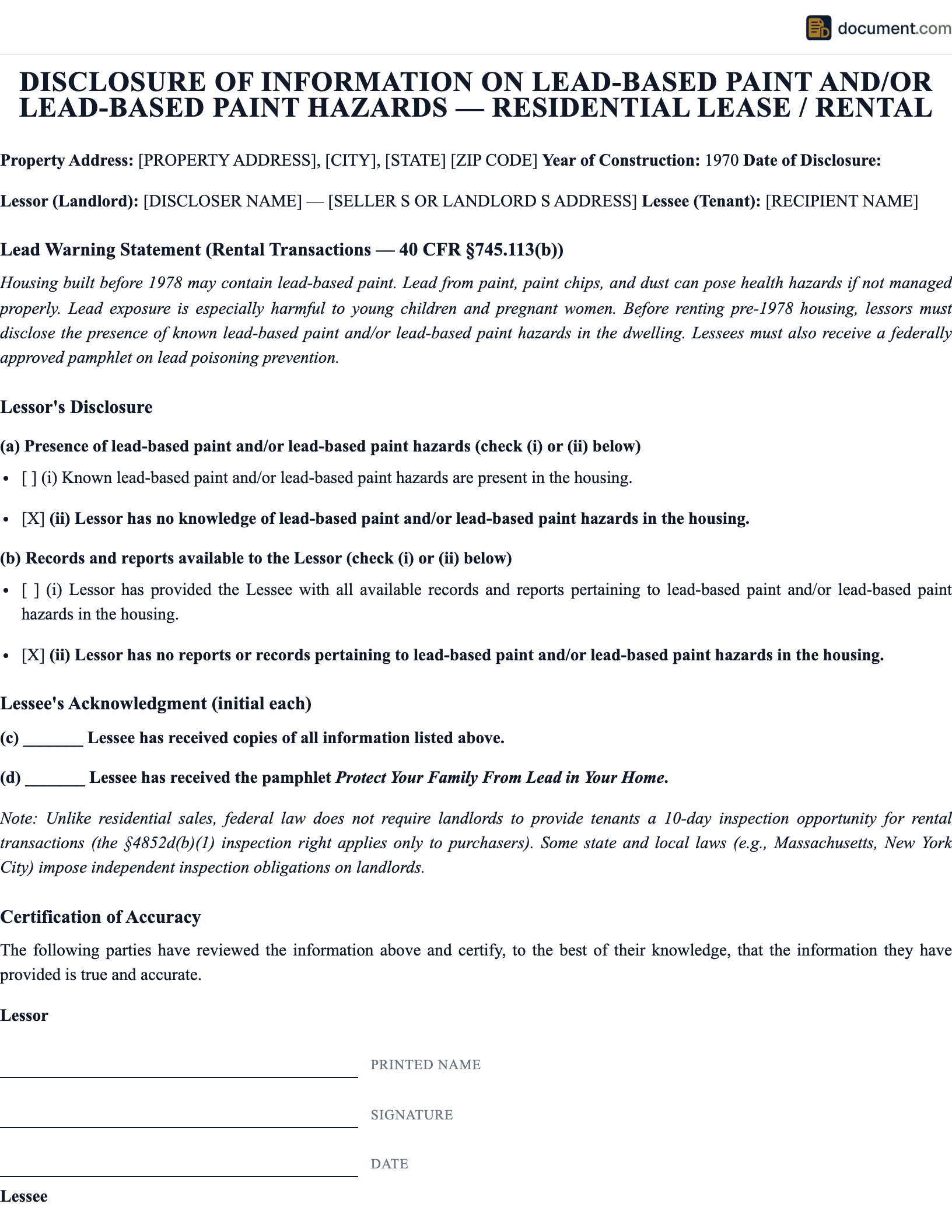
Preview of our lead paint disclosure template. Your customized document will be tailored to your state's specific requirements.
LEAD-BASED PAINT DISCLOSURE
Legal Document Template
PARTIES
Party 1: [Full Legal Name]
Party 2: [Full Legal Name]
Address: [Property Address]
TERMS AND CONDITIONS
Effective Date: [Date]
Consideration: $[Amount]
State: [State]
SIGNATURES & NOTARIZATION
Signature: [Signature]
Date: [Date]
Notary: [Seal & Signature]
When to Use a Lead Paint Disclosure
Understanding when to use a lead paint disclosure is essential for ensuring your real estate transaction is properly documented and legally compliant. This document type serves specific purposes that distinguish it from other real estate documents.
A lead paint disclosure is most commonly used in situations involving property transfers, financing arrangements, lease agreements, or compliance with state and federal regulations. The specific circumstances under which you need this document depend on your role in the transaction and the requirements of your state.
Whether you are a property owner, buyer, seller, landlord, tenant, or real estate professional, our template ensures you have a properly formatted and legally compliant document. Consult with a licensed attorney in your state if you have questions about whether this is the appropriate document for your situation.
State Compliant
Meets all state-specific legal requirements for validity and recording
Legally Reviewed
Template reviewed by licensed attorneys for legal accuracy
Key Components
A properly prepared lead paint disclosure contains several essential components that ensure its legal validity and effectiveness. Each element serves a specific legal purpose and must be accurately completed for the document to be enforceable.
The key components include proper identification of all parties, accurate property descriptions, clear statement of terms and conditions, appropriate signatures, and compliance with state-specific notarization and witness requirements. Missing or incorrect information can render the document invalid or unenforceable.
Our template guides you through each required component with clear instructions and formatting that meets recording office standards. State-specific provisions are automatically included based on your state selection to ensure full compliance with local requirements.
- Party Identification: Full legal names and addresses of all parties involved in the transaction
- Property Description: Complete legal description, parcel number, and property address
- Terms and Conditions: Clear statement of the agreement terms, obligations, and any consideration
- Signatures: Properly executed signatures with notarization as required by state law
- Recording Information: Return address, preparer information, and other details required for recording
Legal Requirements
Each state has specific legal requirements for lead paint disclosures that must be met for the document to be valid and enforceable. Common requirements include notarization, witness signatures, proper formatting, and recording with the appropriate government office.
Failure to meet state-specific requirements can result in the document being rejected for recording, deemed unenforceable, or challenged in court. Our templates are designed to meet the requirements of all 50 states, but it is important to verify specific requirements with your local recording office or a licensed attorney.
General requirements that apply in most states include: the document must be in writing, it must be signed by the appropriate parties, signatures must be notarized, the property must be accurately described, and the document must be recorded with the county recorder or equivalent office to provide constructive notice.
Lead Paint Disclosures by State
Select your state below to access state-specific lead paint disclosure requirements, fees, and filing instructions.
Sample Lead Paint Disclosure
Preview of our lead paint disclosure template. Your document will include all required provisions for your state.
LEAD-BASED PAINT DISCLOSURE
Sample Document
DOCUMENT DETAILS
This Lead Paint Disclosure is entered into on [Date] by and between [Party 1] and [Party 2] concerning the property located at [Address].
Frequently Asked Questions
Common questions about lead paint disclosures, including legal requirements, costs, and best practices.
How It Works
Creating your document is a straightforward process. Our guided template walks you through each required field and automatically includes state-specific provisions based on your location.
Select Your State
Choose your state to ensure your document meets all local legal requirements, including notarization, witness, and recording specifications unique to your jurisdiction.
Fill In the Details
Enter the required information including party names, property details, and specific terms of the transaction. Our form validates entries to help prevent common errors.
Review and Download
Preview your completed document, make any necessary edits, and download as PDF or Word format. Print, sign, notarize, and file with your local recording office.
Common Mistakes to Avoid
Real estate documents that contain errors or omissions can be rejected by the recording office, deemed unenforceable, or lead to costly legal disputes. Here are the most common mistakes to watch out for when preparing your document.
Incorrect Legal Description
The legal description must exactly match the property records. Even minor discrepancies can cause the document to be rejected or create title issues down the road.
Missing Notarization
Almost every state requires notarization. A document without proper notarization will be rejected for recording and may be deemed legally unenforceable.
Incorrect Party Names
Names must match exactly as they appear on the current deed and government-issued identification. Misspellings or variations can create clouds on the title.
Ignoring Tax Implications
Property transfers can trigger transfer taxes, gift taxes, capital gains implications, and property tax reassessments. Understand the tax consequences before proceeding.
Failing to Record Promptly
An unrecorded document does not provide constructive notice to third parties. Record your document promptly with the appropriate county office to protect your interests.
Additional Information
Understanding the broader context of real estate documents helps ensure you choose the right document type and execute it properly. Whether you are a first-time homebuyer, experienced investor, landlord, or real estate professional, proper documentation is the foundation of every successful real estate transaction.
Real estate law varies significantly from state to state. What is required in one state may be optional or even prohibited in another. Our state-specific templates account for these differences, but staying informed about your state's requirements is important, especially as laws and regulations change over time.
The recording system in the United States provides public notice of property ownership and encumbrances. When a document is recorded with the county recorder or equivalent office, it becomes part of the public record and provides constructive notice to the world of the transaction. This is why timely recording is essential.
Title insurance plays a crucial role in most real estate transactions. While a properly executed document provides legal protection, title insurance provides financial protection against undiscovered defects, liens, or claims that were not found during the title search. Most lenders require title insurance for financed transactions.
Professional legal advice is always recommended for complex real estate transactions. While our templates are comprehensive and legally compliant, an attorney can provide guidance specific to your unique situation and help you navigate any complications that may arise during the transaction process.
Official Resources
Use these official resources to verify requirements, find recording offices, and access government forms.
Create your Lead Based Paint Disclosure in under 10 minutes.
Answer a few questions and download a compliant, attorney-drafted document ready for your state.