



West Virginia Non-Payment of Rent Notice Overview
West Virginia does not require a specific statutory notice period for non-payment. Under W. Va. Code §55-3A-1, the landlord can file for eviction after rent becomes due and unpaid, though sending a written demand is recommended practice.
West Virginia evictions are filed in Magistrate Court, which has very low filing fees ($30-$50) and processes cases quickly. Kanawha County (Charleston) and Cabell County (Huntington) handle the most cases.
Varies
Notice period
$40
Avg. filing fee
No mandatory cure
Right to cure
2-4 wks
Court process
West Virginia's Notice (No Fixed Requirement) Notice Requirement
Under W. Va. Code §55-3A-1, when a tenant fails to pay rent when due, the landlord must deliver a written notice giving the tenant the required period. The notice must clearly state the amount of rent due, the deadline for payment, and that the landlord will terminate the rental agreement if the tenant does not comply.
West Virginia does not have a fixed statutory notice period for non-payment. Landlords generally must demand rent and, if unpaid, can file for eviction. The state has minimal landlord-tenant regulation. Evictions are handled in Magistrate Court with low filing fees.
West Virginia: No Fixed Notice Period
West Virginia does not require a specific number of days notice before filing for eviction for non-payment. A written demand is recommended but the statute does not mandate a specific waiting period. The process through Magistrate Court is fast and inexpensive.
West Virginia Legal Requirements (W. Va. Code §55-3A-1)
For the notice to be valid under West Virginia law, it must meet specific requirements established by statute and interpreted by West Virginia courts. A defective notice will result in dismissal of the eviction action, requiring the landlord to start the process over.
Required Notice Elements
- Written Format: The notice must be in writing. Verbal demands are not legally sufficient under West Virginia law
- Exact Rent Amount: State the precise dollar amount of rent owed, broken down by period if applicable
- Cure Period: Clearly state the tenant has the required period to pay or vacate
- Property Address: Include the full street address and unit number of the rental premises
- Tenant Names: List all tenants named on the lease who must be served with the notice
- Termination Warning: State that the rental agreement will terminate if rent is not paid within the notice period
- Landlord Information: Include the landlord's name, address, and contact information
West Virginia Grace Period & Late Fee Rules
No statutory grace period. No fixed notice period. Understanding West Virginia's specific rules about when rent becomes late and what fees can be charged is essential for properly timing and drafting the non-payment notice.
No statutory cap. Must be reasonable. Landlords should ensure all fee provisions are clearly documented in the lease agreement and comply with West Virginia law.
West Virginia Late Fee Quick Reference
Grace Period
No statutory grace period.
Late Fee Rule
No statutory cap.
Partial Payment
Does not cure.
Right to Cure
No mandatory cure.
How to Serve a Non-Payment Notice in West Virginia
West Virginia law specifies acceptable methods for delivering the notice. Improper service will invalidate the notice and require the landlord to start the process over, losing valuable time. West Virginia courts require proof of proper service before proceeding with an eviction action.
Personal Delivery (Preferred)
Hand the notice directly to the tenant. This is the most reliable method and preferred by West Virginia courts. Use a witness or process server to establish proof of service.
Substitute Service
If the tenant is not available, leave the notice with a person of suitable age and discretion residing at the premises. Document the name and relationship of the person who accepted it.
Post and Mail
Post the notice conspicuously on the main entrance of the unit and mail a copy via first-class mail. Both steps must be completed for valid service under this method.
Certified Mail
Send via certified mail with return receipt requested. Keep the return receipt as proof of delivery. The notice period begins when the tenant receives or signs for the mail.
File After Notice Expires
After the notice period passes without payment, file an eviction complaint in West Virginia Magistrate Court. Include the original notice and proof of service with your filing.
West Virginia Non-Payment Eviction Timeline
The West Virginia eviction process for non-payment follows a structured timeline. Understanding this timeline helps landlords plan appropriately and set realistic expectations for regaining possession.
| Step | Timeframe |
|---|---|
| Written demand for rent (recommended) | Day 1 |
| File wrongful occupation complaint in Magistrate Court | Day 1-5 |
| Summons served (5+ days before hearing) | Day 5-10 |
| Court hearing | Day 10-20 |
| Judgment entered | Day 10-20 |
| Writ of possession executed | Day 13-26 |
Total: 2-4 weeks. Fast process with low costs.
West Virginia Eviction Filing Fees & Costs
Filing fees for eviction actions in West Virginia vary by court. Below are typical costs landlords should expect.
| Fee / Cost | Typical Amount |
|---|---|
| Magistrate Court Filing Fee | $30 - $50 |
| Service of Process | $15 - $40 |
| Writ of Possession/Restitution | $20 - $50 |
| Attorney Fees (if hired) | $300 - $1,200 |
| Appeal (if needed) | $75 - $175 |
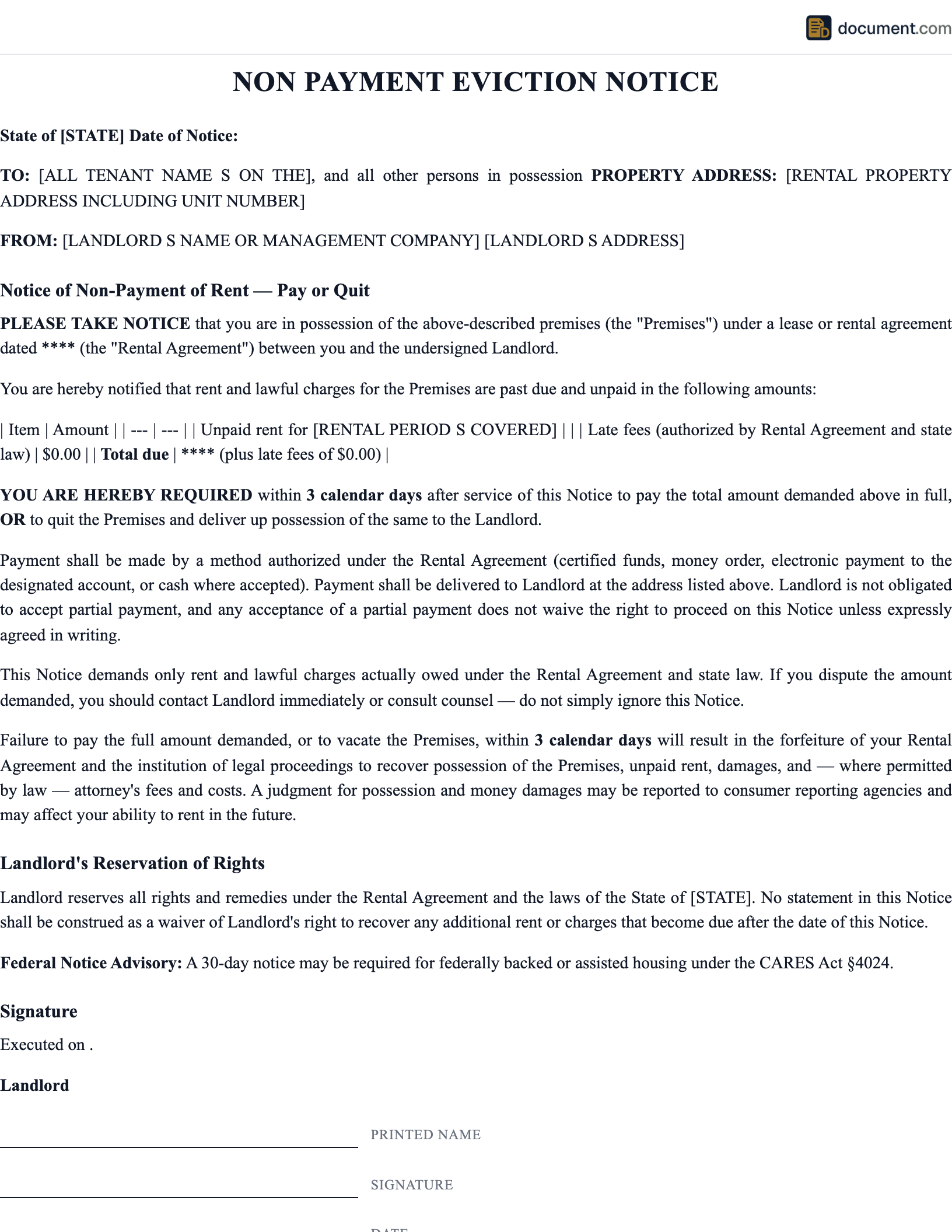
Sample West Virginia Notice (No Fixed Requirement) Non-Payment Notice
Below is a preview of our West Virginia-specific non-payment notice. The final document includes all statutory language required under W. Va. Code §55-3A-1 and is formatted for West Virginia court proceedings.
DEMAND FOR RENT AND NOTICE OF EVICTION
STATE OF WEST VIRGINIA
Pursuant to W. Va. Code §55-3A-1
TO TENANT(S):
Name(s): [All Tenants on Lease]
Property: [Full West Virginia Property Address]
RENT DUE:
Total rent owed: $[Amount]for the period of [Month/Year].
WEST VIRGINIA STATUTORY NOTICE:
DEMAND IS MADE for payment of rent of $[Amount]. If unpaid, a wrongful occupation complaint will be filed in West Virginia Magistrate Court.