



Alaska Non-Payment of Rent Notice Overview
Alaska's eviction process for non-payment of rent is governed by the Alaska Uniform Residential Landlord and Tenant Act, codified at AS 34.03.010 through 34.03.360. Under AS 34.03.220(b), when a tenant fails to pay rent, the landlord must serve a written notice giving the tenant 7 days to pay the full amount due or vacate the premises. This notice is the prerequisite to filing a Forcible Entry and Detainer (FED) action in Alaska District Court.
Alaska's unique geography and remote communities add practical considerations to the eviction process. In rural areas and bush communities, service of notice may take longer due to limited mail service and transportation challenges. However, the legal requirements remain the same statewide. Alaska courts have consistently held that strict compliance with the notice requirements is necessary for a valid eviction.
7 Days
Notice period
$75
Filing fee (FED)
Yes
Right to cure
3-5 wks
Court process
Alaska's 7-Day Notice Requirement
Under AS 34.03.220(b), a landlord may deliver written notice to a tenant who has failed to pay rent, demanding that the tenant pay the outstanding rent within 7 days or vacate. If the tenant pays the full amount within the 7-day period, the rental agreement remains in effect. If not, the rental agreement terminates at the end of the notice period and the landlord may file an FED action.
The notice must specify the exact amount of rent due and the date by which payment must be received. Alaska courts require strict compliance with the 7-day period. The landlord cannot file the FED action before the 7 days have fully expired, even if the tenant has verbally stated they will not pay.
Alaska-Specific: Repeat Non-Payment
Under AS 34.03.220(e), if the tenant is late on rent more than once within a 6-month period, the landlord may serve a non-waivable 5-day notice to quit on the second occurrence. This accelerated process does not give the tenant a right to cure by paying. This provision recognizes that habitual non-payment imposes significant burdens on landlords, particularly in Alaska where property costs and maintenance expenses are above the national average.
Alaska Legal Requirements (AS 34.03.220)
For the notice to be valid under Alaska law, it must meet specific requirements established by the URLTA and interpreted by Alaska courts. A defective notice will result in dismissal of the FED action, requiring the landlord to start the process over.
Required Notice Elements
- Written Format: The notice must be in writing. Verbal demands are not sufficient under AS 34.03.220
- Exact Amount Due: Specify the precise dollar amount of rent owed, broken down by period if multiple months are due
- 7-Day Cure Period: State clearly that the tenant has 7 days to pay the full amount or vacate
- Property Identification: Include the full address and unit number of the rental premises
- Tenant Names: List all tenants on the lease. Each tenant should be served individually
- Termination Consequence: State that the rental agreement will terminate if rent is not paid within 7 days
- Landlord Contact: Include the landlord or property manager's name and contact information
Alaska Grace Period & Late Fee Rules
Alaska does not mandate a statutory grace period for residential rent payments. Rent is due on the date specified in the lease. If the lease does not specify a due date, rent is typically due at the beginning of each rental period. Landlords may voluntarily include a grace period in the lease, but this is not legally required.
Late fees must be stated in the lease agreement and must be reasonable. Alaska courts apply the general contract principle that late fees cannot be punitive. Given Alaska's high cost of living and property expenses, courts have generally upheld late fees in the range of $25-$75 or 5-8% of monthly rent as reasonable for most residential rentals.
Alaska Late Fee Quick Reference
Statutory Grace Period
None required. Lease-dependent only.
Late Fee Cap
No specific cap. Must be reasonable.
Partial Payment
Does not cure notice. May waive eviction rights.
Repeat Non-Payment
5-day non-curable notice on 2nd offense in 6 months.
How to Serve a Non-Payment Notice in Alaska
Under AS 34.03.150, notices must be served using one of the methods approved by statute. Proper service is essential because Alaska courts will dismiss an FED action if the landlord cannot prove the notice was properly delivered.
Personal Delivery
Hand-deliver the notice directly to the tenant. This is the most reliable and preferred method in Alaska courts. Use a witness or process server to document delivery.
Substitute Service
If the tenant cannot be found at the premises, leave the notice with a person of suitable age and discretion at the tenant's dwelling. Document the name of the person who received it.
Post and Mail
Affix the notice to the main entrance of the dwelling in a conspicuous manner and mail a copy by first-class mail. Both steps are required for valid service under this method.
Certified Mail
Send via certified mail, return receipt requested. The 7-day notice period begins when the tenant signs for the mail. In remote Alaska communities where certified mail may be delayed, plan for additional time.
File FED After Expiration
After the full 7 days have passed without payment, file a Forcible Entry and Detainer complaint with the Alaska District Court. Include the original notice and proof of service with your filing.
Alaska Non-Payment Eviction Timeline
The Alaska eviction process for non-payment is relatively structured under the FED statutes (AS 09.45.060-160). Here is the typical timeline from notice to possession.
| Step | Timeframe |
|---|---|
| Serve 7-Day Notice | Day 1 |
| Notice period expires | Day 8 |
| File FED complaint in District Court | Day 8-10 |
| Summons served on tenant (2-day minimum) | Day 10-15 |
| Court hearing | Day 18-28 (10-15 days after filing) |
| Judgment and writ of assistance | Same day or within 5 days of hearing |
| Physical removal by law enforcement | Day 25-40 (varies by judicial district) |
Total estimated time: 3-6 weeks for uncontested cases. Remote judicial districts may experience longer timelines due to court scheduling and law enforcement availability.
Alaska Eviction Filing Fees & Costs
Alaska court fees for FED actions are set by the Alaska Court System. Below are typical costs.
| Fee / Cost | Amount |
|---|---|
| FED Filing Fee (District Court) | $75 |
| Service of Process | $40 - $100 |
| Writ of Assistance | $25 - $50 |
| Attorney Fees (if hired) | $750 - $3,000 |
| Appeal (if needed) | $250 |
Sample Alaska 7-Day Non-Payment Notice
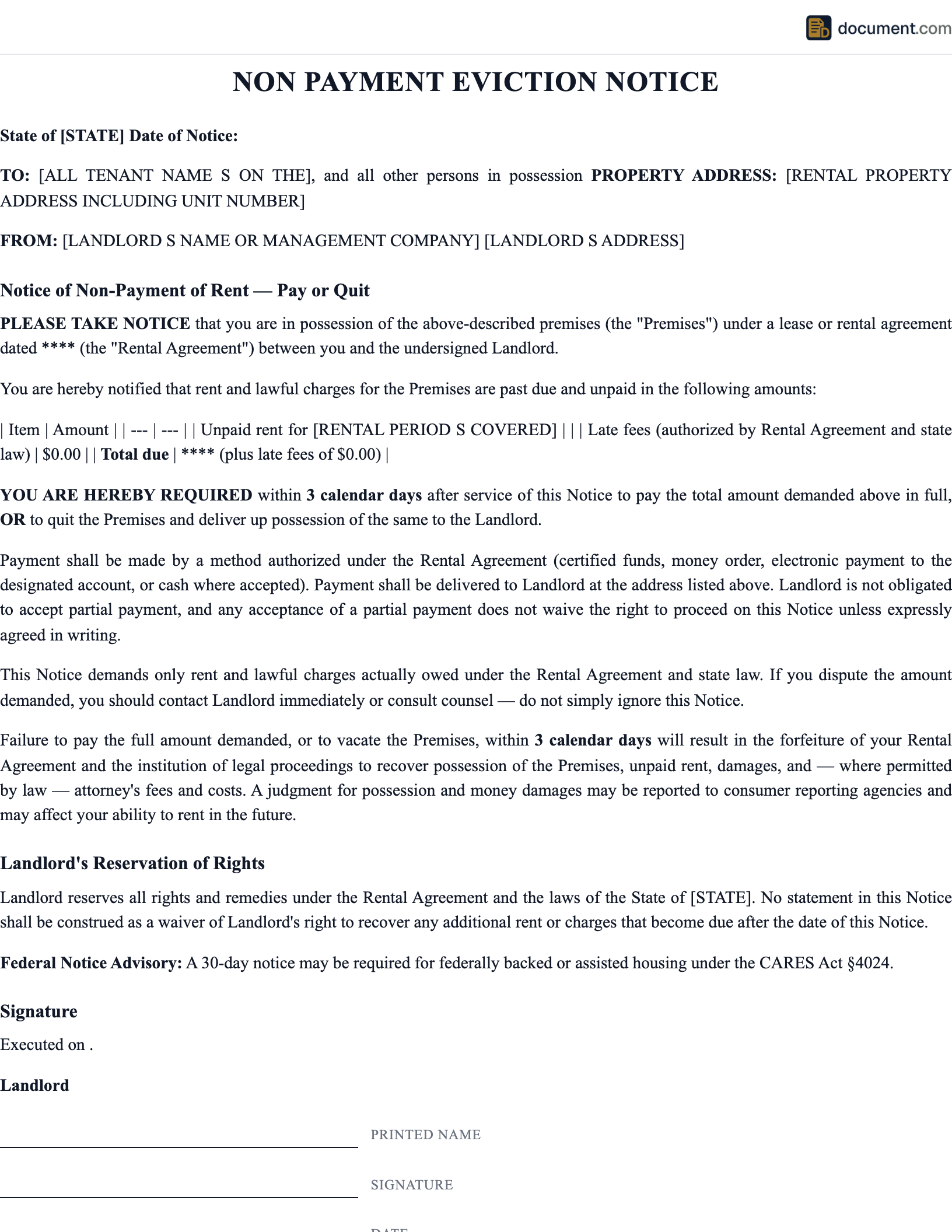
Below is a preview of our Alaska-specific notice. The final document includes all language required under AS 34.03.220 and is formatted for Alaska District Court FED proceedings.
SEVEN (7) DAY NOTICE TO PAY RENT OR QUIT
STATE OF ALASKA
Pursuant to AS 34.03.220(b)
TO TENANT(S):
Name(s): [All Tenants on Lease]
Property: [Full Alaska Property Address]
DEMAND FOR RENT PAYMENT:
You are in default of your rental agreement for failure to pay rent in the amount of $[Amount] due for the period of [Month/Year].
STATUTORY NOTICE (AS 34.03.220(b)):
You have SEVEN (7) DAYS from the date of delivery of this notice to pay the full amount of rent due or vacate the premises. If you fail to pay or vacate within 7 days, your rental agreement will be terminated and the landlord will file a Forcible Entry and Detainer action in Alaska District Court to recover possession, unpaid rent, court costs, and attorney fees.