
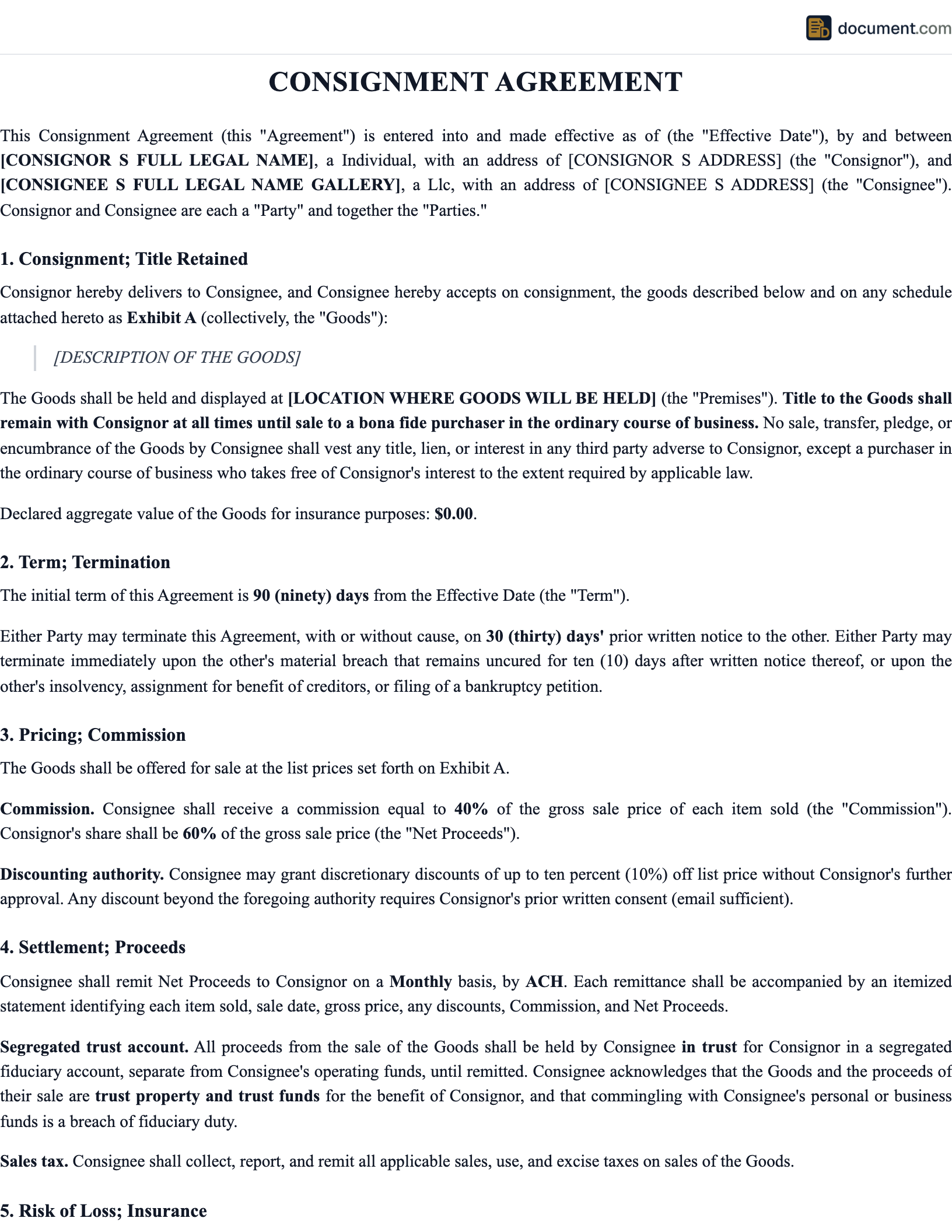



What Is a Consignment Agreement?
A consignment agreement is a contract under which one party (the consignor) entrusts goods to another party (the consignee) for sale to third-party customers, while retaining ownership of the goods until they are actually sold. The consignee acts as a sales agent — displaying, marketing, and selling the goods on behalf of the consignor in exchange for an agreed commission. Unlike a wholesale purchase, no money changes hands at the moment the goods are delivered to the consignee, and the consignor bears the risk that the goods will not sell.
Consignment is the dominant business model for several industries: thrift and resale boutiques, fine art galleries, antique malls, vintage clothing shops, used car lots, auction houses, and a growing share of online resale platforms like The RealReal, StockX, Vestiaire Collective, and Poshmark. The arrangement lets the consignee offer a wide selection of inventory without tying up cash in purchases, and lets the consignor reach customers without operating its own retail infrastructure. Both sides win when the deal is structured well — and both can lose when it is not.
The legal foundation of consignment is bailment plus agency. The consignor delivers possession (but not title) to the consignee, who holds the goods as a bailee with a duty of reasonable care. When a customer comes in to buy, the consignee acts as the consignor's sales agent, transferring title from consignor to customer in exchange for the purchase price, then accounting to the consignor for the net proceeds after commission. Because title remains with the consignor throughout, unsold goods can be reclaimed and the consignor's interest is generally superior to other parties' claims — with one major exception under UCC Article 9.
UCC Article 9 treats most commercial consignments as a security interest, meaning the consignee's general creditors can reach the consigned goods unless the consignor perfects a purchase money security interest by filing a UCC-1 financing statement and giving notice to prior secured parties. Many small consignors are unaware of this rule and discover it only when the consignee files for bankruptcy and the consigned inventory becomes part of the consignee's bankruptcy estate. A thoughtful consignment agreement addresses UCC perfection explicitly, especially for higher-value inventory.
Whether you are an artist placing work in a gallery, a homeowner consigning furniture to a resale shop, a manufacturer testing distribution through a boutique, or a dealer accepting goods to resell, our attorney-reviewed consignment agreement templates give you a structure that addresses pricing, commission, markdowns, term, return of unsold goods, insurance, sales tax, payment timing, UCC protection, and the special art consignment rules that apply in most states.
Title Retained
Consignor keeps ownership until the goods are sold to a customer
Commission Based
Consignee earns a defined percentage of each completed sale
UCC-1 Protection
Optional financing statement protects consigned goods from consignee creditors
Consignment Form Preview
Walkthrough of the standard sections in our consignment agreement template.
Consignment Agreement
Retail / Resale
Section 1: Parties
Section 2: Consigned Goods
| Item | SKU | List Price | Min Price |
|---|---|---|---|
| Vintage Hermes Scarf | EW-001 | $320 | $240 |
| Chanel Tweed Jacket | EW-002 | $1,450 | $1,100 |
| YSL Leather Boots | EW-003 | $485 | $365 |
Section 3: Commission & Term
Section 4: Markdown Schedule
- Days 1-30: List price
- Days 31-60: 25% off
- Days 61-90: 40% off
- Day 91+: Return to consignor or markdown to clearance
Types of Consignment Agreements
Each consignment industry has its own customs around commission rates, term length, markdown schedules, and reporting. Pick the closest fit.
Consignment vs Other Sales Models
Consignment is one of several ways to move inventory through an intermediary. Knowing the differences helps you choose the right structure.
Consignment vs Outright Sale
Consignment
- - Title stays with consignor
- - Consignor bears unsold-inventory risk
- - Consignee earns commission
- - Goods can be reclaimed
Outright Sale
- - Title transfers at delivery
- - Buyer bears all risk
- - Buyer earns markup
- - No reclaim rights
Consignment vs Sale on Approval
Consignment
- - Goods held for resale to third parties
- - Consignee is a merchant intermediary
- - Long-term arrangement
Sale on Approval
- - End user evaluates before buying
- - Trial-and-return arrangement
- - Short-term, single transaction
Consignment vs Distribution Agreement
Consignment
- - Pay-on-sale model
- - Commission economics
- - Title-retention structure
- - Lower volume, higher margin items
Distribution Agreement
- - Wholesale purchase by distributor
- - Markup economics
- - Title transfers on shipment
- - High-volume, broader reach
How to Create a Consignment Agreement: 8 Steps
Drafting a consignment agreement is mostly about anticipating disputes — pricing, returns, payment, loss — and writing down the answer in advance. Work through these eight steps.
Inventory the Goods Item by Item
Create a detailed list of every item being consigned: description, photos, SKU, condition, agreed retail price, agreed minimum acceptable price, and any provenance or authentication documentation. This list becomes Schedule A to the agreement and is the single most important record for resolving disputes.
Set the Commission Structure
Decide on a flat commission percentage, tiered commissions based on sale price, or an item-specific commission for high-value pieces. Specify whether the commission is calculated on gross sale price or net of credit card processing fees and sales tax — this is one of the most common areas of dispute. Document any agreed expenses (cleaning, repair, framing) that will be deducted from proceeds.
Define the Consignment Term and Markdowns
Set a specific term — 60, 90, or 120 days are typical for retail; longer for art and antiques. Build in a markdown schedule with pre-authorized price reductions at defined intervals, so the consignee can move slow-moving inventory without seeking approval each time. Specify what happens at the end of the term: pickup, automatic renewal, donation, or final markdown.
Allocate Risk of Loss and Insurance
Decide whether the consignee or the consignor bears the risk of theft, fire, water damage, and mishandling. Best practice is to require the consignee to insure the consigned goods at full replacement value and to name the consignor as additional insured. For high-value items, require a fine art floater or specific scheduled coverage and proof of insurance before delivery.
Address UCC Article 9 Protection
If the aggregate value exceeds $1,000 and the consignee deals in goods of that kind under its own name, file a UCC-1 financing statement to perfect a purchase money security interest. Notify any prior secured parties of the consignment. Without UCC perfection, the goods can be reached by the consignee's general creditors in bankruptcy or judgment enforcement.
Set Payment Terms and Reporting
Specify how often the consignee will report sales (weekly, bi-weekly, monthly) and pay the consignor (typically within 5 to 15 days of the reporting period). Require itemized statements showing each item sold, the sale price, the commission deducted, and the net amount due. Set interest on late payments and reserve the right to terminate for non-payment.
Include Sales Tax and Tax Reporting
Specify which party will collect and remit sales tax to the state — usually the consignee, since it makes the retail sale. For business consignors, address Form 1099 or other tax reporting if required. For artists, include the special art consignment statute language required in your state.
Add Termination, Pickup, and Default Provisions
Allow either party to terminate for material breach with notice and an opportunity to cure. Require the consignee to return all unsold goods within a defined window after termination. Specify the consequences of consignee default (immediate termination, expedited return, recovery of unpaid proceeds). Include reasonable attorney's fees for the prevailing party in any enforcement action.
Key Components
Essential elements of any complete consignment agreement.
| Component | Description |
|---|---|
| Parties | Legal names of consignor and consignee with addresses |
| Inventory Schedule | Detailed list of every consigned item with description and value |
| Title Retention | Express statement that title remains with consignor until sale |
| Pricing | Agreed list price and minimum acceptable price for each item |
| Commission | Percentage and basis (gross or net) of commission |
| Markdown Schedule | Pre-authorized price reductions over the consignment term |
| Term | Duration of the consignment with renewal or termination provisions |
| Risk of Loss | Allocation of risk for theft, damage, and destruction |
| Insurance | Insurance requirements and additional insured language |
| UCC-1 Filing | Financing statement and prior-creditor notice provisions |
| Display and Care | Standards for how goods will be stored, displayed, and handled |
| Reporting and Payment | Frequency of sales reports and payment timing |
| Sales Tax | Allocation of sales tax collection and remittance |
| Returns from Customers | Procedure for handling customer returns and refunds |
| Termination | Grounds for termination and post-termination obligations |
| Return of Unsold Goods | Procedure and deadline for retrieving unsold inventory |
| Governing Law | Choice of law and venue for disputes |
Legal Requirements and Compliance
Consignment is a deceptively complex area of commercial law. The interaction of UCC Article 9, state art consignment statutes, sales tax, and bailment law creates traps for the unwary on both sides of the deal.
UCC Article 9 Perfection
Under UCC § 9-103(d), a consignor's interest in consigned goods is treated as a purchase money security interest. To protect against the consignee's general creditors, the consignor must (1) file a UCC-1 financing statement in the appropriate state filing office, and (2) provide written notice to any prior secured parties holding a security interest in the consignee's inventory. Failure to perfect can result in the consigned goods being treated as part of the consignee's estate in bankruptcy.
State Art Consignment Statutes
Approximately 30 states have enacted art consignment statutes that give artists special protection when delivering work to a gallery or dealer. These statutes typically establish that the artwork is trust property in the dealer's hands, the proceeds are trust funds, the artwork is not subject to the dealer's creditors, and the dealer must hold proceeds separately. California's Civil Code §§ 1738-1738.9 is one of the most protective. Massachusetts, New York, Illinois, Oregon, and many others have similar statutes that cannot be waived by contract.
Bailment Duty of Care
As a bailee for the mutual benefit of the parties, the consignee owes a duty of ordinary care for the consigned goods. Negligent loss or damage gives the consignor a cause of action for the value of the goods. The agreement should clarify the standard of care, allocate risk for loss outside the consignee's control (force majeure), and require insurance to back up the contractual allocation.
Sales Tax Liability
Sales tax responsibility varies by state. Most states treat the consignee as the seller for sales tax purposes (since the consignee makes the retail sale), but some states reach through to treat the consignor as the seller in certain circumstances. The Wayfair decision and subsequent state economic nexus rules complicate the analysis for online consignment platforms. Verify your state's rules and document the allocation in the agreement.
Documentation Best Practices
- Photo every item: Take date-stamped photos of every item at delivery to document condition and prevent disputes.
- Get a signed inventory: Both parties should sign the inventory schedule at delivery to acknowledge receipt and condition.
- Insist on regular statements: Monthly itemized statements prevent surprises and create an audit trail.
- Reserve reasonable audit rights: Once or twice per year, with reasonable notice, to verify reported sales.
Sample Consignment Agreement
Condensed preview of our consignment template.
CONSIGNMENT AGREEMENT
Retail Resale
This Consignment Agreement is entered into between[Consignor]("Consignor") and[Consignee]("Consignee").
1. CONSIGNMENT
Consignor delivers to Consignee the items listed in Schedule A (the "Goods") for sale on consignment. Title to the Goods shall remain with Consignor until sold to a third-party customer in the ordinary course of business.
2. COMMISSION
Consignee shall be entitled to a commission of [%]of the gross sale price of each item sold (before sales tax). The remaining[%] shall be remitted to Consignor.
3. TERM & MARKDOWNS
The consignment period is [X]days from delivery. Consignee is pre-authorized to mark down items per the schedule in Exhibit B (typically 25% off after 30 days, 40% off after 60 days).
4. PAYMENT
Consignee shall provide Consignor with an itemized monthly statement and shall pay all amounts due within ten (10) days of month-end.
5. RISK OF LOSS & INSURANCE
Consignee shall bear the risk of loss for the Goods while in its possession and shall maintain insurance covering the Goods at full replacement value, naming Consignor as additional insured.
6. RETURN OF UNSOLD GOODS
Upon expiration or termination, Consignor shall retrieve all unsold Goods within fifteen (15) days. Goods not retrieved within that period shall be deemed abandoned.
7. UCC FILING
Consignor may file a UCC-1 financing statement to perfect its purchase money security interest in the Goods. Consignee agrees to cooperate in all such filings.
Frequently Asked Questions
Common questions about consignment, title, commission, and creditor protection.
Official Resources
Authoritative sources on consignment law, UCC filing, and art consignment statutes.
ULC - UCC Article 9
Uniform Law Commission text and adoption status of UCC Article 9 (secured transactions)
Cornell LII - UCC Article 9
Free official text of UCC Article 9 with annotations and case law
California Art Consignment Act
California Civil Code §§ 1738-1738.9 - one of the strongest state art consignment statutes
FTC Business Guidance
Federal Trade Commission resources on consumer protection in retail and resale
IRS Small Business
Federal tax guidance on income reporting for consignment sales
SBA Business Resources
Small Business Administration guide to consignment and resale business models
Association of Art Museum Directors
Best practices for art consignment, loans, and provenance
NARTS - Resale Professionals
National Association of Resale Professionals for thrift, consignment, and resale shops
Create your Consignment Agreement in under 10 minutes.
Answer a few questions and download a compliant, attorney-drafted document ready for your state.