



What Is a Certificate of Incumbency?
A certificate of incumbency is a corporate document that identifies the current officers and directors of a corporation and confirms that the named individuals are duly elected or appointed to the offices listed. The certificate is signed by the corporate secretary (or another authorized officer) on behalf of the corporation and is used by third parties who need a reliable answer to a deceptively simple question: who has authority to sign on behalf of this company? Banks need it to open accounts. Counterparties need it to close contracts. Foreign governments need it to register a branch. Lenders need it to fund a loan. In every case, the certificate provides the same baseline assurance — that the person putting pen to paper actually holds the office they claim.
The need for incumbency certification arises from a basic gap in public corporate records. The articles of incorporation that a corporation files with the state when it is formed are public, but they do not list the current officers — they only name the initial incorporator and registered agent. Bylaws, which establish the offices and the procedure for electing officers, are internal documents that are not filed publicly. And board resolutions electing specific people to specific offices live inside the corporate minute book, which is also not public. The certificate of incumbency bridges that gap: it is a formal, signed statement from the corporation itself certifying who currently holds office, based on the secretary's direct knowledge of the corporate records.
The corporate secretary is the natural signer because the secretary is the officer formally responsible for the corporation's books and records. In larger corporations the secretary is a senior executive or in-house lawyer; in smaller closely held corporations the secretary is often a director, a co-founder, or an outside attorney. Whoever holds the role, the secretary's signature on the certificate is what gives it weight: by signing, the secretary is representing — on behalf of the corporation and based on the corporate records — that the listed individuals are who they claim to be. Many transactions also require the certificate to be co-signed by the chair, president, or CEO as a cross-check, and many require notarization for additional identity verification.
Certificates of incumbency are most often delivered alongside other corporate documents at the closing of a transaction. A typical bank account opening package includes the certificate of incumbency, a board resolution authorizing the account, a copy of the articles of incorporation, a copy of the bylaws, and a FinCEN beneficial ownership certification. A typical financing closing package includes the certificate, the corporate resolutions authorizing the financing, a good standing certificate from the state, and a secretary's certificate bundling several certifications together. In international transactions, the certificate often needs to be notarized and then apostilled or legalized for use in the destination country.
Whether you are opening a new business bank account, closing a financing, registering to do business abroad, or just responding to a counterparty's due-diligence request, our attorney-reviewed certificate of incumbency templates give you a clean, professional document with the right structure for the intended use. Each template includes the secretary's certification language, specimen signature lines where needed, the corporate seal placeholder, and the notary acknowledgment block — ready to be customized, signed, and delivered.
Authority Verification
Confirms to banks and counterparties that named officers have authority to sign
Banking-Ready
Includes specimen signature lines and the language banks expect
International Use
Apostille-ready format for cross-border transactions and foreign registration
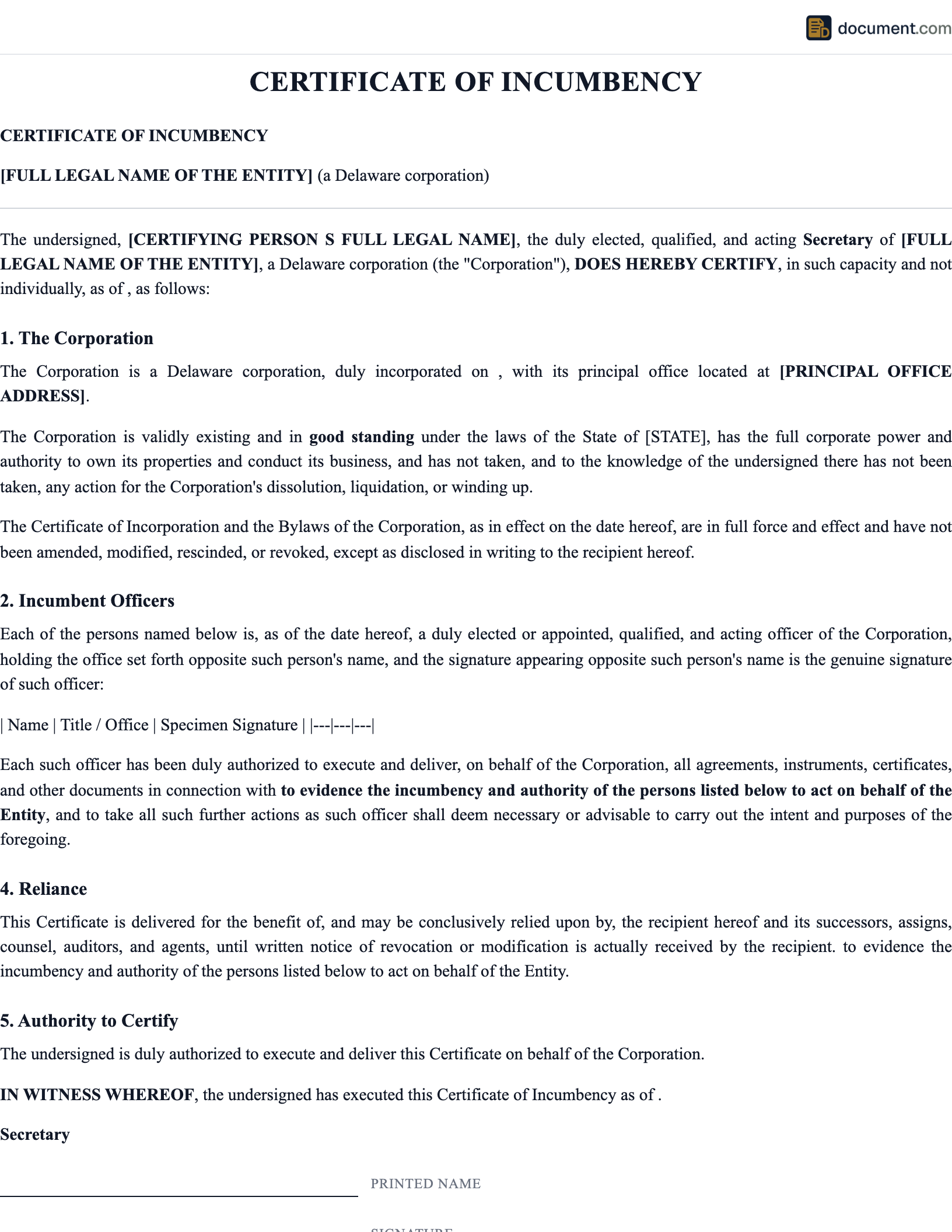
Certificate of Incumbency Form Preview
Below is a preview of the structure of our certificate of incumbency template. Your completed certificate will be a fully formatted, professionally drafted document with the right elements for your specific use case.
Certificate of Incumbency
Banking & Authority Verification
Section 1: Corporation Information
Section 2: Current Officers
Section 3: Current Directors
Section 4: Certification Statement
Section 5: Signature, Seal & Notary
Secretary Signature
Notary Public
Types of Incumbency Certificates
Different uses call for slightly different formats. Choose the type that matches the intended counterparty and the level of formality required.
When You Need a Certificate of Incumbency
Certificates of incumbency are requested in a wide variety of business situations. Anytime a third party needs to verify who has authority to act on behalf of the corporation, an incumbency certificate is the standard answer.
Opening a Bank Account
Banks require an incumbency certificate (and usually a board resolution) to open a new corporate or LLC account and establish authorized signatories.
Closing a Financing
Lenders and equity investors require an incumbency certificate at closing to confirm that the officers signing the loan or financing documents actually hold their offices.
M&A Transactions
In acquisitions, both buyer and seller deliver incumbency certificates at closing as part of the standard closing deliverables package.
International Registration
Foreign governments and counterparties typically require an apostilled or legalized incumbency certificate when registering a branch office or signing a major contract abroad.
Major Contracts
Sophisticated counterparties — particularly in real estate, construction, and government contracting — request an incumbency certificate as part of contract execution.
Licenses and Permits
Some regulatory licenses and government permits require an incumbency certificate as part of the application package.
Third-Party Audits
Auditors and due-diligence reviewers may request an incumbency certificate to verify management identity and authority.
Power of Attorney Authentication
When a corporation grants a power of attorney to an outside party, the recipient often requires an incumbency certificate confirming that the granting officer is authorized.
Incumbency vs Other Corporate Certificates
Several corporate documents look similar but serve different purposes. Here is how the certificate of incumbency fits into the broader family of corporate certificates.
| Document | What It Certifies | Signed By |
|---|---|---|
| Certificate of Incumbency | Current officers and directors | Corporate secretary |
| Secretary's Certificate | Incumbency plus other corporate facts | Corporate secretary |
| Officer's Certificate | Specific transaction-related facts | Senior officer (often CEO/CFO) |
| Corporate Resolution | A specific board action | Secretary attests |
| Good Standing Certificate | State filings are current | Secretary of State |
| Certificate of Existence | Corporation legally exists | Secretary of State |
How to Create a Certificate of Incumbency
Creating a certificate of incumbency is a quick process for any corporation that has reasonably current records. Follow these eight steps to produce a clean, defensible document.
Verify Corporate Status
Confirm that the corporation is in good standing with the state of incorporation. If not, address the underlying issue (often a missed annual report) before issuing the certificate.
Pull the Current Officer List
Identify each current officer of the corporation by reference to the most recent board resolutions, written consents, or election minutes in the corporate minute book.
Pull the Current Director List
If the certificate format requires directors, list each current director, noting any chairs or vice-chairs and the date of the most recent election.
Capture Specimen Signatures (If Banking)
For banking and certain closing uses, collect a specimen signature from each authorized officer. The bank will compare future signed instruments against these specimens.
Add the Certification Statement
Include the secretary's sworn certification that the listed individuals hold the offices listed and are authorized to act on behalf of the corporation as of the date of the certificate.
Apply the Corporate Seal
If the corporation maintains a corporate seal, apply it to the certificate. The seal is not legally required in most states but is expected by many third parties as a formality.
Notarize If Needed
Have the secretary's signature notarized if required by the intended use — almost always for international, banking, and closing purposes.
Apostille for International Use
For use in countries party to the Hague Apostille Convention, obtain an apostille from the Secretary of State of the issuing state. For other countries, follow the legalization chain.
Key Components
Every well-drafted certificate of incumbency includes the following elements. Missing any of them can cause the certificate to be rejected by a careful counterparty.
Corporation Identification
Full legal name, state of incorporation, date of incorporation, and entity type.
Officer List
Each current officer with full name and exact title as elected.
Director List
Each current director (in formats that include directors), with chair identification.
Specimen Signatures
Genuine signature samples for each officer, used for banking and closing verification.
Certification Statement
The secretary's sworn statement attesting to the truth of the listed information.
Corporate Seal
Impression or facsimile of the corporate seal where the corporation maintains one.
Secretary's Signature
The corporate secretary's signature, with date and printed name.
Notary Acknowledgment
Notary block confirming the secretary's identity, where required by the intended use.
International Use and Apostille
When a certificate of incumbency will be used outside the United States, it usually needs to be authenticated for use in the destination country. The process depends on whether the destination country is a party to the Hague Apostille Convention of 1961. For Apostille countries, authentication is a single step: the certificate (signed by the secretary and notarized) receives an apostille from the competent authority in the issuing state — usually the Secretary of State's office. The apostille is a standardized certification that the destination country is required to accept without further authentication.
For countries that are not parties to the Apostille Convention, the certificate must go through the older legalization chain: notarization by a U.S. notary, county clerk authentication (in some states), state-level authentication, U.S. Department of State authentication, and finally legalization at the destination country's embassy or consulate. The full chain can take several weeks and should be planned for in advance of any international closing or registration deadline.
Validity Period
Certificates of incumbency do not expire by their own terms — they remain technically accurate for as long as the information in them remains true. In practice, however, most third parties impose their own freshness requirements. Banks commonly require a certificate dated within the last 30 to 90 days at the time of account opening. Closing checklists for financings and acquisitions typically require a certificate dated as of the closing date or no more than a few days before. Foreign counterparties often require the certificate to be dated within 14 to 30 days.
Active corporations often maintain a current draft of the incumbency certificate that the secretary can quickly date and sign whenever a fresh copy is needed. Whenever officers change, the corporation should issue a new certificate and notify any third parties whose records depend on the prior version.
Sample Certificate of Incumbency
Below is a condensed example of a certificate of incumbency for a fictional corporation. Use it as a reference for the language, structure, and signature blocks expected by banks and counterparties.
CERTIFICATE OF INCUMBENCY
Pinecone Industries, Inc.
A Delaware Corporation
The undersigned, Mei Lin Chen, hereby certifies that she is the duly elected and acting Secretary of Pinecone Industries, Inc., a corporation organized and existing under the laws of the State of Delaware (the "Corporation"), and that she is authorized to execute this Certificate of Incumbency on behalf of the Corporation.
The undersigned further certifies that the persons named below are duly elected, qualified, and acting officers and directors of the Corporation, holding the offices set forth opposite their respective names as of the date of this Certificate, and that the signatures appearing opposite their names are their genuine signatures:
OFFICERS:
DIRECTORS:
The undersigned further certifies that each of the above-named officers is authorized to act on behalf of the Corporation in the ordinary course of business and to execute documents, instruments, and agreements binding the Corporation in accordance with the Corporation's bylaws and the resolutions of the Board of Directors.
IN WITNESS WHEREOF, the undersigned has executed this Certificate of Incumbency as of the date first written below.
Dated: [Date]
Mei Lin Chen, Secretary
Pinecone Industries, Inc.
[Notary Acknowledgment Block]
State of __________, County of __________. On this _____ day of __________, 20___, before me personally appeared Mei Lin Chen, known to me (or satisfactorily proven) to be the person whose name is subscribed to the within instrument, and acknowledged that she executed the same in her capacity as Secretary of the Corporation...
Frequently Asked Questions
Answers to common questions about certificates of incumbency, banking use, international authentication, and how they differ from other corporate certificates.
Official Resources
For authoritative information on apostille certification, corporate authentication, and beneficial ownership requirements, consult these resources.
Hague Apostille Convention
Official information on the 1961 Convention and apostille countries
U.S. State Department - Authentications
Federal-level authentication and apostille information
Delaware Division of Corporations
Most-used U.S. corporate jurisdiction — corporate filings and good standing
FinCEN - Beneficial Ownership
Corporate Transparency Act beneficial ownership reporting requirements
ABA Business Law Section
American Bar Association resources on corporate practice and recordkeeping
NASS - National Association of Secretaries of State
Directory of state apostille and authentication offices
National Notary Association
Professional notary association — notarization standards and best practices
FDIC - Banker Resources
Federal Deposit Insurance Corporation guidance on corporate account documentation
Create your Certificate of Incumbency in under 10 minutes.
Answer a few questions and download a compliant, attorney-drafted document ready for your state.