



What Is a Toll Manufacturing Agreement?
A toll manufacturing agreement (sometimes called a toll processing agreement or simply a "tolling agreement" in the manufacturing context) is a contract under which one party — the tolling customer or principal — provides raw materials to another party — the toll manufacturer or toller — who processes those materials into finished product in exchange for a service fee. The defining feature is that the customer retains ownership of the materials throughout the process. The toller never buys the raw materials and never sells the finished product; it provides only the manufacturing service.
Toll manufacturing originated in the chemical industry and remains most common there, but the model has spread to pharmaceuticals, food and beverage co-packing, cosmetics, metal processing, textiles, and even cannabis processing in legalized states. The arrangement benefits buyers who own proprietary formulations and want manufacturing capacity without building their own plants, and it benefits manufacturers by allowing them to monetize underutilized capacity without taking on raw material price risk.
Tolling has several important advantages over conventional contract manufacturing. The buyer keeps title to its inventory, simplifying accounting and protecting against manufacturer insolvency (since materials at the toller's facility belong to the buyer and generally do not become part of the toller's bankruptcy estate). The buyer also retains control over raw material sourcing, which is critical when dealing with proprietary intermediates, custom synthesis, or strict supply chain quality requirements. And the buyer's gross margin is more predictable because it does not vary with the manufacturer's raw material costs.
At the same time, toll arrangements introduce unique complexities. Both parties must carefully manage the bailee/bailor relationship, including segregation of materials, insurance coverage, customs treatment for cross-border movements, and accounting for yield losses. The toll fee structure must compensate the toller fairly for capacity, labor, and overhead without exposing the buyer to overruns. And because the toller is producing someone else's product, the FDA, EPA, OSHA, and other regulators look to both parties to ensure compliance, requiring careful allocation of regulatory responsibilities.
Whether you are a chemical company seeking custom synthesis capacity, a pharmaceutical company engaging a CMO to fill and finish your drug, a food brand using a co-packer for seasonal volume, or a cosmetics company outsourcing filling operations, our attorney-reviewed toll manufacturing agreement templates provide the legal framework you need. Each template addresses the unique features of toll arrangements — material ownership, yield, conversion fees, segregation, cGMP allocation, and IP protection — while remaining customizable for your specific industry.
Buyer Owns Materials
Title to raw materials and finished goods stays with the buyer throughout
Conversion Fee Model
Toller is paid a service fee, not a per-unit purchase price
Common in Regulated Industries
Standard in chemicals, pharma, food, and cosmetics
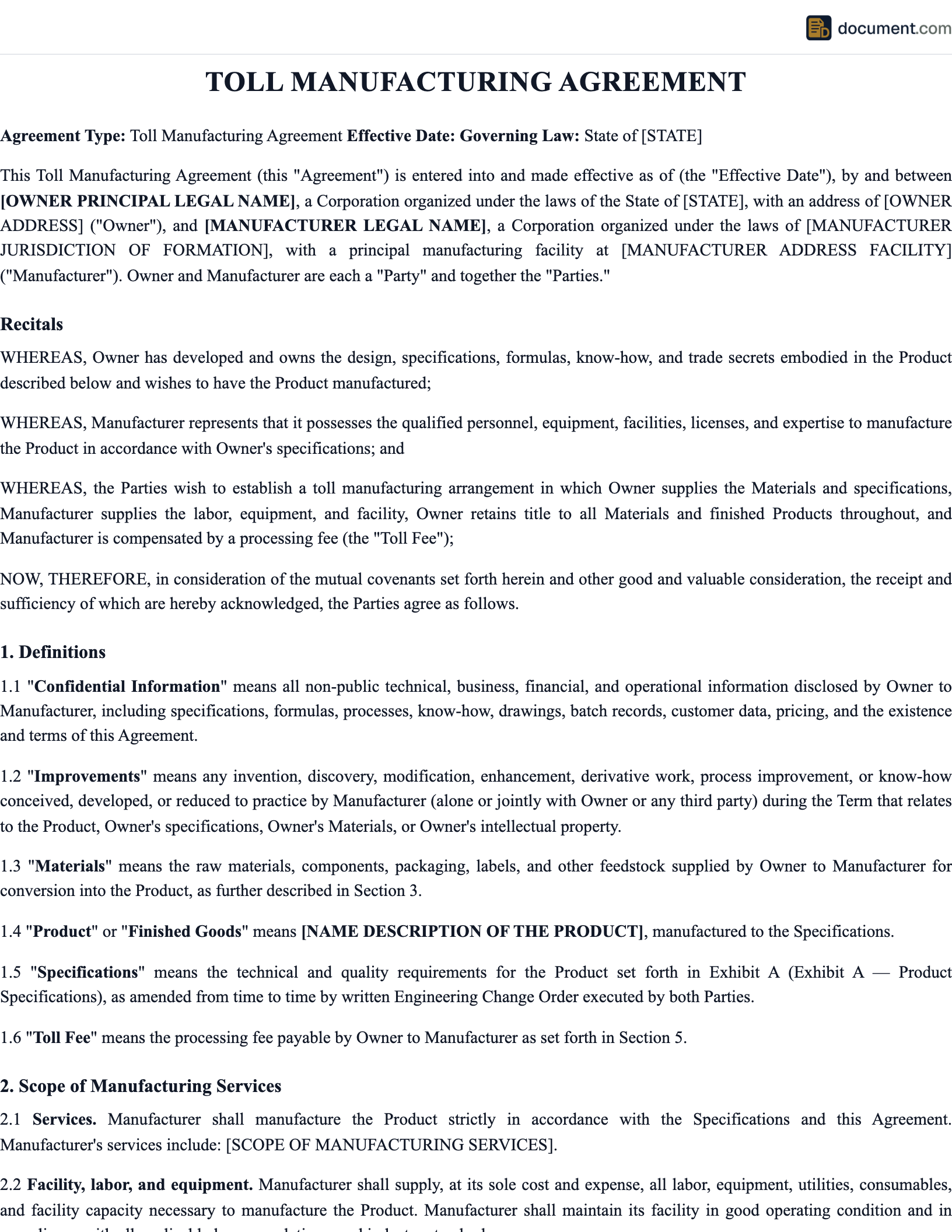
Toll Manufacturing Form Preview
A visual preview of our toll manufacturing agreement template structure.
Toll Manufacturing Agreement
Conversion Services Contract
Section 1: Parties
Section 2: Raw Materials & Title
Section 3: Conversion Services
Section 4: Tolling Fees
Section 5: Insurance & Bailment
Toll Manufacturing vs Contract Manufacturing
| Feature | Toll Manufacturing | Contract Manufacturing |
|---|---|---|
| Material ownership | Buyer owns throughout | Manufacturer purchases |
| Pricing model | Conversion fee | Per-unit price |
| Material price risk | Buyer bears | Manufacturer bears |
| Yield risk | Buyer bears (with min) | Manufacturer bears |
| Bankruptcy protection | Strong (bailment) | Limited |
| Common in | Chemicals, pharma, food | Electronics, apparel |
How to Draft a Toll Manufacturing Agreement
- 1
Define the conversion services
Describe exactly what processing the toller will perform, the SOPs that will govern, and the finished product specifications.
- 2
Set raw material specifications
Identify each raw material the buyer will supply, including grade, source, packaging, and quality requirements.
- 3
Establish title and bailment language
State unambiguously that the buyer retains title to all materials and finished goods, and require segregation.
- 4
Set tolling fees and minimum billing
Specify base fees, per-unit charges, capacity reservations, minimum monthly billing, and any escalation provisions.
- 5
Define yield targets and guarantees
Set target yield, guaranteed minimum yield, scrap procedures, and material reconciliation protocols.
- 6
Allocate cGMP and regulatory responsibilities
Reference a quality agreement (in regulated industries) and assign FDA/EPA/OSHA compliance roles.
- 7
Address insurance and risk of loss
Require bailee's insurance, name buyer as additional insured, and specify risk of loss during processing.
- 8
Add IP indemnity and confidentiality
Allocate IP infringement risk and protect proprietary formulations and processes.
Key Components
Scope of services
Detailed description of conversion services and applicable SOPs.
Raw material specifications
Identification of materials supplied by the buyer.
Title and bailment
Clear statement that the buyer retains ownership at all times.
Tolling fees
Base fees, per-unit charges, and minimum billing.
Yield and reconciliation
Target yield, minimum guarantee, and material accounting.
Quality and regulatory
cGMP allocation and quality agreement reference.
Insurance
Bailee's, product liability, and additional insured requirements.
IP and confidentiality
Trade secret protection and infringement indemnity.
Termination
Notice periods, materials return, and transition assistance.
Legal Requirements
Toll manufacturing agreements are governed primarily by state contract law and bailment doctrine. Because the toller takes possession of the buyer's property without buying it, the relationship is legally classified as a bailment for hire — the toller is a bailee with a duty of care to the buyer's materials. Bailment law imposes obligations on the toller to take reasonable care, segregate the materials, and return them in the agreed condition. UCC Article 2 may apply selectively if the agreement involves a sale of any goods, but pure service contracts fall under common-law contract principles.
In FDA-regulated industries, both parties bear regulatory responsibility regardless of contract terms. FDA holds the product owner accountable for the safety and quality of finished product, even when manufactured by a third party. Tollers must comply with cGMP regulations applicable to their work — 21 CFR Parts 210/211 for drugs, Part 820 for medical devices, and 21 CFR Part 117 for human food. A separate quality agreement is expected by FDA in pharmaceutical tolling and is good practice in all regulated industries.
International toll manufacturing implicates customs and trade law. The U.S. allows tolling through Foreign Trade Zones and bonded warehouses; Mexico operates the IMMEX program; the EU has Inward Processing Relief. Each program has registration, recordkeeping, and reporting requirements that must be reflected in the agreement. Sanctions and export controls (EAR, ITAR) may also apply when materials cross borders.
Sample Toll Manufacturing Provisions
1. Conversion Services. Toller shall convert the Raw Materials supplied by Customer into Finished Products in accordance with the Specifications and SOPs attached as Exhibit A.
2. Title to Materials. All Raw Materials, work-in-process, and Finished Products at Toller's facility shall remain the sole property of Customer at all times. Toller acknowledges that it is a bailee for hire with respect to such materials and shall not commingle them with its own inventory or that of any other customer.
3. Tolling Fee. Customer shall pay Toller the conversion fees set forth in Exhibit B. Fees are payable net thirty (30) days from invoice. The fees include all labor, utilities, equipment use, overhead, and quality control performed by Toller.
4. Yield. Toller shall achieve a minimum yield of [%]. Toller shall be liable for any yield below this minimum due to Toller's negligence or failure to follow the SOPs.
5. Insurance. Toller shall maintain bailee's insurance covering Customer's property in an amount no less than the maximum value of Customer materials at Toller's facility, naming Customer as loss payee.
Frequently Asked Questions
Official Resources
Ready to Create Your Toll Manufacturing Agreement?
Generate an attorney-reviewed toll processing contract.
Create Document