
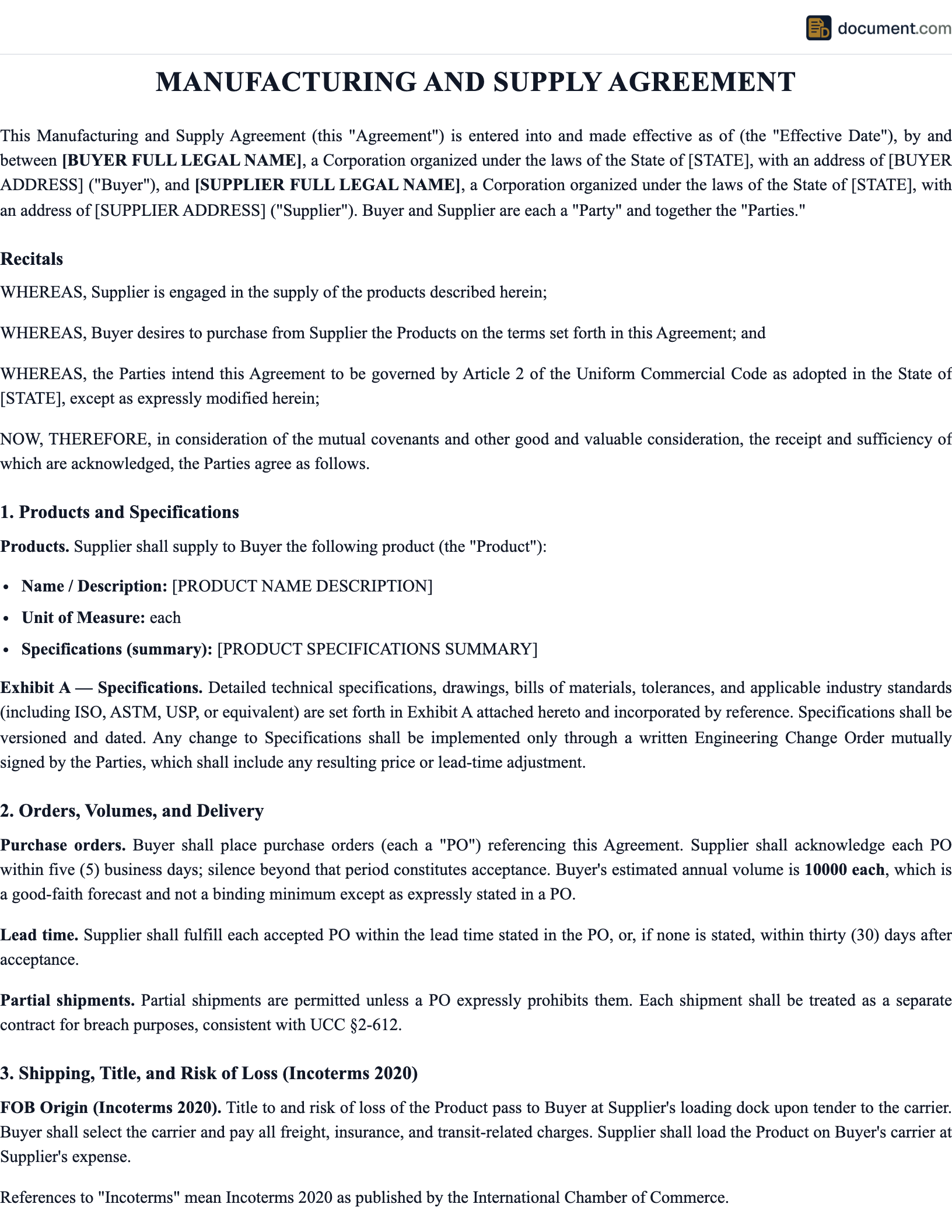



What Is a Manufacturing and Supply Agreement?
A manufacturing and supply agreement (MSA) is a long-term contract under which one party (the manufacturer) commits to producing specified goods to the other party's (the buyer's) specifications and selling them on agreed pricing, volume, and delivery terms over a defined contract period. Unlike a one-time purchase order, an MSA establishes the framework for an ongoing commercial relationship — sometimes lasting many years — and addresses the dozens of operational, quality, IP, and risk issues that arise when one company depends on another for the production of goods central to its business.
MSAs are the backbone of global supply chains. Consumer electronics brands rely on contract manufacturers in Asia to build their products under specifications and brand guidelines. Pharmaceutical companies engage contract manufacturing organizations (CMOs) to produce drug substance and finished dosage forms under FDA-mandated quality systems. Automotive OEMs and tier-one suppliers maintain MSAs that cover everything from specifications and tooling to engineering change orders and end-of-production buyback obligations. In each case, the MSA aligns the buyer's product strategy with the manufacturer's production capacity over a multi-year horizon.
At its core, an MSA must answer several questions: What is being manufactured (with detailed specifications)? How much, when, and at what price? What quality standards apply, and what happens if they are not met? Who owns the resulting intellectual property? Who bears the risk if raw materials become unavailable, if a key tool fails, if regulators change the rules, or if the relationship breaks down? A well-drafted MSA addresses each of these questions explicitly, leaving as little as possible to be sorted out under pressure when a problem arises.
MSAs differ from simple supply contracts in their depth and duration. A supply contract may cover a single product, a single delivery, or a brief period of supply — it is essentially a framework for issuing purchase orders. An MSA typically covers a product family over a multi-year term, includes detailed quality and IP provisions, and contemplates a deeper operational integration between the parties. MSAs are also distinguished from distribution agreements (which cover the resale of goods rather than their production) and from toll manufacturing agreements (in which the buyer supplies all raw materials and the manufacturer is paid a conversion fee).
Whether you are a consumer brand sourcing from an offshore factory, a pharmaceutical company engaging a CMO, or an OEM negotiating a long-term tier-one relationship, our attorney-reviewed manufacturing and supply agreement templates provide the comprehensive framework you need. Each template addresses specifications, MOQs, pricing, quality, IP, exclusivity, force majeure, recall, indemnification, insurance, and termination — and is customizable for the specific industry and product type.
Production Framework
Establish specifications, volume, pricing, and quality over a multi-year term
IP Protection
Allocate background and foreground IP and protect trade secrets
Risk Allocation
Address force majeure, recall, indemnity, insurance, and termination
MSA Form Preview
A visual preview of the structure and core sections of our MSA template.
Manufacturing & Supply Agreement
Long-Term Production Contract
Section 1: Parties
Section 2: Products & Specifications
Section 3: Volume & MOQ
Section 4: Pricing & Payment
Section 5: Quality & Compliance
Types of Manufacturing & Supply Agreements
MSAs come in many forms depending on exclusivity, volume commitment, and IP allocation.
MSA vs Other Supply Contracts
| Contract | Term | Materials | Best For |
|---|---|---|---|
| Manufacturing & Supply | Multi-year | Manufacturer-supplied | Long-term production |
| Toll Manufacturing | Multi-year | Buyer-supplied | Conversion services |
| Purchase Order | Single delivery | Manufacturer-supplied | One-time orders |
| Distribution Agreement | Multi-year | N/A | Reselling finished goods |
| Quality Agreement | With MSA | N/A | Regulated industries |
How to Draft an MSA
- 1
Define the products and specifications
Attach detailed specifications as exhibits, including drawings, materials, tolerances, packaging, and labeling requirements.
- 2
Set volume commitments and MOQs
Determine annual minimums, per-PO minimums, forecasting cadence, and any take-or-pay obligations.
- 3
Establish pricing and payment terms
Decide between fixed pricing, indexed pricing, or pass-through provisions, and set payment terms and currency.
- 4
Address quality and acceptance
Reference industry standards, define acceptance criteria, set inspection rights, and specify nonconformance handling.
- 5
Allocate intellectual property
Identify background IP, assign foreground IP, address tooling ownership, and protect trade secrets.
- 6
Negotiate exclusivity and territory
Decide whether the relationship is exclusive and define any geographic or product-line limitations.
- 7
Add force majeure and risk allocation
Specify covered events, notice requirements, and termination rights for prolonged force majeure.
- 8
Draft termination and wind-down
Cover for-cause and for-convenience termination, notice periods, and transition obligations.
Key Components
Product specifications
Detailed technical specifications attached as exhibits.
Volume and MOQ provisions
Annual minimums, per-order minimums, and forecasting cadence.
Pricing mechanism
Fixed, indexed, or pass-through with payment terms and currency.
Quality standards
Industry standards, inspection rights, and acceptance criteria.
IP allocation
Background and foreground IP, tooling, and trade secrets.
Exclusivity and territory
Manufacturer or buyer exclusivity and any geographic limits.
Force majeure
Covered events, notice procedure, and termination triggers.
Indemnification and insurance
Mutual indemnities and minimum insurance requirements.
Termination and wind-down
For-cause and for-convenience termination with transition obligations.
Legal Requirements
Manufacturing and supply agreements are governed primarily by Article 2 of the Uniform Commercial Code (UCC), which has been adopted in some form by every state. UCC Article 2 applies to contracts for the sale of goods and provides default rules on warranties, risk of loss, delivery, acceptance, rejection, and remedies. Many of these defaults can be varied by contract, and a well-drafted MSA does so explicitly to allocate risk in the manner the parties intend.
For international supply, the United Nations Convention on Contracts for the International Sale of Goods (CISG) may apply by default unless the parties opt out. Most U.S. companies expressly disclaim CISG application in favor of a specific state's UCC. Customs and trade laws (Section 232 tariffs, Section 301 China tariffs, USMCA rules of origin, sanctions) also affect international supply arrangements and should be addressed contractually.
Industry-specific regulations layer additional requirements. FDA-regulated products must comply with cGMP, ISO 13485, and 21 CFR Part 211 or 820. Automotive parts must meet IATF 16949. Aerospace components must comply with AS9100. Each industry has its own quality standards, audit expectations, and traceability requirements that must be reflected in the MSA.
Sample MSA Provisions
1. Scope. Manufacturer shall manufacture and supply, and Buyer shall purchase, the Products described in Exhibit A in accordance with the Specifications and the terms of this Agreement.
2. Forecasts and Orders. Buyer shall provide Manufacturer with a rolling twelve (12) month forecast updated monthly. The first three months of each forecast shall constitute a binding commitment.
3. Pricing. Prices for the Products are set forth in Exhibit B and shall remain fixed for the first twelve (12) months of the Term, after which they may be adjusted annually by no more than the lesser of three percent (3%) or the change in the U.S. Producer Price Index.
4. Quality. Manufacturer shall manufacture all Products in accordance with the Specifications and applicable industry standards (ISO 9001). Buyer shall have the right to inspect and audit Manufacturer's facilities upon thirty (30) days' prior notice.
5. Force Majeure. Neither party shall be liable for any failure or delay in performance due to causes beyond its reasonable control, provided that the affected party gives prompt notice and uses commercially reasonable efforts to mitigate.
Frequently Asked Questions
Official Resources
Ready to Create Your MSA?
Generate an attorney-reviewed manufacturing and supply agreement.
Create Document