



Wisconsin Disclosure Statement Overview
Wisconsin has a well-established seller disclosure requirement under Wis. Stat. 709.01 through 709.10. Every residential seller must complete the state's Real Estate Condition Report, commonly called the RECR, and deliver it to the buyer before the offer to purchase is signed. The RECR is one of the most familiar documents in Wisconsin real estate. Buyers know to ask for it, agents know to request it early in the listing process, and sellers who skip it create immediate legal exposure. The form is not filed with any government office and requires no notarization.
What sets Wisconsin's RECR apart is its scope. In addition to the structural and mechanical conditions common to most state disclosure forms, Wisconsin requires disclosure of flooding and drainage issues, private well conditions, zoning violations, and pending legal proceedings affecting the property. Wisconsin's landscape, with its lakes, rivers, wetlands, and farmland, means that flooding, drainage, and water supply conditions are genuinely material to many buyers across the state. Sellers who complete the form thoughtfully protect themselves and help buyers make informed decisions.
Mandatory
Required under Wis. Stat. 709
2 Business Days
Buyer rescission window
Not Required
No notarization needed
RECR
Real Estate Condition Report
Wisconsin Requirements
Wisconsin's RECR covers more categories than the typical state disclosure form. Sellers should complete every section based on actual knowledge and not rush through sections they think are unlikely to apply. Several Wisconsin-specific categories surprise first-time sellers who assume the form is just about roof and foundation.
Wisconsin Specific Note
Wisconsin sellers must disclose flooding and drainage issues, private water supply well conditions, zoning violations, and pending legal proceedings. These categories go beyond what most state forms require. Properties near Wisconsin's many lakes and rivers should pay particular attention to the flooding and drainage section. Sellers with any unpermitted work, code violations, or neighbor disputes should not omit these from the RECR.
What Wisconsin's RECR Covers
- Structural and Mechanical Systems: Foundation, roof, walls, HVAC, plumbing, and electrical
- Environmental Conditions: Mold, lead paint, asbestos, radon, and underground storage tanks
- Drainage and Flooding: Any known flooding, drainage problems, standing water, or water intrusion
- Private Water Supply Wells: Whether the property relies on a private well and any known water quality or system issues
- Zoning Violations and Non-Conforming Uses: Any known code violations, unpermitted additions, or non-conforming conditions
- Pending Legal Proceedings: Any lawsuits, code enforcement actions, or legal disputes affecting the property
How to File in Wisconsin
Delivering a Wisconsin RECR is a straightforward seller-to-buyer process. No government office is involved, no notarization is required, and there are no filing fees. The form is completed by the seller, reviewed with their agent, and handed to the buyer before they sign the offer to purchase.
Complete the Wisconsin RECR
Work through all sections based on your actual knowledge of the property. Do not skip the drainage, flooding, private well, or zoning sections even if you think they may not apply. If you are uncertain about a condition, note the uncertainty rather than leaving the section blank.
Review With Your Listing Agent
Wisconsin listing agents know the RECR well. Your agent should review the completed form, flag any sections that seem incomplete or inconsistent with what they observed during the listing walkthrough, and confirm that the form is ready to deliver before the offer process begins.
Deliver to the Buyer Before the Offer to Purchase
The RECR must reach the buyer before they sign the offer to purchase. If it arrives after signing, the buyer has 2 business days from receipt to rescind. Because Wisconsin's rescission window is shorter than most states, timing the delivery correctly is important.
Get the Buyer's Signed Acknowledgment
Have the buyer sign and date an acknowledgment confirming they received the RECR. This document is your proof of delivery. Keep it with your closing file. Wisconsin buyers who later claim they were not given the disclosure cannot overcome a signed acknowledgment.
Update and Re-Deliver if Conditions Change Before Closing
Wisconsin sellers who discover a new material defect between the initial disclosure and closing should amend the RECR and re-deliver it. Failing to update after learning of a new condition carries the same legal risk as the original omission.
Wisconsin Disclosure Costs
Wisconsin's RECR is delivered from seller to buyer and is never filed with a government office. There are no recording fees, no transfer taxes, and no notarization costs connected to the disclosure form. The costs below reflect what sellers typically spend on preparation and professional support.
| Cost Item | Typical Range |
|---|---|
| RECR Preparation | Free with our template |
| Pre-Listing Home Inspection (recommended) | $300 - $600 |
| Private Well Water Test (if applicable) | $100 - $300 |
| Attorney Review (optional) | $150 - $400 |
| Government Recording Fees | None (disclosure is not recorded) |
Seller Liability for Non-Disclosure in Wisconsin
Wisconsin sellers who omit known material defects from the RECR face legal consequences that can include rescission of the sale, compensatory damages for the cost of addressing the undisclosed condition, and in intentional concealment cases, punitive damages. Wisconsin courts assess seller liability based on what the seller actually knew, but sellers who had visible warning signs before listing and chose not to investigate may find that "I didn't know" is not a reliable defense.
The zoning violation and pending legal proceedings categories deserve particular attention. Sellers who know about an unpermitted addition, a code enforcement notice, or an ongoing boundary dispute and fail to disclose it are creating a problem that will almost certainly surface during the transaction or after closing. Title searches and buyer due diligence often turn up exactly these kinds of issues, and a seller who omitted a known violation from the RECR will have a difficult time defending that omission.
Private well disclosures carry their own liability dimension. Wisconsin has areas with documented groundwater quality concerns, particularly around agricultural land where nitrate contamination is common. Sellers who know their well has had contamination issues in the past and fail to disclose it expose themselves to significant damages, particularly if a buyer's family relied on the water between closing and discovering the problem.
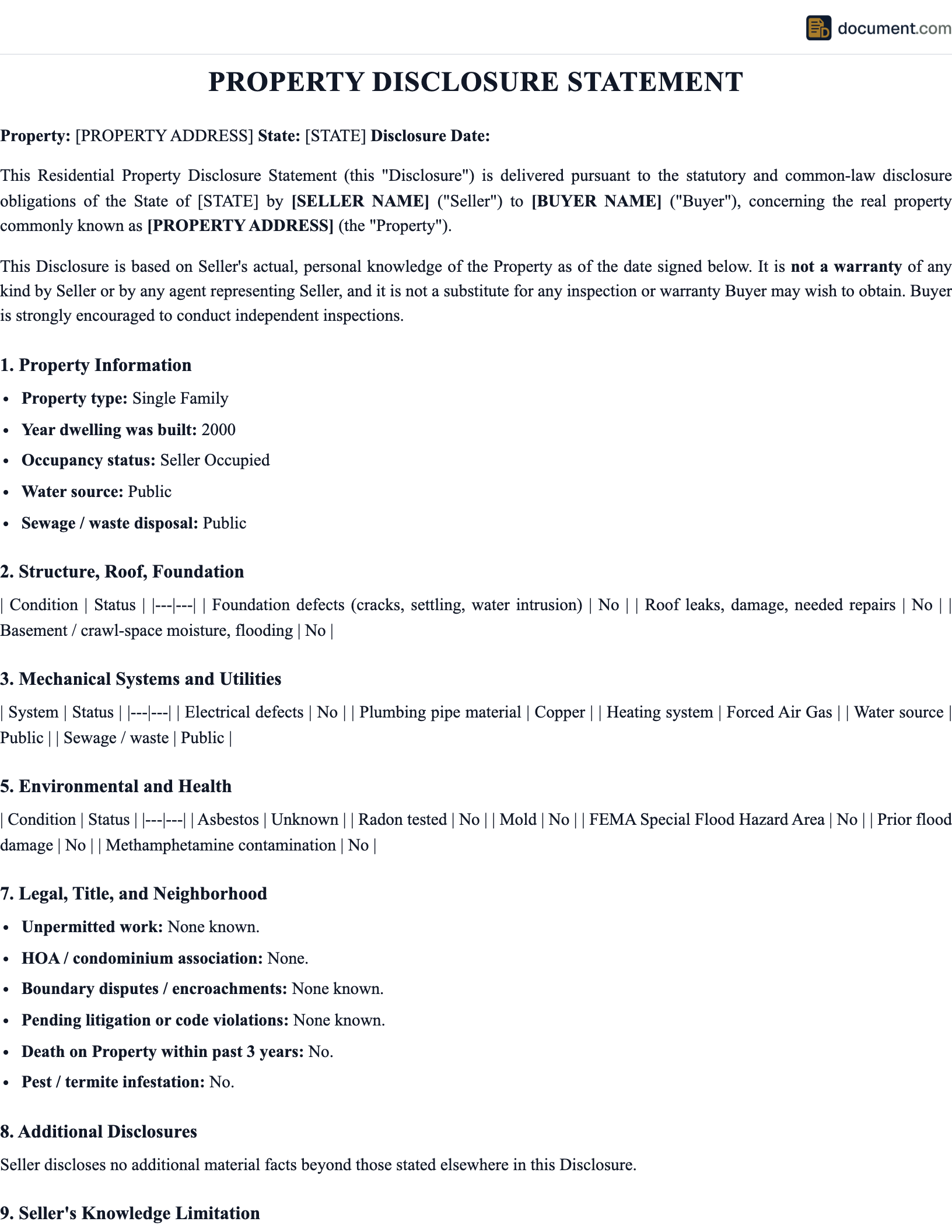
Sample Wisconsin Disclosure Statement
Preview of our Wisconsin-specific template. Your document will include all fields required for recording in any Wisconsin county.
PROPERTY DISCLOSURE STATEMENT
STATE OF WISCONSIN
Legal Document
PARTY INFORMATION
Name: [Full Legal Name]
Address: [Wisconsin Address]
County: [County]
PROPERTY DESCRIPTION
County: [County] State: Wisconsin
Legal Description: [Per Recorded Plat]
Parcel No.: [APN]
Wisconsin Disclosure Statement FAQ
Common questions about filing in Wisconsin, including requirements, fees, and tax implications.
Official Wisconsin Resources
Official state resources for verifying requirements and finding your local recording office.
Important Considerations for Wisconsin Sellers
Wisconsin's 2 business day rescission window is shorter than most states. Sellers should deliver the RECR to buyers as early as possible in the process, ideally before any offer is made rather than waiting until the last moment before signing. Buyers who feel rushed through a disclosure review are more likely to rescind or negotiate aggressively. Sellers who deliver the RECR early give buyers time to absorb the information and move forward with confidence.
Properties on or near Wisconsin lakes, rivers, and wetlands frequently have drainage, flooding, and water table issues that genuinely matter to buyers. If your property has experienced water in the basement, yard ponding, or any flooding from a nearby water body, those conditions belong on the RECR regardless of how long ago they occurred or whether they were repaired. Past flooding that was fixed does not disappear from the form.
If you have a private well, consider getting a water quality test before listing. Wisconsin's DNR offers testing resources and guidance. Sellers who can show buyers a recent clean water test report remove a common buyer concern and may accelerate the transaction. Sellers who are uncertain about their well's water quality are better off testing proactively than having a buyer's inspection reveal a problem during the under-contract period.
Practical Tip for Wisconsin Sellers
Wisconsin agents are experienced with the RECR and can help you identify which sections are most relevant to your property type and location. If you are selling a rural property with a well, septic system, and land near a body of water, your agent should walk through those specific sections with you before you finalize the form. Getting those sections right the first time avoids the need for amendments and keeps the transaction moving smoothly.
Related Documents
Depending on your situation, you may need additional documents alongside this one. Below are commonly related documents that are frequently used together in real estate transactions.
Important Considerations
Before proceeding with your document, there are several important factors to consider. Each real estate transaction is unique, and understanding the specific requirements and implications of your situation will help ensure a smooth and legally compliant process.
Real estate laws and regulations are subject to change, and local requirements may differ from state-level rules. It is always advisable to verify current requirements with your local recording office before submitting any documents for recording.
If your transaction involves complex circumstances such as multiple parties, commercial properties, trusts, estates, or interstate elements, consulting with a licensed real estate attorney is strongly recommended. An attorney can provide guidance specific to your situation and help you avoid potential legal issues.
Keep copies of all documents related to your real estate transaction in a safe place. Recorded documents become part of the public record, but having your own copies ensures you can reference the terms and conditions at any time. Digital copies stored securely are also recommended as a backup.
Professional Recommendation
While our templates are designed to be comprehensive and legally compliant, we recommend having your completed document reviewed by a licensed attorney before recording, especially for high-value transactions or complex situations. Many attorneys offer flat-fee document review services that provide peace of mind at a reasonable cost.
Related Documents
Depending on your situation, you may need additional documents alongside this one. Below are commonly related documents that are frequently used together in real estate transactions.
Create your Wisconsin Property Disclosure Statement in under 5 minutes.
Answer a few questions and download a Wisconsin-compliant document, ready for the state agency.