



Washington Disclosure Statement Overview
Washington has built one of the most comprehensive seller disclosure frameworks in the United States. Under RCW 64.06, sellers of residential property must complete the state's Seller Disclosure Statement, commonly known as Form 17, before the purchase contract reaches mutual acceptance. Unlike many states that focus mainly on structural and mechanical systems, Washington's form reaches into title conditions, neighborhood factors, shared water infrastructure, and geologic hazards. The form is delivered from seller to buyer. It is never filed with a government office or notarized.
Washington's disclosure requirements reflect the state's diverse real estate environment. Rural properties in Eastern Washington often involve water rights and irrigation agreements that are legally distinct from the structure itself. Properties on the west side of the Cascades face different hazard disclosures than farmland in the Yakima Valley. Sellers across the state must take the Form 17 seriously. It is a legally binding document, and Washington courts have imposed significant liability on sellers who used it carelessly.
Mandatory
Required under RCW 64.06
3 Business Days
Buyer rescission window
Not Required
No notarization needed
Form 17
State standard disclosure form
Washington Requirements
Washington's Form 17 covers more categories than most state disclosure forms. Sellers should work through each section carefully, disclosing everything they actually know. Guessing or leaving sections blank without explanation is not acceptable. The form is completed by the seller, not the agent, though agents routinely review it before delivery.
Washington Specific Note
Washington's Form 17 includes categories that many sellers don't anticipate: shared wells, water rights, irrigation agreements, marijuana grow operation history, earthquake fault zones, and volcanic hazard zones. Rural sellers in Eastern Washington should pay particular attention to the water rights and shared infrastructure sections, which can be dispositive for buyers of agricultural or semi-rural properties.
What Washington Form 17 Covers
- Structural and Mechanical Systems: Foundation, roof, walls, HVAC, plumbing, and electrical
- Environmental Conditions: Mold, asbestos, radon, contamination, underground storage tanks
- Water Rights and Shared Infrastructure: Known issues with shared wells, irrigation rights, and water rights associated with the property
- Geologic Hazards: Whether the property is in a known earthquake fault zone or volcanic hazard zone
- Prior Marijuana Grow Operations: Whether the property was ever used as a marijuana grow site, which can affect indoor air quality
- Title and Neighborhood Conditions: Encroachments, easements, boundary disputes, nuisance neighbors, proposed road projects
How to File in Washington
Washington's disclosure process is seller-to-buyer. There is no government office to file with, no notary required, and no recording fee. The seller completes Form 17, the agent reviews it, and it goes to the buyer before mutual acceptance of the purchase and sale agreement.
Complete Washington Form 17
Work through all sections of Form 17 based on your actual knowledge of the property. Pay special attention to sections on water rights, shared infrastructure, geologic hazards, and prior marijuana grow operations. Do not skip sections or generalize.
Review With Your Listing Agent
Washington listing agents have an independent obligation to disclose material facts they know. Make sure your agent has reviewed the completed Form 17 and that it is consistent with anything they know about the property from the listing process.
Deliver Before Mutual Acceptance
The disclosure must reach the buyer before both parties sign and ratify the purchase and sale agreement. If delivered after mutual acceptance, the buyer gets 3 business days to rescind the contract from the date of receipt.
Get the Buyer's Signed Acknowledgment
The buyer must sign an acknowledgment of receipt. Keep a copy in the transaction file. Washington's legal framework puts the burden on the seller to prove delivery, so documentation matters.
Amend the Form if New Information Surfaces
If you discover a material condition after delivering the initial disclosure, you must amend and re-deliver. Washington law requires updates when the seller learns of a new material fact before closing. Ignoring a newly discovered defect carries the same liability as the original omission.
Washington Disclosure Costs
There are no government filing fees associated with Washington's seller disclosure statement. The form is delivered directly from seller to buyer and does not require recording with any county office. Costs are limited to preparation and any professional review the seller chooses to obtain.
| Cost Item | Typical Range |
|---|---|
| Form 17 Preparation | Free with our template |
| Pre-Listing Home Inspection (recommended) | $400 - $700 |
| Attorney Review (optional) | $150 - $400 |
| Water Rights Research (if applicable) | $200 - $600 |
| Government Recording Fees | None (disclosure is not recorded) |
Seller Liability for Non-Disclosure in Washington
Washington sellers who omit or misrepresent known material facts on Form 17 face a layered set of legal risks. At minimum, a buyer who discovers an undisclosed defect after closing can pursue a claim for the cost of repairs. More significantly, Washington's Consumer Protection Act can apply to real estate fraud, and a successful CPA claim entitles the buyer to attorney fees in addition to actual damages. This makes non-disclosure in Washington substantially more expensive than in many other states.
Washington courts have made clear that the seller's actual knowledge is the standard. If the seller did not know about a condition, they cannot be liable for failing to disclose it. But if there are facts suggesting the seller should have investigated, courts will look at what a reasonable owner would have known. Sellers who recently remodeled a bathroom over a moisture problem they knew existed, or who painted over mold, are in a difficult position when buyers discover the condition post-closing.
Real estate agents carry their own disclosure obligations in Washington. An agent who knows about a material defect and stays silent while the seller's Form 17 omits it can be held jointly liable. Sellers and their agents should be aligned on the disclosure before the form reaches the buyer.
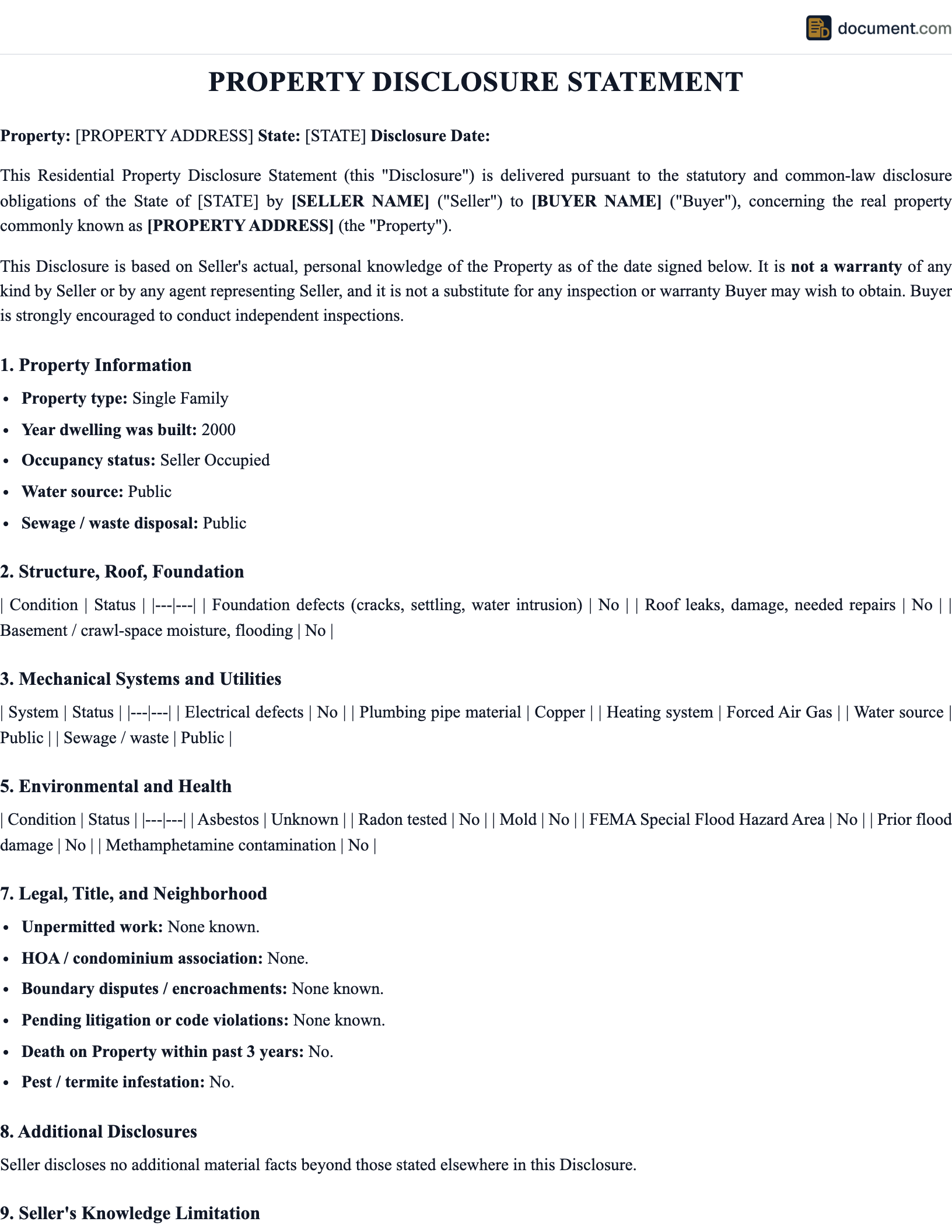
Sample Washington Disclosure Statement
Preview of our Washington-specific template. Your document will include all fields required for recording in any Washington county.
PROPERTY DISCLOSURE STATEMENT
STATE OF WASHINGTON
Legal Document
PARTY INFORMATION
Name: [Full Legal Name]
Address: [Washington Address]
County: [County]
PROPERTY DESCRIPTION
County: [County] State: Washington
Legal Description: [Per Recorded Plat]
Parcel No.: [APN]
Washington Disclosure Statement FAQ
Common questions about filing in Washington, including requirements, fees, and tax implications.
Official Washington Resources
Official state resources for verifying requirements and finding your local recording office.
Important Considerations for Washington Sellers
Washington's Form 17 is unusually broad, and sellers are sometimes caught off guard by sections they didn't expect. If you are selling a property that has a shared well, shared septic, or any irrigation water rights attached to it, those sections of the form deserve careful attention. Water rights in Washington are a matter of state law and can be significant in value. Getting them wrong on a disclosure form can create title problems that outlast the sale.
The geologic hazard disclosures matter more in Washington than in most states. Washington sits above the Cascadia Subduction Zone, and certain areas face elevated seismic risk. Properties near active volcanoes or within designated lahar zones may be subject to hazard disclosures that affect buyer perception and insurance costs. Sellers in these areas should check the Washington State Department of Natural Resources hazard maps before filling out the form.
For sellers in the Seattle metro area and other high-demand markets, the pressure to close quickly can make it tempting to rush through the Form 17. Resist that. Buyers in Washington who later discover an undisclosed problem have real legal remedies, and the cost of defending a non-disclosure claim far outweighs the time it takes to complete the form accurately.
Practical Tip for Washington Sellers
Washington sellers who have owned their property for many years should think back through the full ownership history before completing Form 17. Past roof leaks that were repaired, moisture intrusion episodes, prior pest infestations, and even neighborhood disputes that have since resolved may still need to be disclosed if you have knowledge of them. The form asks what you know, not what is currently wrong.
Related Documents
Depending on your situation, you may need additional documents alongside this one. Below are commonly related documents that are frequently used together in real estate transactions.
Important Considerations for Washington Sellers
Washington's Form 17 covers more ground than most sellers anticipate. Sections on water rights, irrigation, shared wells, and geologic hazards require sellers to know their property deeply before signing. Rural sellers especially should verify their water rights status through the Washington Department of Ecology before claiming on the form that there are no known issues.
Washington's Consumer Protection Act adds real teeth to the disclosure requirement. Unlike states where the remedy for non-disclosure is limited to repair costs, Washington buyers who prove fraud or unfair business practices can recover attorney fees as well, making litigation considerably more expensive for sellers who cut corners.
If the property was ever used as a cannabis growing facility, even briefly, that must be disclosed. Indoor grow operations can affect air quality, electrical wiring, moisture levels, and structural integrity. Washington law recognizes this and specifically requires disclosure regardless of whether the prior use was licensed.
Keep a copy of the completed Form 17 and the buyer's signed acknowledgment with your closing documents. Digital copies stored securely
Practical Tip for Washington Sellers
Review Washington's DNR hazard maps and the Department of Ecology's water rights database before completing your Form 17, particularly for rural or semi-rural properties. Sellers who know their disclosure is complete and accurate go into the transaction with confidence. Sellers who are uncertain often find that uncertainty catches up with them at the worst possible moment.
Related Documents
Depending on your situation, you may need additional documents alongside this one. Below are commonly related documents that are frequently used together in real estate transactions.
Create your Washington Property Disclosure Statement in under 5 minutes.
Answer a few questions and download a Washington-compliant document, ready for the state agency.