



Virginia Disclosure Statement Overview
Virginia has required sellers to provide written property disclosures since the 1990s, and the statutory framework under Virginia Code 55.1-700 through 55.1-714 is among the more detailed in the mid-Atlantic region. The purpose of the disclosure is straightforward: buyers deserve to know about known material defects and conditions before they commit to purchasing a home. The form is delivered directly to the buyer, not filed with any government office.
Several features make Virginia's disclosure landscape distinctive. The state's 38 independent cities each function as separate jurisdictions, so local ordinances and inspection rules can vary even within the same metro area. Virginia also requires sellers to disclose whether a property sits in a military installation noise or accident potential zone, a practical necessity given the density of active military bases across Hampton Roads and Northern Virginia. Properties in HOA communities require additional attention to known common area defects. Sellers who understand these specific triggers are far better positioned to complete their disclosure accurately and avoid post-closing disputes.
Mandatory
Disclosure required by law
3 Days
Buyer rescission window
Not Required
No notarization needed
38
Independent cities in VA
Virginia Requirements
Virginia law sets clear expectations for what must appear in a seller's disclosure, and the state has continued to add specific categories over the years. Sellers should complete the form honestly and completely, disclosing everything they actually know about the property's condition, even if they believe the buyer can discover it independently.
Virginia Specific Note
Virginia requires disclosure of military installation noise and accident potential zones, historic district status, and HOA common area defects in addition to the standard structural and mechanical categories. Sellers near military installations in Hampton Roads, Northern Virginia, or the Shenandoah region should check Air Installation Compatible Use Zone (AICUZ) maps before completing their form.
What Virginia Sellers Must Disclose
- Structural and Foundation Conditions: Any known defects in the foundation, load-bearing walls, or roof structure
- Mechanical Systems: Known issues with HVAC, plumbing, electrical, and water heater
- Environmental Hazards: Mold, asbestos, radon, lead-based paint (separate federal requirement), underground storage tanks
- Military Zone Proximity: Whether the property is within a military installation noise or accident potential zone
- Historic District Status: Whether the property is subject to historic district restrictions
- HOA Common Areas: Known defects in common areas if the property is in a planned community or HOA
How to File in Virginia
Delivering a Virginia property disclosure statement is a seller-to-buyer process. There is no government recording office involved. The form is completed by the seller, reviewed by the seller's agent, and handed to the buyer before or at the time of contract signing.
Complete the Virginia Disclosure Form
Work through each section carefully, answering based on what you actually know. Do not guess or leave sections blank without explanation. Pay particular attention to the military zone, historic district, and HOA sections specific to Virginia.
Review With Your Real Estate Agent
Your listing agent should review the completed form before delivery. In Virginia, agents have an independent obligation to disclose known material facts, so alignment between the seller's disclosure and the agent's knowledge matters.
Deliver to the Buyer Before Contract Signing
The disclosure must reach the buyer before or at the time the purchase contract is signed. If it arrives after signing, the buyer's 3-day rescission window begins on the date they receive it, not the contract date.
Obtain the Buyer's Acknowledgment
Have the buyer sign and date an acknowledgment that they received the disclosure. Keep this signed copy in the transaction file. In any future dispute, proof of delivery and receipt protects the seller.
Update the Disclosure if Conditions Change
If you discover a new defect between the disclosure date and closing, Virginia law requires you to update the disclosure and re-deliver it to the buyer. Failing to update after a material change carries the same liability as the original omission.
Virginia Disclosure Costs
There are no government filing fees for a Virginia property disclosure statement. It is delivered directly from seller to buyer. The costs involved are generally preparation and professional review expenses.
| Cost Item | Typical Range |
|---|---|
| Disclosure Form Preparation | Free with our template |
| Pre-Listing Home Inspection (recommended) | $300 - $600 |
| Attorney Review (optional) | $150 - $400 |
| Radon Test (if applicable) | $100 - $300 |
| Government Recording Fees | None (disclosure is not recorded) |
Seller Liability for Non-Disclosure in Virginia
A Virginia seller who knowingly omits or misrepresents a material fact on the disclosure form faces real legal exposure. Virginia courts treat deliberate concealment as fraud, which can support claims for rescission of the sale, compensatory damages to cover repair costs, and in serious cases, punitive damages. The seller's real estate agent can also be named in litigation if they participated in the concealment or failed to disclose what they independently knew.
Even a seller who answers questions in good faith can face a claim if it turns out they "should have known" about a defect. Virginia courts look at what a reasonable seller would have investigated before listing. If a problem was visible or discoverable through routine inspection, claiming ignorance may not be a complete defense. This is why many Virginia sellers get a pre-listing inspection before completing the form.
Sellers who are uncertain about a condition should disclose it rather than omit it. Over-disclosure is far less risky than under-disclosure. Noting a past roof repair, for example, does not necessarily harm the sale; concealing current leaks, however, can unravel a transaction months after closing and expose the seller to damages well beyond what a timely disclosure would have cost them.
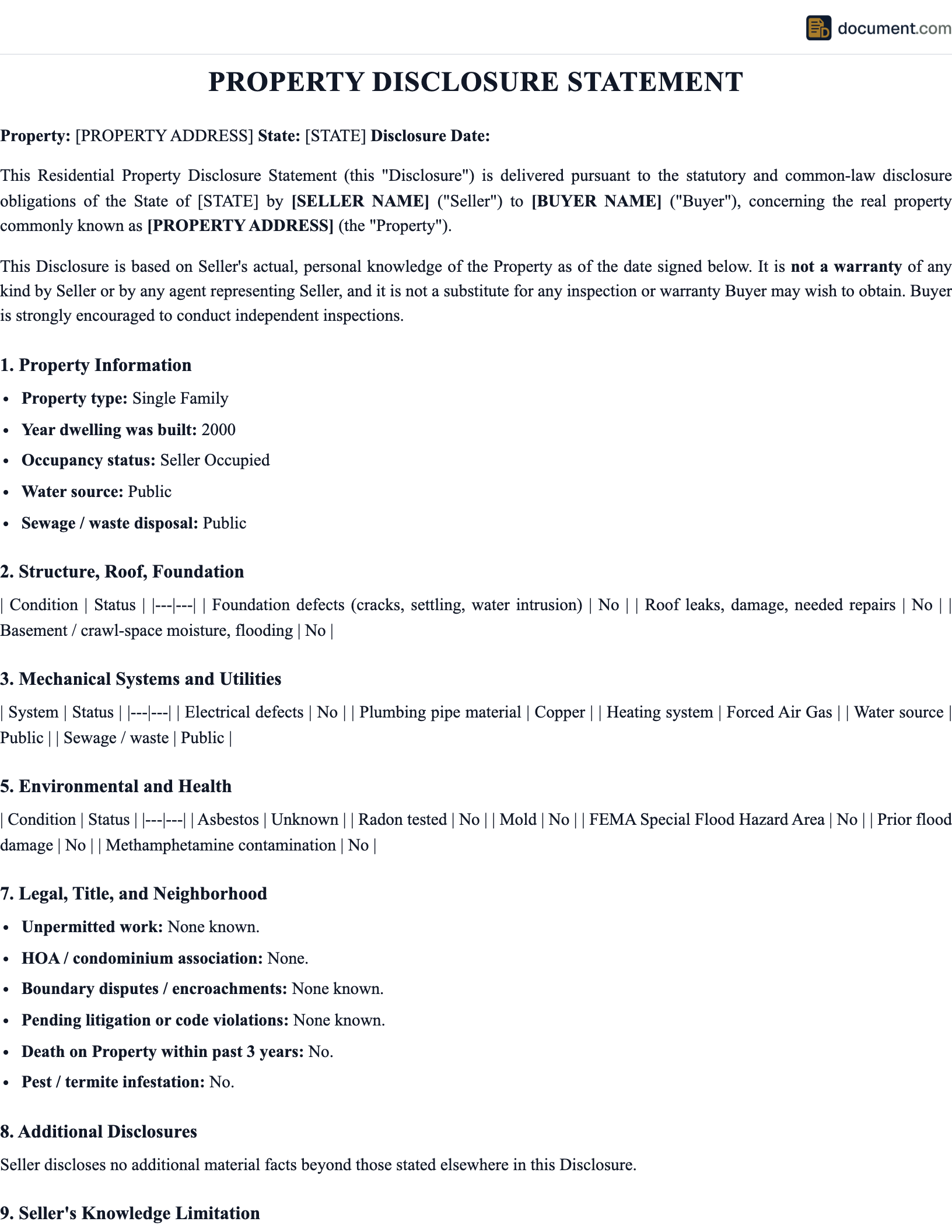
Sample Virginia Disclosure Statement
Preview of our Virginia-specific template. Your document will include all fields required for recording in any Virginia county.
PROPERTY DISCLOSURE STATEMENT
STATE OF VIRGINIA
Legal Document
PARTY INFORMATION
Name: [Full Legal Name]
Address: [Virginia Address]
County: [County]
PROPERTY DESCRIPTION
County: [County] State: Virginia
Legal Description: [Per Recorded Plat]
Parcel No.: [APN]
Virginia Disclosure Statement FAQ
Common questions about filing in Virginia, including requirements, fees, and tax implications.
Official Virginia Resources
Official state resources for verifying requirements and finding your local recording office.
Important Considerations for Virginia Sellers
Virginia's independent city structure deserves special attention. Because the state's 38 independent cities are legally separate from surrounding counties, a property in Alexandria is subject to Alexandria's local ordinances, not Fairfax County's. Sellers in independent cities should confirm with their agent or attorney whether any local disclosure supplements apply beyond the state form.
Military installation proximity is a genuine issue in much of Virginia. If your property is near Joint Base Langley-Eustis, Naval Station Norfolk, Oceana, Fort Belvoir, Quantico, or any other installation, check the relevant AICUZ maps published by the Department of Defense. The disclosure requires you to indicate whether the property falls within a designated noise or accident potential zone, and buyers in those areas have a right to know before they commit.
For properties in HOA communities, Virginia sellers must also address the condition of common areas if they have knowledge of any defects. This often gets overlooked, particularly in condominium transactions where the seller may know about building-wide issues that the HOA has been slow to address. If you know the roof of your condo building has been leaking and the board has not yet repaired it, that is a condition that belongs on the disclosure.
Practical Tip for Virginia Sellers
Consider ordering a pre-listing home inspection before completing your disclosure. Virginia sellers who have an inspection report in hand can answer disclosure questions with confidence, and buyers often feel more comfortable proceeding when the seller has already documented the property's condition. It also reduces the likelihood of a post-inspection renegotiation surprise.
Related Documents
Depending on your situation, you may need additional documents alongside this one. Below are commonly related documents that are frequently used together in real estate transactions.
Important Considerations for Virginia Sellers
Virginia's independent city structure deserves special attention from sellers. Because the state's 38 independent cities are legally separate from surrounding counties, local ordinances and inspection requirements can vary even within the same metro area. A property in Alexandria operates under different local rules than one in Fairfax County, even though they share a border.
Military installation proximity is a genuine issue in much of Virginia. If your property is near Joint Base Langley-Eustis, Naval Station Norfolk, Oceana, Fort Belvoir, Quantico, or any other installation, check the relevant AICUZ maps published by the Department of Defense before completing your disclosure.
For properties in HOA communities, Virginia sellers must address the condition of common areas if they have knowledge of any defects. This often gets overlooked, particularly in condominium transactions where the seller may be aware of building-wide issues the HOA has been slow to repair.
Keep a copy of the completed and signed disclosure acknowledgment with your closing documents. If a dispute arises after closing, proof that the buyer received and acknowledged the disclosure is your first line of defense. Digital copies stored securely are also recommended as a backup.
Professional Recommendation
While our templates are designed to be comprehensive and legally compliant, we recommend having your completed document reviewed by a licensed attorney before recording, especially for high-value transactions or complex situations. Many attorneys offer flat-fee document review services that provide peace of mind at a reasonable cost.
Related Documents
Depending on your situation, you may need additional documents alongside this one. Below are commonly related documents that are frequently used together in real estate transactions.
Create your Virginia Property Disclosure Statement in under 5 minutes.
Answer a few questions and download a Virginia-compliant document, ready for the state agency.