



Vermont Disclosure Statement Overview
Vermont requires sellers of residential real property to complete and deliver a written property disclosure before the purchase contract is signed. This requirement is established by 27 VSA Section 460, and it creates a meaningful obligation to share what the seller knows about the property's condition, history, and any regulatory encumbrances that affect it. Vermont's disclosure form covers the standard categories, structural, mechanical, and environmental conditions, but it also addresses several issues that reflect Vermont's specific property landscape: Act 250 land use permits, shared driveways, and underground oil storage tanks.
Vermont's housing stock is among the oldest in the country. Many homes in the state were built well before 1978, which means lead-based paint disclosure under federal law applies to a large percentage of Vermont property transactions. Sellers of these older homes must complete both the Vermont disclosure and the separate federal lead paint form. Beyond lead, the prevalence of old fuel oil heating systems in Vermont means underground storage tank history comes up regularly as a disclosure issue. A buried tank that was abandoned in place decades ago can still create environmental liability today, and sellers who know of one, whether currently in use or decommissioned, must disclose it.
$15
Recording fee
1.25%-1.45%
Transfer tax
Required
Notarization
0
Witnesses required
Vermont Requirements
Vermont sellers must honestly disclose all known material conditions based on their actual knowledge of the property. The form is comprehensive, covering physical condition, environmental issues, and regulatory restrictions. Because Vermont has several disclosure categories that are unusual compared to other states, sellers should take time to think through each section rather than rushing through it.
Vermont Seller Note
Vermont sellers have two categories that require specific attention beyond standard disclosures: Act 250 land use permits and underground oil storage tanks. If your property was developed under an Act 250 permit, gather those permit documents before filling out the disclosure. If there is any history of oil storage tanks on the property, whether in use or decommissioned, that information must be disclosed. Buyers and lenders in Vermont take environmental contamination risk seriously, and tank history is one of the most common post-closing dispute triggers in the state.
What Vermont Sellers Must Cover
- Structural and mechanical systems: Foundation, roof, walls, plumbing, HVAC, and electrical
- Environmental hazards: Known asbestos, mold, radon, and underground oil storage tanks, whether active or decommissioned
- Lead-based paint: Separate federal disclosure required for all homes built before 1978; particularly relevant in Vermont given the state's older housing stock
- Shared access and boundary issues: Known shared driveways, easements, and any ongoing or recent boundary disputes
- Act 250 permits: Whether the property is subject to a state land use permit and any conditions attached to it
- Land use restrictions: Deed restrictions, conservation easements, or other recorded limitations on use
How to File in Vermont
The Vermont disclosure process is seller-to-buyer. No town clerk, no notarization, no recording fee. The obligation is entirely fulfilled by completing an accurate disclosure form and delivering it to the buyer before the purchase contract is signed. The preparation is where sellers need to invest their time, particularly because Vermont's disclosure form covers categories that require gathering specific documents, not just recalling general impressions about the property.
Gather Relevant Documents Before Starting
Pull together any Act 250 permit documents, records of tank installations or removals, prior inspection reports, lead paint test results, and any recorded easement or shared driveway agreements. These make the disclosure form much easier to complete accurately.
Complete the Vermont Disclosure Form
Work through the form section by section. Do not skip questions. If you are uncertain about a category, note your uncertainty rather than leaving it blank. Silence on a question is not the same as an accurate answer.
Deliver to the Buyer Before Contract Signing
Provide the completed form to the buyer before the purchase agreement is signed. Delivery through your real estate agent, by email, or by hand are all acceptable methods. Document the date of delivery.
Track the Buyer's 5-Day Window If Delivered Late
If the disclosure is delivered after contract execution, the buyer has 5 days to rescind. Note the delivery date clearly. Once 5 days pass without a cancellation notice, the rescission right lapses and the transaction continues.
Retain the Signed Buyer Acknowledgment
Get the buyer's signature acknowledging receipt. Keep this copy in your transaction file. It is your record that the disclosure duty was met, which matters if a dispute arises after closing.
Vermont Fees & Costs
Typical costs for filing in Vermont. Actual fees may vary by county.
| Fee / Tax | Amount |
|---|---|
| Recording Fee | $15 |
| Transfer Tax | 1.25%-1.45% |
| Notarization | $5 - $25 per signature |
| Certified Copy | $1 - $10 per page |
| Attorney Review (optional) | $150 - $500 |
Seller Liability for Non-Disclosure in Vermont
Vermont sellers who knowingly conceal or misrepresent material property conditions face civil liability after closing. Buyers who discover hidden defects, undisclosed environmental problems, or unmentioned Act 250 permit restrictions can bring claims for misrepresentation, fraudulent concealment, or breach of the disclosure statute. Remedies can include repair costs, diminution in value, or rescission of the sale in cases involving deliberate concealment.
Underground oil storage tank non-disclosure is one of the more consequential categories in Vermont specifically. If a buried tank has leaked and contaminated soil or groundwater, the cleanup costs can be substantial, and Vermont's environmental liability rules can reach sellers who knew about the tank and said nothing. Buyers who later discover an undisclosed tank, particularly one that has caused contamination, have strong grounds for a serious claim against the prior owner.
The disclosure form works in the seller's favor when it is completed honestly and thoroughly. A buyer who acknowledges receiving a disclosure that accurately described the property's condition, including any known issues, cannot later claim they were misled about those conditions. Vermont courts recognize this, and a well-documented disclosure file is often the most effective defense a seller has against post-closing disputes.
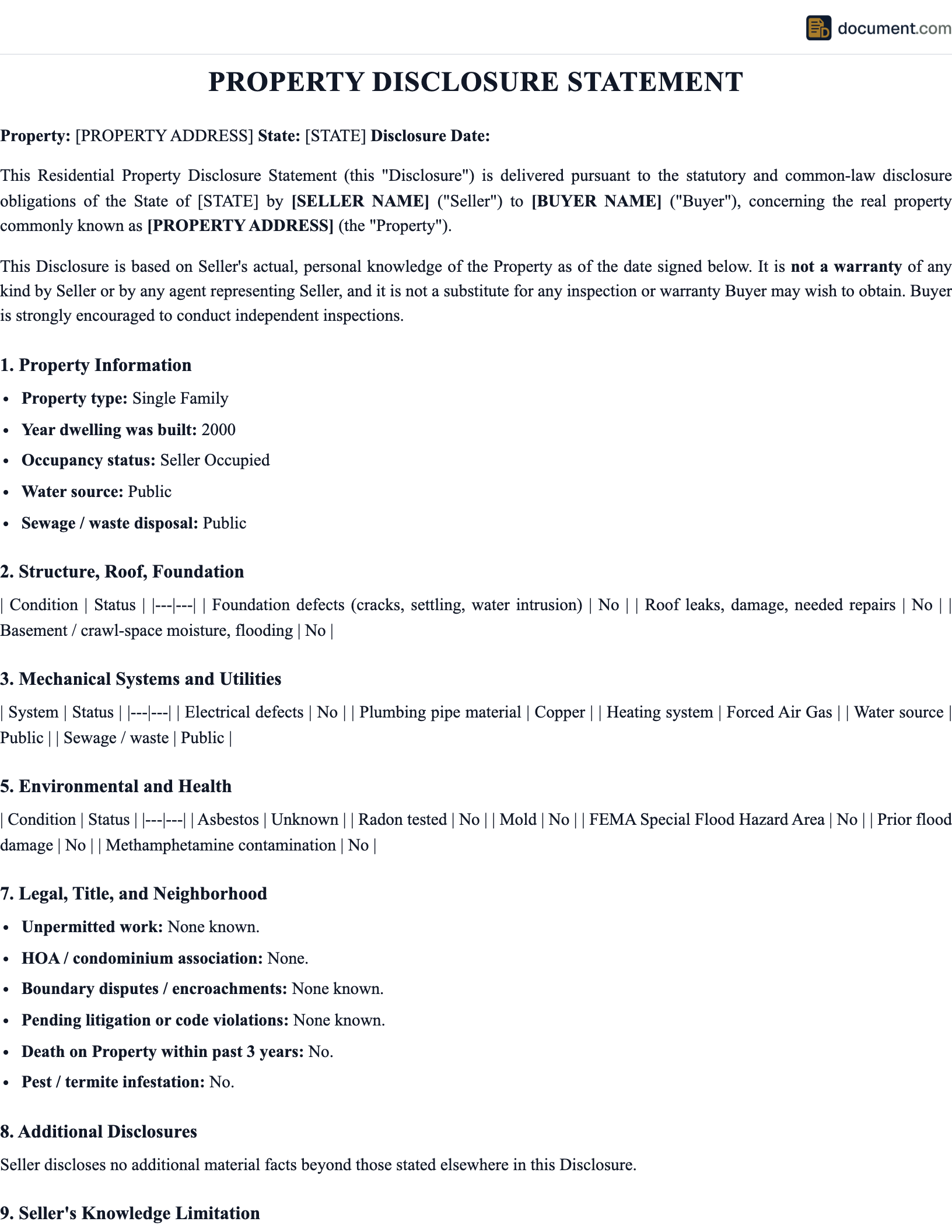
Sample Vermont Disclosure Statement
Preview of our Vermont-specific template. Your document will include all fields required for recording in any Vermont county.
PROPERTY DISCLOSURE STATEMENT
STATE OF VERMONT
Legal Document
PARTY INFORMATION
Name: [Full Legal Name]
Address: [Vermont Address]
County: [County]
PROPERTY DESCRIPTION
County: [County] State: Vermont
Legal Description: [Per Recorded Plat]
Parcel No.: [APN]
Vermont Disclosure Statement FAQ
Common questions about filing in Vermont, including requirements, fees, and tax implications.
Official Vermont Resources
Official state resources for verifying requirements and finding your local recording office.
Important Considerations for Vermont Sellers
Vermont sellers of older homes should treat the lead-based paint and environmental sections of the disclosure form with the same seriousness as the structural sections. Given the age profile of Vermont's housing, lead paint is present in many homes, and radon levels can be elevated in certain geological areas of the state. Sellers who have had their home tested for either of these should have that documentation available and should disclose any known results.
For properties with any Act 250 history, take time to locate the actual permit before filling out the disclosure. Act 250 permits often contain specific conditions about what can be built, how septic systems must be maintained, and what limits apply to future development on the parcel. A buyer who is planning to expand or modify the property needs to know about these constraints before signing a purchase agreement. Disclosing them after closing is not an option.
Rural Vermont properties with shared driveways should include any written driveway maintenance agreements or informal understandings with neighbors in the disclosure. If there is no formal agreement, disclose that too. Buyers need to understand whether they have clear legal access or are relying on a neighborly arrangement that may not be enforceable.
Vermont-Specific Tip
Vermont's real estate transactions often involve multiple forms of due diligence specific to the state: Act 250 permit searches, underground tank inquiries through the Vermont Agency of Natural Resources, and radon testing. Vermont buyers and their lenders are familiar with these steps. Sellers who are transparent about relevant history in each area tend to have smoother transactions than those who leave these questions unanswered on the disclosure form.
Related Documents
Depending on your situation, you may need additional documents alongside this one. Below are commonly related documents that are frequently used together in real estate transactions.
Working With a Vermont Real Estate Attorney
Vermont residential closings routinely involve attorney participation, and the complexity of Vermont's property law makes this practice sensible. Act 250 permits, environmental liability from oil tanks, and the prevalence of older homes with lead paint create a legal landscape where sellers benefit from professional guidance before listing rather than after a problem surfaces.
A Vermont real estate attorney can review your completed disclosure form and flag any areas where your answers may be incomplete or where additional documentation would strengthen your position. They can also advise on whether particular conditions, such as a buried tank that was removed and tested years ago with clean results, require disclosure and how to characterize them accurately if they do.
Keep your complete disclosure file, buyer acknowledgment, and any supporting documentation for several years after closing. Vermont's statute of limitations for misrepresentation claims can extend well beyond the closing date, and your documentation from the transaction is your best protection if a dispute arises later.
Professional Recommendation
Vermont sellers dealing with properties that have environmental history, Act 250 permits, or significant deferred maintenance should consult an attorney before completing the disclosure form. Getting these answers right the first time is far less costly than defending a post-closing misrepresentation claim.
Related Documents
Depending on your situation, you may need additional documents alongside this one. Below are commonly related documents that are frequently used together in real estate transactions.
Create your Vermont Property Disclosure Statement in under 5 minutes.
Answer a few questions and download a Vermont-compliant document, ready for the state agency.