



Utah Disclosure Statement Overview
Utah requires residential sellers to deliver a property disclosure statement to prospective buyers before a purchase contract is signed. This obligation is established in Utah Code 57-27-101 through 57-27-105. The statute applies to most residential real property transactions and requires sellers to honestly describe the known condition of the home, including structural systems, mechanical systems, environmental issues, and a category that is especially relevant in Utah: natural hazard area designations and water rights.
Water rights are not a footnote in Utah real estate. They are central to the value and usability of property across much of the state, particularly outside urban areas. Whether a property has adjudicated irrigation rights, shares a culinary water connection, or relies on a water district, these details belong on the disclosure form. Similarly, Utah properties in the Wasatch Front metropolitan corridor sit near active seismic fault zones, and sellers aware of fault proximity or landslide risk in their area have an obligation to share that. Natural hazard disclosures in Utah are not hypothetical: they address real conditions that regularly affect property values and insurability.
$15
Recording fee
None
Transfer tax
Required
Notarization
0
Witnesses required
Utah Requirements
Utah sellers must complete the disclosure form based on their actual knowledge of the property and deliver it before the purchase contract is executed. The statute does not require sellers to perform inspections or investigate conditions they have no reason to know about, but it does require honest answers to every question on the form.
Utah Seller Note
Utah sellers of rural or agricultural properties should give special attention to the water rights section of the disclosure form. Buyers in Utah rely heavily on water availability information and any known adjudications or water district affiliations are material. For properties in the Wasatch Front region, check whether any geotechnical or fault zone studies have been done for your area and whether those results should appear in the natural hazard section.
What Utah Sellers Must Cover
- Structural systems: Foundation, roof, walls, attic, windows, and exterior
- Mechanical systems: Plumbing, heating, cooling, electrical, and water heater
- Environmental conditions: Known mold, asbestos, lead paint, radon, and underground storage tanks
- Water rights: Known water rights, water district memberships, irrigation entitlements, and shared water arrangements
- Natural hazards: Known flood zone designation, landslide risk, or fault zone proximity
- Lead-based paint: Separate federal disclosure required for homes built before 1978
How to File in Utah
Delivering the Utah disclosure is a seller-to-buyer process. No government office is involved and no fees are paid. The entire obligation is satisfied by completing the form accurately and getting it to the buyer before the purchase contract is signed. What takes time is not the delivery itself but the preparation, particularly for properties with water rights, known hazard issues, or deferred maintenance history.
Gather Your Property Information
Before filling out the form, collect what you know: repair records, permits, any previous inspection reports, water district or irrigation documents, and any geotechnical or soil reports for properties in hazard-designated areas.
Complete the Disclosure Form
Work through each section carefully. Answer based on your actual knowledge. Pay special attention to the water rights and natural hazard sections, which are particularly relevant in Utah. Do not leave sections blank.
Deliver to the Buyer Before Signing the Contract
Provide the form to the buyer before the purchase agreement is executed. Once the buyer signs the contract without having received the disclosure, your 3-day rescission clock starts running. Deliver early to avoid that complication.
Obtain a Signed Acknowledgment
Get the buyer's signature confirming receipt. This is your documentation that the disclosure obligation was fulfilled. Keep this record with your closing documents.
Update If You Discover New Issues Before Closing
If you learn of a new defect or material condition between signing and closing, provide an updated disclosure promptly. The duty to disclose does not end at contract execution.
Utah Fees & Costs
Typical costs for filing in Utah. Actual fees may vary by county.
| Fee / Tax | Amount |
|---|---|
| Recording Fee | $15 |
| Transfer Tax | None |
| Notarization | $5 - $25 per signature |
| Certified Copy | $1 - $10 per page |
| Attorney Review (optional) | $150 - $500 |
Seller Liability for Non-Disclosure in Utah
Utah sellers who fail to disclose known material defects face civil liability after closing. Buyers who discover concealed problems, whether a cracked foundation, a failing septic system, undisclosed water rights issues, or known geological instability, can bring claims for misrepresentation or fraud. The remedy can include repair costs, property value diminishment, or rescission of the transaction in severe cases.
Water rights non-disclosure is a category of exposure that is sometimes underestimated by Utah sellers. If a property has irrigation rights, shares a water source with neighboring parcels, or has had water right disputes, and the seller says nothing, a buyer who later discovers those facts has grounds for a claim. Water access in Utah is not a peripheral concern for many buyers, and courts treat its nondisclosure seriously.
The disclosure form also provides protection to sellers who complete it carefully. A seller who disclosed known foundation settling, noted a prior drainage issue that was corrected, and described the property's water arrangement accurately is in a strong defensive position if a buyer later tries to claim surprise about any of those conditions. Thorough disclosure reduces the space for post-closing disputes.
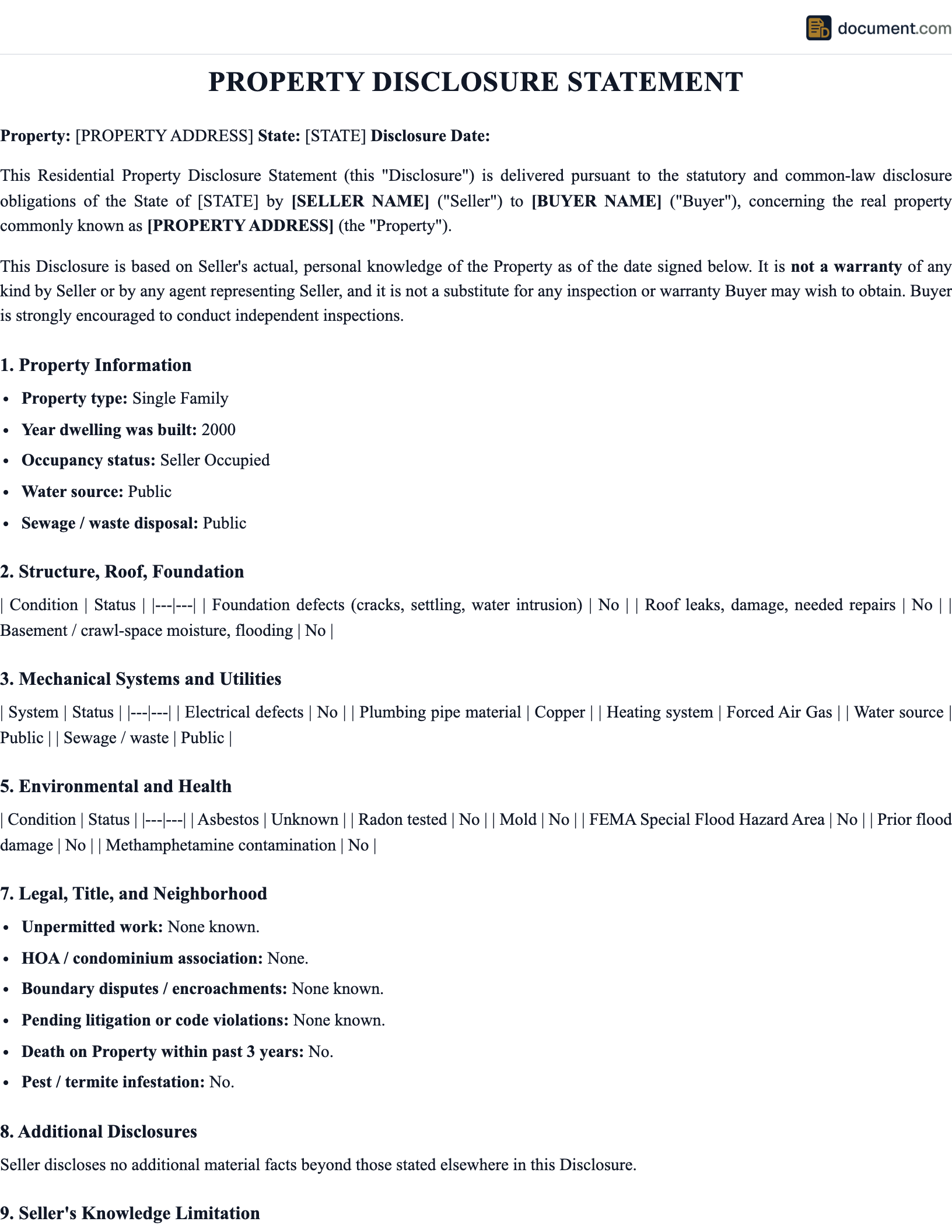
Sample Utah Disclosure Statement
Preview of our Utah-specific template. Your document will include all fields required for recording in any Utah county.
PROPERTY DISCLOSURE STATEMENT
STATE OF UTAH
Legal Document
PARTY INFORMATION
Name: [Full Legal Name]
Address: [Utah Address]
County: [County]
PROPERTY DESCRIPTION
County: [County] State: Utah
Legal Description: [Per Recorded Plat]
Parcel No.: [APN]
Utah Disclosure Statement FAQ
Common questions about filing in Utah, including requirements, fees, and tax implications.
Official Utah Resources
Official state resources for verifying requirements and finding your local recording office.
Important Considerations for Utah Sellers
Utah sellers of properties outside the major metro areas should think carefully about two categories the disclosure form addresses that are often overlooked: water rights and natural hazards. If your property has any water shares, a water district connection with separate fee obligations, or an irrigation entitlement tied to the parcel, those need to be disclosed. Buyers moving to rural Utah from other states are often unfamiliar with the prior appropriation water system and may not think to ask. That is not a reason to omit the information; it is a reason to be thorough.
For properties in the Wasatch Front corridor, earthquake fault zones are a real feature of the landscape. The Wasatch Fault runs through some of the most heavily populated areas of the state. If you are aware that your property is near a mapped fault trace or if a geotechnical assessment was done in your neighborhood, that information belongs on the disclosure. Buyers obtaining lenders or insurance sometimes independently discover this, and a seller who appears to have withheld it faces obvious credibility problems.
Keep repair receipts, contractor invoices, and any prior inspection reports accessible while completing the disclosure form. These documents help you answer questions accurately and give buyers confidence that the property's history is documented, not hidden.
Professional Recommendation
Utah real estate attorneys can advise on water rights disclosure specifically, which is a nuanced area that many general disclosure guides do not address adequately. If your property has any water rights complexity, a brief consultation before listing is worthwhile.
Related Documents
Depending on your situation, you may need additional documents alongside this one. Below are commonly related documents that are frequently used together in real estate transactions.
Working With a Utah Real Estate Attorney
Attorney involvement in Utah residential closings is not legally required, but it is worth considering for properties with any significant complexity. Sellers with water rights questions, those near mapped fault zones, or those whose properties have had major structural or environmental events should have the disclosure reviewed before delivery. Mischaracterizing any of these Utah-specific conditions, even unintentionally, can create post-closing liability.
Utah attorneys who handle real estate transactions regularly can also advise on whether certain conditions require disclosure under the statute versus whether they are simply good practice to include. There is often a zone of ambiguity around conditions the seller suspects but has not confirmed, and an attorney can help you navigate that honestly.
After closing, store your complete disclosure file, including the signed buyer acknowledgment, in a safe location. Post-closing claims in Utah can arise well after the sale date, and this documentation is your record of what you disclosed and when.
Professional Recommendation
Utah real estate attorneys who practice in the Wasatch Front corridor are particularly familiar with the natural hazard and seismic disclosure questions that come up in that region. If your property is in Salt Lake, Utah, Davis, or Weber County, a brief consultation is a reasonable precaution.
Related Documents
Depending on your situation, you may need additional documents alongside this one. Below are commonly related documents that are frequently used together in real estate transactions.
Create your Utah Property Disclosure Statement in under 5 minutes.
Answer a few questions and download a Utah-compliant document, ready for the state agency.