



Texas Disclosure Statement Overview
Texas has one of the most detailed mandatory property disclosure frameworks in the country. Under Texas Property Code Section 5.008, sellers of residential property containing not more than one dwelling unit must complete and deliver the state-mandated Seller's Disclosure Notice before the purchase contract is signed. This is not a form sellers can draft on their own or adapt from a generic template. Texas uses a specific form, and deviation from it undermines compliance with the statute.
The scope of what Texas sellers must address is unusually broad. In addition to the standard structural, mechanical, and environmental categories found in other states, the Texas form specifically requires sellers to disclose flood plain status, prior flooding events, insurance requirements, HOA obligations, and the presence of mold, asbestos, or lead-based paint. The flood-related questions are particularly important in Texas, a state that has experienced repeated and severe storm and hurricane flooding in communities across the Gulf Coast region and inland waterways. Sellers who have any history of flood events on or near the property need to answer those questions with care and accuracy.
$16
Recording fee
None
Transfer tax
Required
Notarization
0
Witnesses required
Texas Requirements
Texas sellers must use the state-mandated Seller's Disclosure Notice and deliver it to the buyer before signing the purchase contract. The form must be completed honestly and thoroughly. Sellers answer based on their actual knowledge, but the breadth of required categories means sellers need to think carefully about each section rather than rushing through it.
Texas Seller Note
Texas's 7-day buyer rescission right (when disclosure is delivered after contract signing) is one of the longest in the country. Sellers should deliver the Seller's Disclosure Notice before the contract is signed to avoid triggering this window. Texas also has an aggressive Deceptive Trade Practices Act that applies to real estate transactions, meaning intentional concealment of known defects carries elevated legal risk beyond simple misrepresentation claims.
What the Texas Disclosure Must Cover
- Structural and mechanical systems: Foundation, roof, walls, plumbing, electrical, HVAC, and built-in appliances
- Flood plain and flooding history: Whether property is in a 100-year flood plain, has flooded, or has required flood insurance
- Environmental hazards: Known mold, asbestos, lead-based paint, underground storage tanks, and hazardous substances
- HOA information: Whether the property is subject to a homeowners association and any applicable fees or assessments
- Other material conditions: Encroachments, easements, boundary disputes, and any other conditions that materially affect the property
How to File in Texas
Delivering the Texas Seller's Disclosure Notice is a straightforward process, but the timing matters enormously. No government office is involved. The form goes directly from seller to buyer, without notarization or recording. What does matter is that delivery happens before the purchase contract is signed.
Complete the State-Mandated Form
Use the Texas Seller's Disclosure Notice form. Go through each section carefully and answer every question based on what you actually know. The flood plain, HOA, and environmental sections require particular attention in Texas.
Deliver to the Buyer Before Contract Signing
Give the completed form to the prospective buyer before the purchase contract is executed. Delivery through your listing agent or electronically through a transaction management platform is standard practice in Texas.
If Delivered Late, Track the 7-Day Window
If the form is delivered after the contract is signed, the buyer has 7 days to terminate and recover earnest money. Document the delivery date clearly. After 7 days without a termination notice, this right expires.
Get a Signed Receipt from the Buyer
The form includes a buyer signature line acknowledging receipt. Make sure this is signed and dated. Keep the completed, signed form in your transaction file. This is your record of compliance.
Provide Amended Disclosure If Conditions Change
If the property is damaged or a new defect is discovered between signing and closing, provide an updated disclosure. Texas sellers cannot reasonably stay silent about material changes that occur during the contract period.
Texas Fees & Costs
Typical costs for filing in Texas. Actual fees may vary by county.
| Fee / Tax | Amount |
|---|---|
| Recording Fee | $16 |
| Transfer Tax | None |
| Notarization | $5 - $25 per signature |
| Certified Copy | $1 - $10 per page |
| Attorney Review (optional) | $150 - $500 |
Seller Liability for Non-Disclosure in Texas
Texas sellers face significant legal exposure for failing to disclose known material defects. A post-closing buyer who discovers a concealed condition can sue under several theories, including common-law fraud, negligent misrepresentation, and the Texas Deceptive Trade Practices Act. The DTPA is especially potent because it allows recovery of up to three times the buyer's actual damages when the seller's conduct was knowing or intentional. In a high-value Texas real estate transaction, that exposure is not abstract.
The flood-related questions on the Texas disclosure form have generated a significant number of post-closing disputes, particularly in the Houston metro area and other parts of the Gulf Coast region. Buyers who purchased homes without being told about prior flooding events, and later experienced flooding themselves, have successfully pursued sellers and agents. Texas courts have been willing to find liability when sellers had actual knowledge of flooding history and did not disclose it.
For sellers, the disclosure form is also protection. A buyer who receives and signs a complete disclosure, including accurate flood history and all known defects, has a much harder time arguing they were deceived after closing. Sellers who complete the form carefully and keep a signed copy have a documentary record that defines the scope of what they disclosed and when.
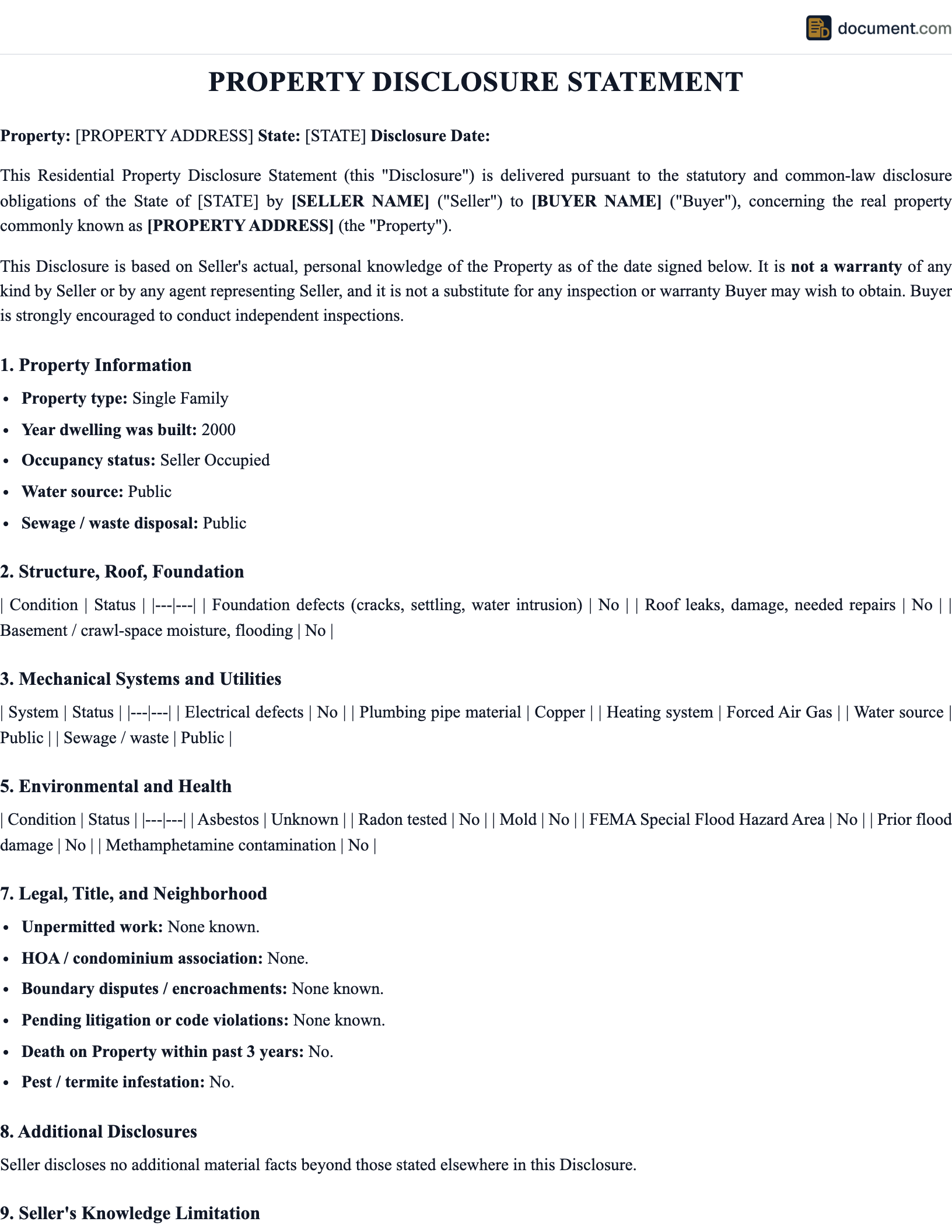
Sample Texas Disclosure Statement
Preview of our Texas-specific template. Your document will include all fields required for recording in any Texas county.
PROPERTY DISCLOSURE STATEMENT
STATE OF TEXAS
Legal Document
PARTY INFORMATION
Name: [Full Legal Name]
Address: [Texas Address]
County: [County]
PROPERTY DESCRIPTION
County: [County] State: Texas
Legal Description: [Per Recorded Plat]
Parcel No.: [APN]
Texas Disclosure Statement FAQ
Common questions about filing in Texas, including requirements, fees, and tax implications.
Official Texas Resources
Official state resources for verifying requirements and finding your local recording office.
Important Considerations for Texas Sellers
Texas sellers in flood-prone areas should approach the disclosure form with particular care. If the property has ever taken on water from a storm, drainage backup, or any other source, that history must be disclosed even if repairs were made afterward. The disclosure asks about flooding events, not just current conditions. Sellers who repaired water damage but never mentioned the underlying event are the ones most likely to face post-closing claims.
For properties in HOA communities, sellers should confirm the current status of dues and any outstanding assessments before filling out the disclosure. Buyers in Texas HOA transactions are also entitled to receive a separate resale package from the HOA itself, but the seller's disclosure must accurately reflect HOA-related obligations the seller is aware of.
If your property has ever had mold remediation, a roof replacement, foundation repair, or any major system repair, those facts are almost certainly relevant to the disclosure even if the work was done properly. Buyers need to know the history. Sellers sometimes worry that disclosure will hurt negotiations, but buyers who learn about well-documented prior repairs and completed remediation often gain confidence rather than concern.
Texas-Specific Tip
Texas uses a state-mandated form. Make sure you are using the current version from the Texas Real Estate Commission. Using an outdated or altered version of the form does not satisfy the statutory requirement. Your listing agent should have the current form, or you can obtain it directly from the TREC website.
Related Documents
Depending on your situation, you may need additional documents alongside this one. Below are commonly related documents that are frequently used together in real estate transactions.
Working With a Texas Real Estate Attorney
Attorney involvement is not required in Texas residential transactions, but sellers with complex histories should seriously consider it. Properties that have experienced flooding, foundation issues, mold remediation, or other significant events before listing are the situations where professional guidance on disclosure pays dividends. A Texas real estate attorney can help you accurately characterize these conditions and avoid language on the form that could later be construed as downplaying what you knew.
The Texas DTPA is a significant reason why sellers in high-value transactions sometimes request an attorney review of their disclosure before delivery. Intentional or knowing misrepresentation under the DTPA can result in treble damages. Sellers who are uncertain about how to answer a particular question are better served getting advice than guessing.
Keep your complete disclosure file, including the signed buyer acknowledgment, for several years after closing. Texas statutes of limitation for real estate fraud claims can extend well beyond the closing date, and having a complete record of what you disclosed and when is your best protection if a dispute arises later.
Professional Recommendation
Texas real estate attorneys familiar with DTPA exposure can review your completed disclosure form and flag any areas of concern before you deliver it to the buyer. Given the elevated damages available under Texas law for knowing misrepresentation, that review is especially valuable when the property has a complicated history.
Related Documents
Depending on your situation, you may need additional documents alongside this one. Below are commonly related documents that are frequently used together in real estate transactions.
Create your Texas Property Disclosure Statement in under 5 minutes.
Answer a few questions and download a Texas-compliant document, ready for the state agency.