



Tennessee Disclosure Statement Overview
Tennessee's Residential Property Disclosure Act has been in place for decades, and it creates a clear obligation: sellers of residential property must deliver a written disclosure of known material defects to prospective buyers before or at the time of signing a purchase contract. The statute runs from TCA 66-5-201 through 66-5-212 and covers a wide range of property conditions, from structural and mechanical systems to environmental hazards and even neighborhood nuisances that would substantially reduce a property's value.
That last category, neighborhood nuisances, is worth noting because many states do not address it in their disclosure statutes at all. Tennessee takes the position that a buyer has a legitimate interest in knowing about nearby conditions that would affect how much the property is worth or how livable it is. Sellers who are aware of a problematic situation beyond their property line should think carefully before deciding it does not need to be disclosed. The safer practice is almost always to include it and let the buyer weigh it themselves.
$10
Recording fee
$0.37 per $100
Transfer tax
Required
Notarization
0
Witnesses required
Tennessee Requirements
Under the Tennessee Residential Property Disclosure Act, sellers must complete and deliver the state disclosure form before the purchase contract is signed. The form requires sellers to honestly answer questions about every major category of property condition based on their personal knowledge. Answers must be truthful; sellers who guess or deliberately minimize known problems take on significant legal risk.
Tennessee Seller Note
Tennessee's 3-day rescission window is shorter than most states. Make sure the buyer receives the disclosure before signing the purchase contract, not after. If you provide it late, the buyer's 3-day right to cancel runs from actual receipt. Sellers should also remember that Tennessee requires disclosure of neighborhood nuisances, not just on-property conditions. When in doubt about whether something needs to be disclosed, include it.
What Tennessee Sellers Must Cover
- Structural systems: Foundation, roof, walls, attic, and exterior surfaces
- Mechanical systems: HVAC, plumbing, electrical, water heater, and built-in appliances
- Environmental hazards: Known asbestos, lead paint, radon, mold, underground storage tanks
- Geological conditions: Any known landslide risk, subsidence, or earth movement on or near the property
- Neighborhood nuisances: Known nearby conditions that substantially affect the property's value or livability
- Lead-based paint: Separate federal disclosure required for homes built before 1978
How to File in Tennessee
The Tennessee disclosure process is completed between the seller and the buyer before signing the purchase contract. No government office is involved, no recording fee is owed, and notarization is not required. The disclosure is a written communication from seller to buyer and it must happen early in the transaction.
Fill Out the Tennessee Disclosure Form
Work through the form carefully, section by section. Answer every question based on what you actually know about the property. Do not skip sections or leave blanks. If you are unsure whether something qualifies as a material defect, err toward disclosure.
Deliver to the Buyer Before the Contract
Tennessee law requires delivery at or before the time the purchase contract is signed. Work through your real estate agent to ensure the form reaches the buyer early in the process. Email delivery through your agent is typical and appropriate.
Track the 3-Day Rescission Window
Once the buyer receives the disclosure, they have 3 days to rescind the agreement without penalty. Note the delivery date so both sides know exactly when this window opens and closes. After 3 days without a rescission notice, the deal proceeds.
Get the Buyer's Signed Acknowledgment
Obtain the buyer's signature confirming they received and reviewed the disclosure. This is your evidence that the obligation was met. Keep this in your closing file.
Provide Updates If New Issues Arise
If you discover or become aware of a new material condition between signing and closing, provide an updated disclosure promptly. Tennessee sellers cannot sit on newly discovered information and wait to see if the buyer notices.
Tennessee Fees & Costs
Typical costs for filing in Tennessee. Actual fees may vary by county.
| Fee / Tax | Amount |
|---|---|
| Recording Fee | $10 |
| Transfer Tax | $0.37 per $100 |
| Notarization | $5 - $25 per signature |
| Certified Copy | $1 - $10 per page |
| Attorney Review (optional) | $150 - $500 |
Seller Liability for Non-Disclosure in Tennessee
Tennessee sellers who fail to disclose known material defects face real legal exposure. A buyer who discovers a problem after closing that the seller knew about can bring a civil claim for misrepresentation, fraudulent concealment, or breach of the disclosure statute itself. The remedies can include recovery of repair costs, damages for diminished property value, and in extreme cases, rescission of the entire transaction.
One area where Tennessee sellers sometimes underestimate their exposure is the neighborhood nuisance category. A seller who knows that a nearby commercial operation creates a persistent problem, and does not mention it on the disclosure form, can be held liable even though the issue is technically off the seller's property. The statute's reach into surrounding conditions is broader than many sellers expect.
The disclosure statement also creates a documented record that benefits sellers in dispute situations. If a buyer complains about a condition after closing that was clearly addressed on the disclosure form, the seller can point to the signed acknowledgment as evidence that the buyer was informed. This is why complete and careful disclosure is always the better strategy compared to hoping issues go unnoticed.
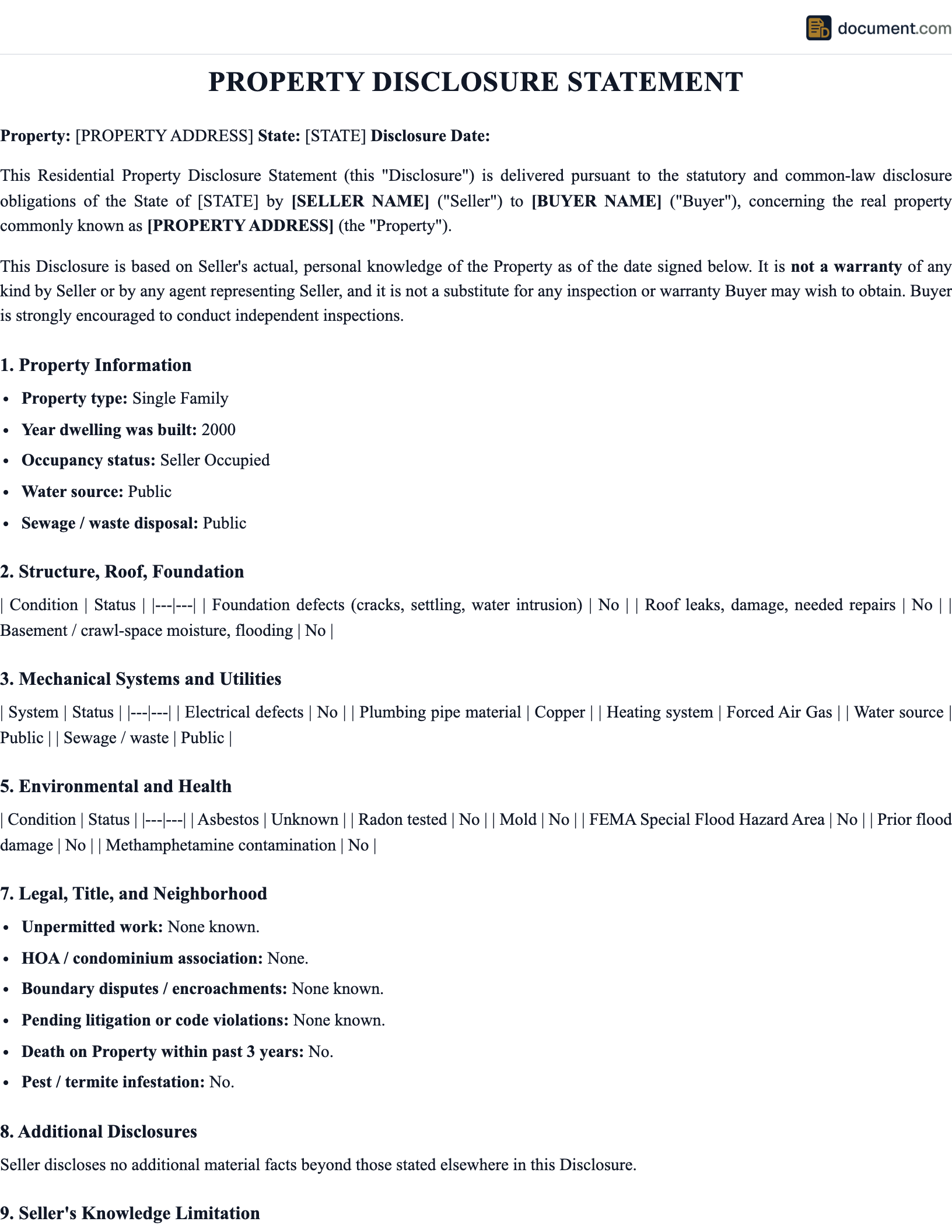
Sample Tennessee Disclosure Statement
Preview of our Tennessee-specific template. Your document will include all fields required for recording in any Tennessee county.
PROPERTY DISCLOSURE STATEMENT
STATE OF TENNESSEE
Legal Document
PARTY INFORMATION
Name: [Full Legal Name]
Address: [Tennessee Address]
County: [County]
PROPERTY DESCRIPTION
County: [County] State: Tennessee
Legal Description: [Per Recorded Plat]
Parcel No.: [APN]
Tennessee Disclosure Statement FAQ
Common questions about filing in Tennessee, including requirements, fees, and tax implications.
Official Tennessee Resources
Official state resources for verifying requirements and finding your local recording office.
Important Considerations for Tennessee Sellers
Tennessee sellers should pay particular attention to the geological conditions section of the disclosure form. The state has areas where landslide and subsidence risk is genuinely elevated, particularly in parts of Middle and East Tennessee with steep terrain and certain soil types. Sellers who are aware of any past earth movement, slope instability, or subsidence on or near the property must disclose that information. Buyers who later discover these conditions were known and not disclosed have a strong basis for a claim.
For properties in neighborhoods undergoing commercial development or near active agricultural operations, take the neighborhood nuisance section seriously. Tennessee is one of the few states that explicitly requires disclosure of these conditions, and sellers who have complained about a nearby situation to a neighbor or local authority have usually already established their own knowledge of the problem.
Sellers of older homes should coordinate the state disclosure with the separate federal lead-based paint disclosure, which is required for any home built before 1978. Both forms need to be signed by the buyer. Missing either one can expose the seller to claims under both state and federal law.
Timing Tip for Tennessee Sellers
Get the disclosure form completed and ready before listing the property. Handing it to buyers at the first showing or at contract signing avoids any argument about whether disclosure happened before the contract. A buyer who receives the form on the same day they sign the contract still has 3 days to rescind. A seller who delivers it after signing has arguably already violated the statute.
Related Documents
Depending on your situation, you may need additional documents alongside this one. Below are commonly related documents that are frequently used together in real estate transactions.
Working With a Tennessee Real Estate Attorney
Tennessee does not require attorney involvement in a standard residential sale, but sellers dealing with known defects, disputed conditions, or properties with complex histories will benefit from a consultation before listing. An attorney can review your completed disclosure form, identify anything that may be legally ambiguous, and advise you on how to accurately describe borderline conditions without understating them.
If you have made repairs to address a prior defect, an attorney can also help you think through how to accurately describe what was fixed and whether any underlying condition still needs to be disclosed. In Tennessee, disclosing a prior problem along with the completed repair is usually the right approach, and it tends to generate fewer buyer concerns than an unexplained gap in the property's history.
Keep your signed disclosure form and acknowledgment receipt in a secure location after closing. Post-closing disputes in Tennessee can arise months or even years after the sale, and a complete disclosure file is often the most useful evidence a seller has.
Professional Recommendation
Tennessee real estate attorneys commonly offer flat-fee consultations for disclosure review. The cost is modest compared to the risk of a post-closing misrepresentation claim, particularly if your property has a complicated repair history or sits in an area with known geological or environmental sensitivities.
Related Documents
Depending on your situation, you may need additional documents alongside this one. Below are commonly related documents that are frequently used together in real estate transactions.
Create your Tennessee Property Disclosure Statement in under 5 minutes.
Answer a few questions and download a Tennessee-compliant document, ready for the state agency.