



South Carolina Disclosure Statement Overview
South Carolina's mandatory property disclosure law, SC Code 27-50-10 through 27-50-100, requires residential sellers to provide buyers with a written disclosure of known material defects before the buyer signs a purchase contract. The form goes directly from seller to buyer and is not recorded with any government office. No notarization is required and no filing fee applies. The purpose of the form is to give buyers accurate information about the property's condition based on what the seller actually knows.
South Carolina has several disclosure considerations shaped by the state's climate and real estate market. Termite and wood-destroying insect activity is a major disclosure topic given the state's warm, humid conditions that favor subterranean termites. Coastal flooding and storm surge risk must be addressed for properties in or near FEMA flood zones, particularly in the Grand Strand, Lowcountry, and coastal Beaufort County. HOA disclosure is mandatory where applicable and can affect the buyer's financing and rescission rights. Sellers who omit known conditions face civil liability, and AS-IS contract language does not provide protection against non-disclosure claims.
$10
Recording fee
$1.85 per $500
Transfer tax
Required
Notarization
0
Witnesses required
South Carolina Requirements
Under SC Code 27-50-10 through 27-50-100, the seller must deliver the completed disclosure to the buyer before the buyer signs the purchase agreement. The buyer then has 5 calendar days to rescind without penalty. If the seller learns of material new facts between the initial disclosure and closing, an updated disclosure must be provided. The seller's obligation is limited to conditions within their actual knowledge and does not require them to investigate or discover hidden defects.
South Carolina Disclosure Priorities
Termite and WDI history is a critical South Carolina disclosure item. Flood zone status and storm surge risk must be addressed for coastal and flood-prone properties. HOA disclosure is mandatory where the property is subject to association governance. Buyers have 5 calendar days from delivery to rescind, and this right cannot be waived by AS-IS contract language.
What the South Carolina Disclosure Must Cover
- Structural and Mechanical: Foundation, roofing, walls, plumbing, electrical, HVAC, and appliances
- Termite and WDI: Known termite infestation, prior treatment, and any structural damage caused by wood-destroying insects
- Flood and Storm: FEMA flood zone designation, known flooding history, and storm surge damage
- HOA: Whether the property is in an HOA, current fees, pending special assessments, and management contact information
- Environmental Hazards: Asbestos, lead paint, mold, underground storage tanks, and known contamination
- Legal Matters: Known deed restrictions, easements, boundary disputes, and pending legal actions affecting the property
How to Deliver the Disclosure in South Carolina
South Carolina's disclosure process is seller-to-buyer with no government filing involved. The steps below reflect what SC Code 27-50-10 through 27-50-100 actually require, which differs significantly from what the original template on this page incorrectly described.
Complete the Disclosure Form Carefully
Answer every question on the South Carolina property condition disclosure form based on your actual knowledge. Pay special attention to the termite section. Pull your pest control treatment records if you have them, and note any structural repairs that were made in connection with WDI damage. Address flood zone status honestly, and complete the HOA section if the property is in an association.
Gather Supporting Documents
South Carolina transactions often involve a WDI report from a licensed pest control company, flood zone determination documentation, and HOA governing documents. Have these materials ready before or shortly after delivering the disclosure form so the buyer can review everything within their 5-day rescission window.
Deliver to the Buyer Before Contract Signing
Give the completed disclosure form to the buyer or their agent before the buyer signs the purchase agreement. Document the delivery date and method. Many South Carolina transactions use electronic delivery, which is acceptable as long as both parties agree and the delivery date can be confirmed.
Obtain the Buyer's Acknowledgment of Receipt
Have the buyer sign and date a receipt confirming they received the disclosure. This starts the 5-calendar-day rescission window. If HOA documents or a WDI report are part of the required disclosures, confirm which delivery starts the rescission clock based on your specific contract terms.
Update the Disclosure If Conditions Change
If you discover new material information about the property between initial disclosure and closing, you must provide an updated form. The buyer will then have a new 5-day rescission opportunity based on the updated disclosure. Do not wait to see if the buyer notices the change on their own.
South Carolina Fees & Costs
Typical costs for filing in South Carolina. Actual fees may vary by county.
| Fee / Tax | Amount |
|---|---|
| Recording Fee | $10 |
| Transfer Tax | $1.85 per $500 |
| Notarization | $5 - $25 per signature |
| Certified Copy | $1 - $10 per page |
| Attorney Review (optional) | $150 - $500 |
Seller Liability for Non-Disclosure in South Carolina
South Carolina sellers who fail to disclose known material defects face civil liability under the state's disclosure statute and under common law fraud and negligent misrepresentation theories. A buyer who discovers a concealed defect after closing can bring claims for repair costs, diminished property value, and consequential losses. Courts have also awarded attorney fees in cases where the seller's concealment was particularly clear or deliberate.
Termite damage is one of the most litigated non-disclosure issues in South Carolina. A buyer who moves in and discovers significant structural damage from termites, and who can show the seller had prior treatment records or repair documentation they did not disclose, is in a strong position to recover damages. Given the prevalence of termite activity in the state, South Carolina courts and juries are generally familiar with these claims and how they work.
Flood damage concealment is another common source of post-closing litigation. Coastal and inland properties that have experienced flooding are often renovated and listed without adequate disclosure of the flood history. When buyers discover prior flood damage through insurance records, FEMA claims history, or neighborhood research, the absence of disclosure on the seller's form is a significant problem. South Carolina sellers are better served by thorough disclosure than by assuming the buyer will not investigate.
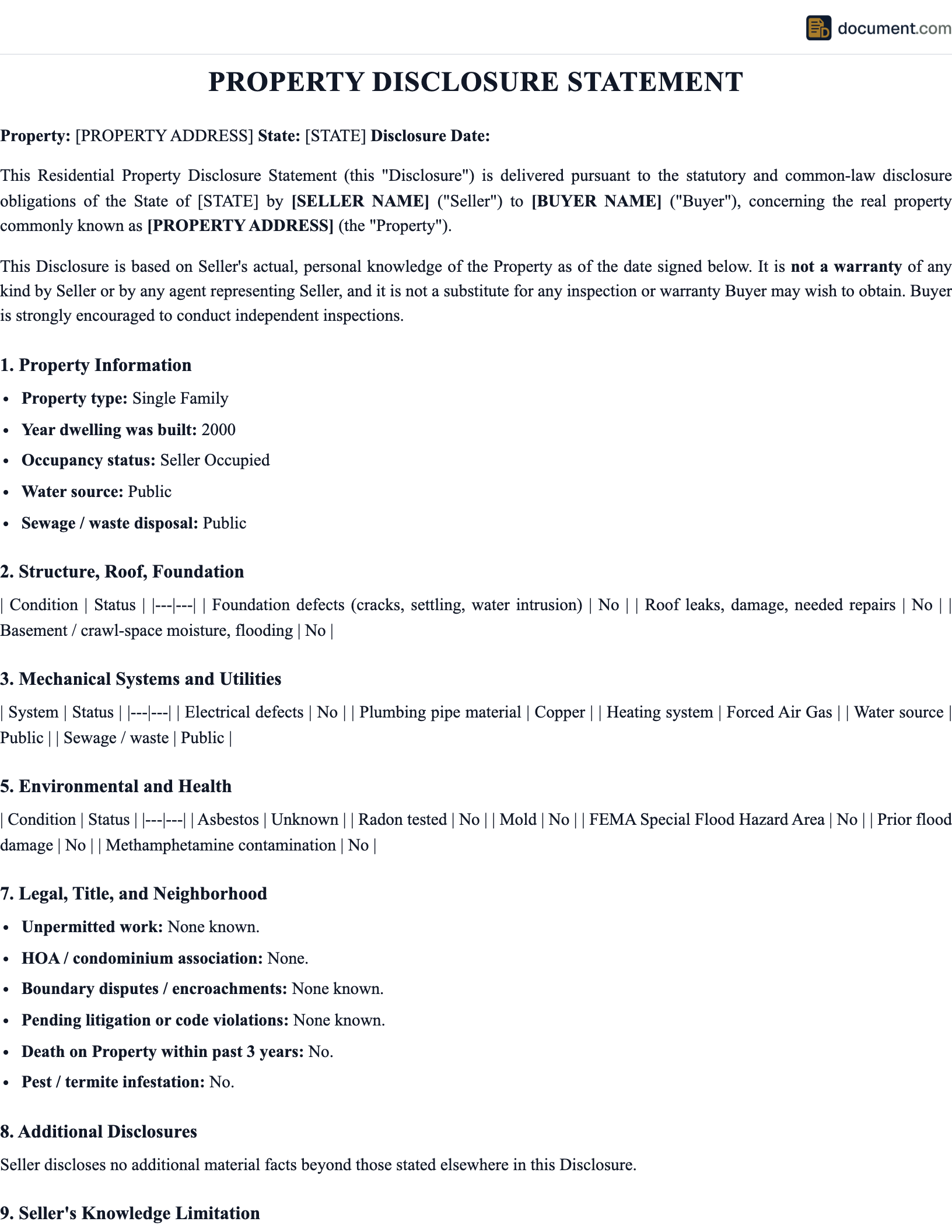
Sample South Carolina Disclosure Statement
Preview of our South Carolina-specific template. Your document will include all fields required for recording in any South Carolina county.
PROPERTY DISCLOSURE STATEMENT
STATE OF SOUTH CAROLINA
Legal Document
PARTY INFORMATION
Name: [Full Legal Name]
Address: [South Carolina Address]
County: [County]
PROPERTY DESCRIPTION
County: [County] State: South Carolina
Legal Description: [Per Recorded Plat]
Parcel No.: [APN]
South Carolina Disclosure Statement FAQ
Common questions about filing in South Carolina, including requirements, fees, and tax implications.
Official South Carolina Resources
Official state resources for verifying requirements and finding your local recording office.
Important Considerations for South Carolina Sellers
Before completing the disclosure form, contact your pest control company and request your treatment history for the property. South Carolina pest control companies typically maintain records of treatments, and having those records allows you to answer the WDI section of the disclosure form accurately. If there was prior structural damage that was repaired in connection with termite activity, that repair history is disclosable regardless of how thorough the fix was.
For coastal and Lowcountry properties, review your homeowners insurance history before completing the disclosure. Insurance claims for flood or storm damage create a documented record, and FEMA maintains a database of prior flood insurance claims tied to specific properties. Buyers and their attorneys know how to access these records, and a disclosure form that omits known flood events will be compared against those records if a dispute arises after closing.
HOA disclosure is a practical issue that sellers sometimes underestimate. Buyers who discover significant special assessments, pending litigation involving the HOA, or major upcoming expenses that were not disclosed tend to feel misled even when the seller genuinely did not think those items were important. Providing full HOA documentation early in the process, rather than waiting for the buyer to request it, typically leads to smoother transactions.
South Carolina Seller Tip
Gather your pest control treatment records, flood insurance claim history, insurance repair claims, HOA financial documents, and any inspection or contractor reports before completing the South Carolina disclosure form. South Carolina real estate attorneys can review a completed disclosure form before delivery, which is particularly worthwhile for coastal properties, properties with termite history, and properties in active HOA communities.
Related Documents
Depending on your situation, you may need additional documents alongside this one. Below are commonly related documents that are frequently used together in real estate transactions.
Working With South Carolina Real Estate Professionals
South Carolina real estate agents are familiar with the disclosure form and can guide sellers through the process, but the legal obligation for accuracy rests with the seller. Your agent can help you understand what each section is asking and coordinate delivery logistics, but the substantive answers must come from your own knowledge of the property.
Many South Carolina residential transactions also involve attorney representation at closing, which is common practice in the state. If you are working with a closing attorney, take the opportunity to ask them to review your completed disclosure form before delivery. A South Carolina real estate attorney can spot areas where sellers commonly under-disclose, particularly on termite history, flood information, and HOA matters.
South Carolina buyers in coastal markets are increasingly sophisticated about flood risk and often engage independent professionals to evaluate flood zone status, elevation certificates, and storm damage history. Sellers in these markets who try to minimize flood-related disclosures often find themselves facing very specific and well-documented claims if issues arise after closing. Proactive and complete disclosure is the better strategy by a significant margin.
South Carolina Documentation Checklist
Before completing the disclosure form, collect: pest control treatment records and WDI reports, flood insurance claims history, homeowners insurance claims, contractor invoices for major repairs, HOA meeting minutes and financial records for the past two to three years, and any inspection reports from your purchase of the property. These documents help you complete the form accurately and protect you against post-closing claims.
Related Documents
Depending on your situation, you may need additional documents alongside this one. Below are commonly related documents that are frequently used together in real estate transactions.
Create your South Carolina Property Disclosure Statement in under 5 minutes.
Answer a few questions and download a South Carolina-compliant document, ready for the state agency.