



Rhode Island Disclosure Statement Overview
Rhode Island's residential property disclosure law, RIGL 5-20.8-2, requires sellers to deliver a written disclosure of known material defects and conditions to the buyer before the buyer signs a purchase agreement. The disclosure is a seller-to-buyer document. It is not recorded with any government office, requires no notarization, and carries no filing fee. It reflects the seller's actual knowledge of the property's condition at the time of sale.
Rhode Island sellers face a few disclosure considerations that reflect the state's unique character. The state's housing stock is among the oldest in the country, making lead paint a significant and recurring disclosure issue for pre-1978 homes. Coastal flooding and erosion are material concerns for properties near Rhode Island's shoreline. Historic district restrictions affecting renovations and exterior changes are disclosable material facts in many Rhode Island communities. Buyers have 10 calendar days after receiving the disclosure to rescind the purchase contract, and sellers who omit known conditions face potential fraud and statutory claims after closing.
$30
Recording fee
$2.30 per $500
Transfer tax
Required
Notarization
0
Witnesses required
Rhode Island Requirements
RIGL 5-20.8-2 sets out the core obligation: sellers of residential real estate must complete and deliver the disclosure form before the buyer signs the purchase agreement. Delivery can occur in person, by mail, or electronically with mutual agreement. No recording and no notarization are required for the disclosure form itself. The seller must also update the disclosure if material new information comes to light between initial delivery and closing.
Rhode Island Disclosure Priorities
Lead paint disclosure is especially significant in Rhode Island given the state's age of housing stock. Coastal flooding, erosion, and storm damage must be disclosed for waterfront and near-coastal properties. Historic district restrictions on renovations are disclosable material facts. Buyers have 10 calendar days from receipt to rescind, and the statutory rescission right cannot be waived by AS-IS contract language.
What the Rhode Island Disclosure Must Cover
- Structural and Mechanical: Foundation, roofing, walls, plumbing, electrical, HVAC, and any known past defects or repairs
- Lead Paint: Presence of known lead-based paint hazards, prior testing, and any remediation conducted in pre-1978 homes
- Flooding and Erosion: Known flood history, FEMA flood zone status, and coastal erosion affecting waterfront or near-shore properties
- Historic Restrictions: Designation in a local historic district or state or federal register that restricts alterations to the property
- Environmental Hazards: Asbestos, mold, underground storage tanks, and known contamination of soil or water
- Legal Encumbrances: Known easements, deed restrictions, boundary disputes, and pending legal proceedings affecting title or use
How to Deliver the Disclosure in Rhode Island
Rhode Island's disclosure process is entirely between seller and buyer. No government office is involved, no recording occurs, and no fee is paid. The practical process has a few steps worth following carefully to protect yourself as a seller.
Complete the Disclosure Form Accurately
Work through the Rhode Island disclosure form and answer based on your actual knowledge of the property. For older homes, pay careful attention to the lead paint section. For coastal or near-shore properties, address flooding, erosion, and storm damage honestly. If the property is in a historic district, note any restrictions that affect what the buyer can do with it.
Confirm Historic District Status If Relevant
If you are unsure whether the property falls within a local or state historic district, check with your city or town's planning office or historic preservation commission before completing that section of the form. Many Rhode Island communities have local historic districts that are distinct from state or federal listings, and sellers are expected to know which designations affect their property.
Deliver to the Buyer Before Contract Signing
Hand the completed disclosure to the buyer or their agent before the buyer executes the purchase agreement. Document the delivery method and date. This is the triggering event for the 10-day rescission window, and clear documentation of when delivery occurred protects you if there is ever a dispute about timing.
Get a Signed Receipt From the Buyer
Have the buyer acknowledge receipt in writing and sign and date that acknowledgment. Keep a copy. This is your evidence that the 10-day clock has started running and that you complied with the RIGL 5-20.8-2 delivery requirement.
Update If You Learn Something New Before Closing
Rhode Island law requires sellers to update the disclosure if they become aware of new material information after the initial delivery. If something comes to light between disclosure and closing, tell the buyer promptly with an updated form. This triggers a new rescission window but it also fulfills your legal obligation and limits post-closing liability.
Rhode Island Fees & Costs
Typical costs for filing in Rhode Island. Actual fees may vary by county.
| Fee / Tax | Amount |
|---|---|
| Recording Fee | $30 |
| Transfer Tax | $2.30 per $500 |
| Notarization | $5 - $25 per signature |
| Certified Copy | $1 - $10 per page |
| Attorney Review (optional) | $150 - $500 |
Seller Liability for Non-Disclosure in Rhode Island
Rhode Island sellers who violate RIGL 5-20.8-2 face civil liability to the buyer. Buyers who discover undisclosed material defects after closing can bring statutory claims as well as common law claims for fraud and negligent misrepresentation. Remedies typically include repair costs and diminution in property value. In egregious cases involving deliberate concealment, punitive damages and attorney fee awards are also possibilities, depending on how the claims are structured.
Lead paint non-disclosure creates overlapping state and federal exposure. A seller of a pre-1978 home who knows of lead paint hazards and fails to disclose them violates both Rhode Island's disclosure statute and federal lead paint disclosure requirements. Rhode Island has historically taken lead paint issues in housing seriously, and buyers who discover that a seller concealed known lead hazards tend to pursue those claims aggressively.
For coastal properties, non-disclosure of known flood history, erosion problems, or storm damage is a recurring area of post-closing disputes. Buyers who purchase waterfront or near-shore properties without accurate information about flood risk and damage history often have substantial claims when problems arise. Sellers who think flood zone status is obvious or that buyers will figure it out through their own research take on significant legal risk by staying silent on these issues.
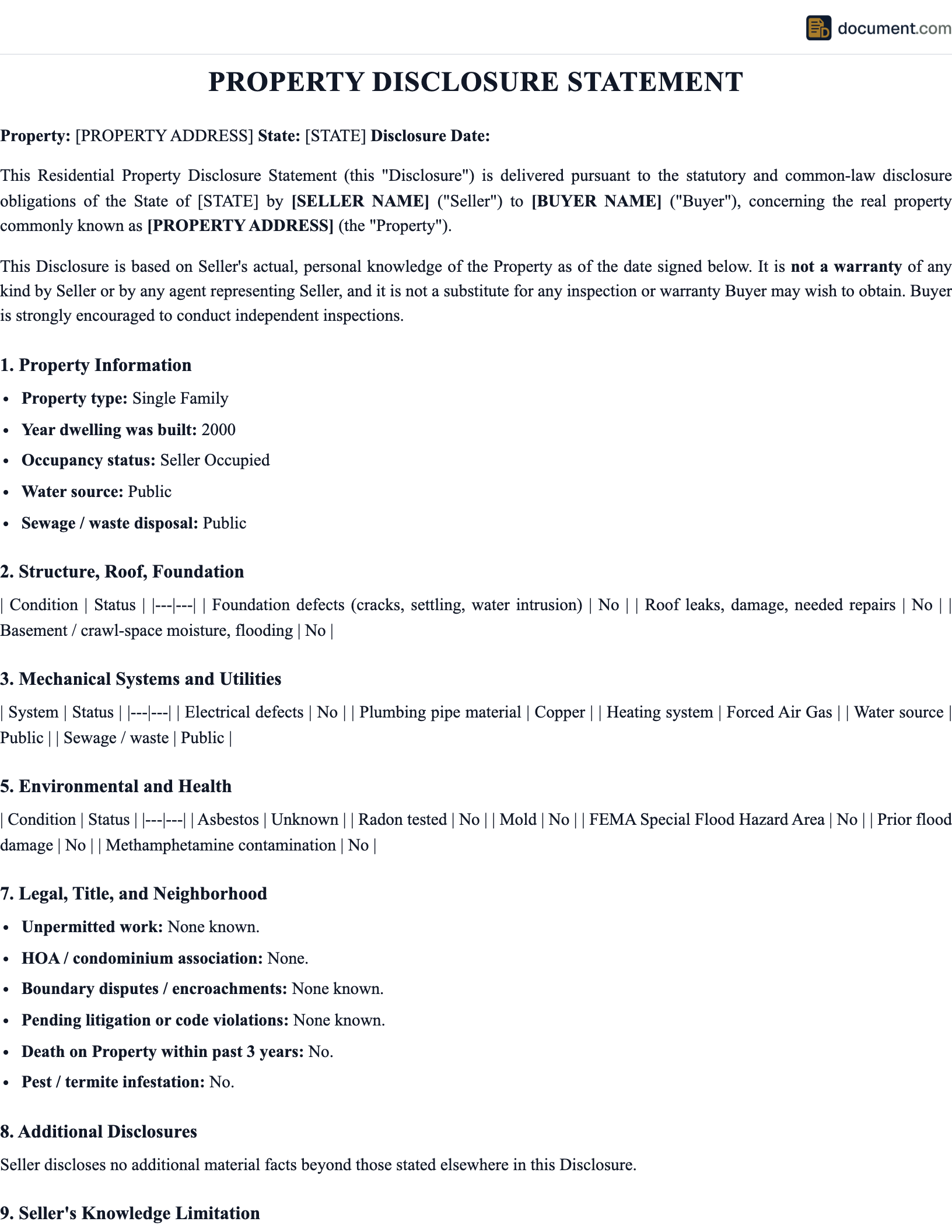
Sample Rhode Island Disclosure Statement
Preview of our Rhode Island-specific template. Your document will include all fields required for recording in any Rhode Island county.
PROPERTY DISCLOSURE STATEMENT
STATE OF RHODE ISLAND
Legal Document
PARTY INFORMATION
Name: [Full Legal Name]
Address: [Rhode Island Address]
County: [County]
PROPERTY DESCRIPTION
County: [County] State: Rhode Island
Legal Description: [Per Recorded Plat]
Parcel No.: [APN]
Rhode Island Disclosure Statement FAQ
Common questions about filing in Rhode Island, including requirements, fees, and tax implications.
Official Rhode Island Resources
Official state resources for verifying requirements and finding your local recording office.
Important Considerations for Rhode Island Sellers
If your home was built before 1978, the lead paint section of the disclosure deserves careful attention. Rhode Island's older cities, including Providence, Pawtucket, Woonsocket, and Central Falls, have significant concentrations of pre-war housing with lead paint issues. If you have had any lead paint testing done during your ownership, those results must be disclosed. If you have never tested, say so, but do not claim the property is free of lead paint when you genuinely have no information on the topic.
For coastal and waterfront properties, think through what you know about the property's flood history before completing the form. If the property sustained damage in major storm events, such as significant hurricanes that have affected the Rhode Island coastline over the past several decades, those events may have left evidence that a buyer and their inspector will find. Disclosing known flood events and any resulting damage is far preferable to having a buyer discover documentation of past flooding that was not on the disclosure form.
Historic district restrictions are a practical issue as much as a legal one. Buyers who move into a Providence College Hill home or a Newport Hill neighborhood property and then discover that the historic district commission controls their renovation plans are going to feel they were not given important information. Even if historic restrictions do not affect the property's current condition, they affect what a buyer can do with it, and that is material.
Rhode Island Seller Tip
Before completing the disclosure form, review your purchase documents, any inspection reports from when you bought the property, repair records, insurance claims, and any lead paint testing reports. Rhode Island buyers, particularly those purchasing older properties, commonly bring in thorough inspectors. Disclosures that align with what the inspector finds tend to result in smoother closings. Disclosures that contradict what the inspector finds tend to result in negotiations or rescissions.
Related Documents
Depending on your situation, you may need additional documents alongside this one. Below are commonly related documents that are frequently used together in real estate transactions.
Working With Rhode Island Real Estate Professionals
Rhode Island real estate transactions often involve attorneys in addition to real estate agents, and this is worth taking advantage of when it comes to disclosure. Rhode Island attorneys experienced in real property transactions can review the completed disclosure form and flag areas where the seller may be under-disclosing relative to what they actually know. This is a much better outcome than a post-closing dispute over what was known and when.
For properties that have been in the family for a long time, the seller may have limited documented knowledge of what happened to the property in prior decades. Answer honestly about what you know from your own experience and what records you have. Speculation is not what the form requires, and courts understand that sellers sometimes have genuine knowledge gaps. The issue arises when sellers have relevant documentation or direct knowledge and choose not to reflect that in their answers.
Rhode Island buyers commonly bring their own inspectors for general home inspections, as well as specialists for specific concerns such as radon, lead paint, pest and WDI, and structural evaluation. Sellers whose disclosures are comprehensive and accurate tend to have significantly smoother inspection processes because there are no surprises. Sellers whose disclosures are vague or incomplete tend to face more friction at the inspection stage and more difficult negotiations afterward.
Rhode Island Documentation Checklist
Collect repair receipts, inspection reports, insurance claims, lead paint test results, any correspondence about structural or mechanical deficiencies, and records of renovations or improvements before completing the disclosure form. For coastal properties, also review any documentation of past flood events, storm damage repairs, or insurance claims related to water. These records support your disclosures and demonstrate good faith.
Related Documents
Depending on your situation, you may need additional documents alongside this one. Below are commonly related documents that are frequently used together in real estate transactions.
Create your Rhode Island Property Disclosure Statement in under 5 minutes.
Answer a few questions and download a Rhode Island-compliant document, ready for the state agency.