
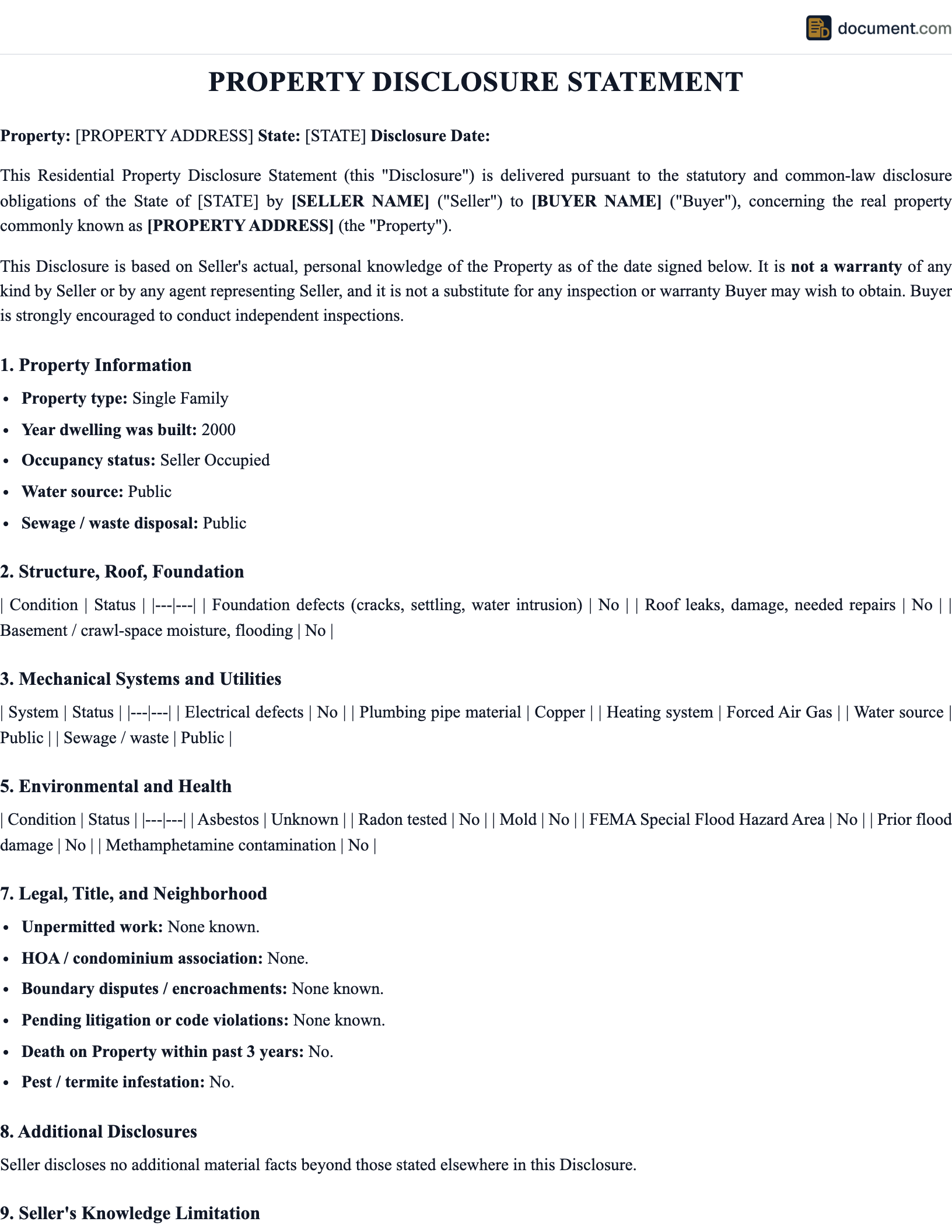



Pennsylvania Disclosure Statement Overview
Pennsylvania's Real Estate Seller Disclosure Law (RESDL), codified at 68 Pa.C.S. Sections 7301-7315, requires sellers of residential property to deliver a written property condition disclosure to buyers before any purchase agreement is signed. The form must reflect the seller's actual knowledge of the property's condition and covers a comprehensive list of structural, mechanical, and environmental categories. There is no recording requirement, no notarization, and no government filing involved. The disclosure is purely seller-to-buyer.
Pennsylvania's disclosure law has several important features that sellers should understand. First, prior repaired defects must still be disclosed, not just current conditions. Second, radon is specifically addressed because Pennsylvania has high radon concentrations statewide. Third, mine subsidence is a required disclosure item in many parts of western and central Pennsylvania due to the state's extensive coal mining history. Sellers who omit known conditions face statutory liability and potential fraud claims that can be brought years after closing.
$25
Recording fee
2% (1%+1%)
Transfer tax
Required
Notarization
0
Witnesses required
Pennsylvania Requirements
The RESDL sets out specific obligations for Pennsylvania sellers. The disclosure form must be delivered to the buyer before the purchase agreement is executed, and the seller must provide an updated disclosure if they learn of new material facts before closing. The buyer has 10 calendar days after receiving the disclosure to rescind the agreement without cause. No notarization, recording, or filing fee applies to the disclosure form itself.
Pennsylvania-Specific Disclosure Items
Pennsylvania sellers must disclose known defects even if those defects were previously repaired. Radon test results are required disclosures, and mine subsidence risk must be addressed for properties in areas with underground mining history. Buyers have 10 calendar days after receiving the form to rescind. AS-IS sales do not exempt the seller from completing the disclosure.
What the Pennsylvania Disclosure Must Cover
- Structural and Mechanical Systems: Foundation, roof, walls, plumbing, electrical, HVAC, and appliances including any prior defects that were repaired
- Radon: Results of any radon testing conducted during the seller's ownership, including mitigation measures taken
- Mine Subsidence: Known mine subsidence risk or damage, applicable primarily in coal regions of western and central Pennsylvania
- Environmental Hazards: Asbestos, lead paint, mold, underground storage tanks, and known soil or water contamination
- Water and Sewer: Water supply source, known issues with the well or septic system, and public utility service status
- Legal Matters: Known zoning violations, deed restrictions, easements, boundary disputes, and pending legal actions affecting the property
How to Deliver the Disclosure in Pennsylvania
Pennsylvania's disclosure process involves the seller completing the RESDL form and delivering it directly to the buyer before any purchase contract is signed. There is no government filing and no recording involved. The steps below reflect what the law actually requires.
Complete the RESDL Form Thoroughly
Answer every question on the Pennsylvania RESDL based on your knowledge of the property. Remember that prior repaired defects must be disclosed, not just current conditions. Pull out any repair receipts, inspection reports, and contractor records from your ownership to make sure you are not overlooking anything.
Address Pennsylvania-Specific Items
Make sure you have addressed radon testing history and mine subsidence risk. If you have had radon tests done, locate those reports before completing the form. If you are selling in Allegheny, Fayette, Washington, Westmoreland, or other historically mined counties, confirm whether any underground mining mapping covers the property.
Deliver to the Buyer Before Contract Signing
Hand the completed RESDL form to the buyer or their agent before the buyer executes the purchase agreement. Document the date and delivery method. If you are working through a real estate agent, confirm with them how delivery is being handled and make sure it happens at the right time.
Obtain the Buyer's Signed Acknowledgment
Have the buyer sign and date a written acknowledgment of receipt. Pennsylvania's 10-day rescission window starts from the acknowledged delivery date. Keep a signed copy of this acknowledgment through closing and for at least several years afterward.
Update the Disclosure If Necessary
If you discover new material information about the property between the initial disclosure delivery and closing, Pennsylvania law requires you to provide an updated disclosure. The buyer will then have a new rescission window based on the updated form. Do not try to manage around this requirement.
Pennsylvania Fees & Costs
Typical costs for filing in Pennsylvania. Actual fees may vary by county.
| Fee / Tax | Amount |
|---|---|
| Recording Fee | $25 |
| Transfer Tax | 2% (1%+1%) |
| Notarization | $5 - $25 per signature |
| Certified Copy | $1 - $10 per page |
| Attorney Review (optional) | $150 - $500 |
Seller Liability for Non-Disclosure in Pennsylvania
Pennsylvania sellers who violate the RESDL face statutory liability to the buyer. Under the law, a buyer who is damaged by a seller's failure to disclose a known material defect can pursue civil claims including breach of the statutory disclosure obligation, fraud, and negligent misrepresentation. Pennsylvania courts have allowed buyers to recover repair costs, diminution in property value, and in some cases consequential damages. The 10-day rescission window provides an immediate remedy before closing, but post-closing claims for concealed defects are viable under the RESDL and common law.
The obligation to disclose previously repaired defects creates particular exposure for sellers who think patching a problem eliminates the need to mention it. A seller who fixed a significant foundation crack, addressed persistent water infiltration, or remediated mold without disclosing those prior conditions is in a vulnerable position if the buyer later experiences related problems. Courts are not sympathetic to sellers who argue that because the repair was complete, the original defect was not material.
Radon and mine subsidence are areas where Pennsylvania buyers are often especially vigilant, and sellers should be. A buyer who tests for radon after closing and finds levels well above EPA action thresholds, and then discovers the seller had prior test results showing the same problem, has a clear factual basis for a non-disclosure claim. Pennsylvania sellers are better served by full disclosure and proper documentation than by hoping a buyer never tests.
Sample Pennsylvania Disclosure Statement
Preview of our Pennsylvania-specific template. Your document will include all fields required for recording in any Pennsylvania county.
PROPERTY DISCLOSURE STATEMENT
STATE OF PENNSYLVANIA
Legal Document
PARTY INFORMATION
Name: [Full Legal Name]
Address: [Pennsylvania Address]
County: [County]
PROPERTY DESCRIPTION
County: [County] State: Pennsylvania
Legal Description: [Per Recorded Plat]
Parcel No.: [APN]
Pennsylvania Disclosure Statement FAQ
Common questions about filing in Pennsylvania, including requirements, fees, and tax implications.
Official Pennsylvania Resources
Official state resources for verifying requirements and finding your local recording office.
Important Considerations for Pennsylvania Sellers
The repaired-defect rule deserves special attention. Before you complete the RESDL, go through your maintenance and repair records for the entire period of your ownership. Any significant structural repair, roof replacement driven by leak damage, plumbing failure, electrical problem, or mold remediation is likely a disclosable condition regardless of whether the fix was successful. Think of it this way: the disclosure form is asking what you know about the property, not just what is currently wrong with it.
If you are selling in a part of Pennsylvania with a history of coal mining, research whether your property is in an area of known underground workings before completing the mine subsidence section. The Pennsylvania Department of Environmental Protection maintains historical mining data, and your county may have additional local resources. Sellers in the Pittsburgh region, the anthracite coal regions of the Scranton-Wilkes-Barre area, and parts of central Pennsylvania should address this question with particular care.
Radon is pervasive in Pennsylvania, and buyers frequently test regardless of what the disclosure says. If you have never tested and are concerned about what a buyer might find, consider having a professional radon measurement done before listing. If levels are elevated, installing a mitigation system before the sale is often more cost-effective than negotiating remediation credit after the buyer's inspection.
Pennsylvania Seller Tip
Gather your repair records, contractor invoices, home warranty documents, inspection reports, and any radon test results before starting the RESDL form. In Pennsylvania, a complete disclosure based on actual documentation is your best protection against post-closing claims. Pennsylvania real estate attorneys can review the completed form before delivery if you have any uncertainty about what to include.
Related Documents
Depending on your situation, you may need additional documents alongside this one. Below are commonly related documents that are frequently used together in real estate transactions.
Working With Pennsylvania Real Estate Professionals
Pennsylvania real estate agents routinely handle the logistics of disclosure delivery, but they cannot complete the form on the seller's behalf. The RESDL places the disclosure obligation squarely on the seller. An agent can explain what each section is asking and remind you of things to consider, but the substance of the answers must come from your own knowledge of the property.
If you have inherited the property or have owned it for a short time, you may have limited knowledge of the property's history. In that situation, answer honestly based on what you do know, and clearly indicate where your knowledge is limited. Pennsylvania courts generally do not hold sellers liable for conditions they genuinely did not know about, but they look carefully at whether the seller had access to information they chose not to review.
Pennsylvania buyers have 10 days to review the disclosure carefully, often alongside home inspection findings. Sellers who provide a thorough, accurate disclosure tend to have smoother transactions because the buyer's discovery process confirms rather than contradicts what was disclosed. Sellers whose disclosures are sparse or vague tend to face more inspection-related negotiations and, in some cases, buyers who exercise their right to rescind.
Pennsylvania Documentation Checklist
Before completing the RESDL, collect: repair and renovation invoices, home warranty records, inspection reports from your purchase and any subsequent inspections, radon test results, pest control records, insurance claims, and any correspondence with contractors about structural or mechanical issues. These documents help you complete the form accurately and protect you if questions arise after closing.
Related Documents
Depending on your situation, you may need additional documents alongside this one. Below are commonly related documents that are frequently used together in real estate transactions.
Create your Pennsylvania Property Disclosure Statement in under 5 minutes.
Answer a few questions and download a Pennsylvania-compliant document, ready for the state agency.