
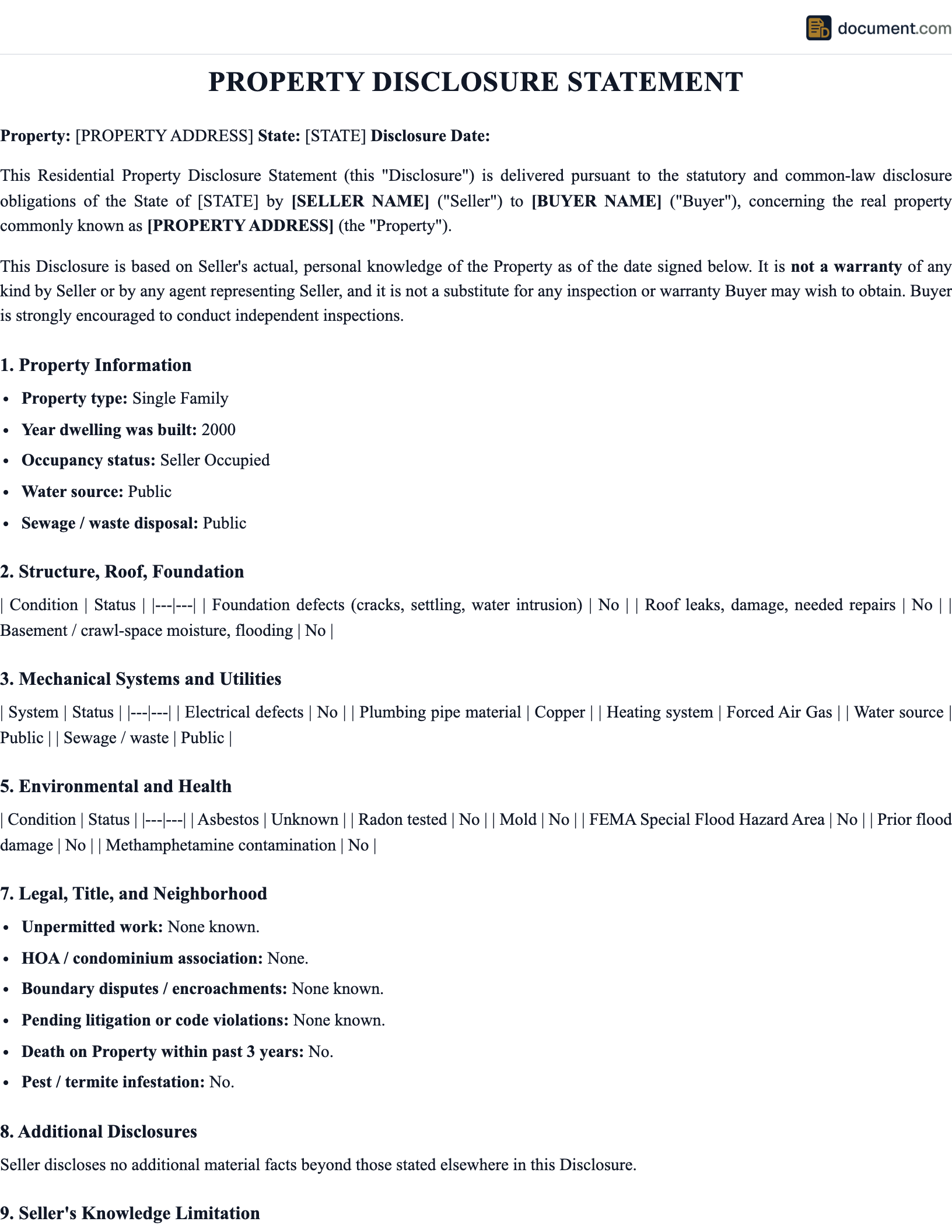



Oregon Disclosure Statement Overview
Oregon's residential property disclosure law, codified at ORS 105.462-105.490, requires sellers to provide buyers with a completed Seller's Property Disclosure Statement before any purchase agreement is signed. This is a seller-to-buyer document. It is not recorded with the county, not notarized, and carries no filing fee. Its purpose is to give buyers accurate information about the property's condition based on the seller's actual knowledge.
Oregon's SPDS stands out because of the natural hazard disclosures it requires. Sellers must address whether the property is in a flood plain, a landslide hazard zone, or a tsunami inundation zone. Water rights disclosures are also required for applicable properties, and wildfire risk is an increasingly significant concern in eastern Oregon and parts of the Rogue Valley. Sellers who omit known material conditions face statutory liability and potential fraud claims that can arise well after closing.
$56
Recording fee
Varies by county
Transfer tax
Required
Notarization
0
Witnesses required
Oregon Requirements
Oregon's disclosure obligation is governed by ORS 105.462-105.490. The seller must deliver the SPDS to the buyer before the buyer signs the purchase agreement. The form reflects the seller's knowledge as of the delivery date, and if the seller discovers new material information after delivery but before closing, Oregon law requires an updated disclosure. The buyer then has a new rescission window based on the updated form.
Oregon Natural Hazard Disclosure Note
Oregon sellers must specifically address flood plain status, landslide zone designation, and tsunami inundation zone for coastal properties. These are not optional questions. Sellers who skip them or mark unknown when they have relevant information face liability for the omission. Buyers have 5 business days from receipt to rescind the purchase agreement based on the disclosure.
What the Oregon SPDS Must Cover
- Structural and Mechanical: Foundation, walls, roof, plumbing, electrical, HVAC, and appliances
- Water and Sewer: Water supply source, known well issues, septic system status and last inspection date
- Natural Hazards: Flood plain, landslide zone, and tsunami inundation zone status
- Water Rights: Any known issues with water rights appurtenant to the property
- Environmental: Asbestos, lead paint, underground storage tanks, and known contamination
- Legal and Title: Known boundary disputes, easements, and any pending legal proceedings affecting the property
How to Deliver the Disclosure in Oregon
Oregon's disclosure process is direct: the seller completes the form and delivers it to the buyer before the purchase agreement is executed. No government filing is involved. The process has a few steps that sellers should follow carefully to protect themselves.
Complete the SPDS Thoughtfully
Work through every section of the Oregon Seller's Property Disclosure Statement and answer based on your actual knowledge. Pay particular attention to the natural hazard questions, including flood plain, landslide, and tsunami zone status. If you do not know the answer to a specific technical question, that is a legitimate response, but do not mark unknown for conditions you actually know about.
Verify Hazard Zone Status If Uncertain
If you are unsure whether your property falls within a designated flood plain, landslide, or tsunami zone, check with the county assessor or Oregon Department of Geology and Mineral Industries before filling out the form. Getting this wrong, even unintentionally, can create post-closing liability.
Deliver to the Buyer Before Contract Signing
Give the completed SPDS to the buyer or their agent before the buyer signs the purchase agreement. Document the delivery date and method. If you are using a real estate agent, they can typically manage the logistics, but the legal obligation rests with you as the seller.
Get the Buyer's Signed Receipt
Have the buyer sign an acknowledgment of receipt. This starts the 5-business-day rescission period and gives you documentation that you complied with Oregon's disclosure statute. Keep a copy of the signed receipt through closing and beyond.
Update the Disclosure If Conditions Change
Oregon requires sellers to update the disclosure if they become aware of new material information after delivery. If you discover a defect between disclosure and closing, you must tell the buyer promptly. This triggers a new rescission period for the buyer based on the updated information.
Oregon Fees & Costs
Typical costs for filing in Oregon. Actual fees may vary by county.
| Fee / Tax | Amount |
|---|---|
| Recording Fee | $56 |
| Transfer Tax | Varies by county |
| Notarization | $5 - $25 per signature |
| Certified Copy | $1 - $10 per page |
| Attorney Review (optional) | $150 - $500 |
Seller Liability for Non-Disclosure in Oregon
ORS 105.475 creates a statutory right of action for buyers who are harmed by a seller's failure to disclose known material defects. A buyer can pursue claims under the statute as well as under common law fraud and negligent misrepresentation theories. Oregon courts have allowed buyers to recover repair costs, lost value, and in some cases consequential damages where the non-disclosure was egregious. Attorney fee awards are also possible depending on the theory of recovery.
The natural hazard disclosures deserve particular attention from a liability standpoint. A seller who knows the property is in a flood plain but marks unknown on the SPDS faces a straightforward misrepresentation claim if the buyer suffers flood damage after closing. In Oregon, where flood, landslide, and wildfire hazards are geographically significant, buyers and their attorneys look carefully at the hazard section of the SPDS during any post-closing dispute.
Sellers who failed to update their disclosure after discovering new information between signing and closing face additional exposure. Oregon's update obligation is a real legal duty, and failing to satisfy it is not a technical oversight a court will simply overlook. If you learn something material about the property after delivery of the SPDS, disclosing it promptly is both the legal requirement and the practical protection against post-closing claims.
Sample Oregon Disclosure Statement
Preview of our Oregon-specific template. Your document will include all fields required for recording in any Oregon county.
PROPERTY DISCLOSURE STATEMENT
STATE OF OREGON
Legal Document
PARTY INFORMATION
Name: [Full Legal Name]
Address: [Oregon Address]
County: [County]
PROPERTY DESCRIPTION
County: [County] State: Oregon
Legal Description: [Per Recorded Plat]
Parcel No.: [APN]
Oregon Disclosure Statement FAQ
Common questions about filing in Oregon, including requirements, fees, and tax implications.
Official Oregon Resources
Official state resources for verifying requirements and finding your local recording office.
Important Considerations for Oregon Sellers
Oregon's geography creates disclosure considerations that sellers in other states do not face. If your property is on or near the coast, confirm whether any portion falls within the Oregon Department of Geology's mapped tsunami inundation zone before completing the form. This information is publicly available, and a seller who marks unknown when the mapping clearly shows the property in the zone will have a hard time defending that answer if a dispute arises after closing.
For properties in the Coast Range, Cascade foothills, or other areas with mapped landslide hazards, the same principle applies. Oregon's landslide hazard mapping is fairly detailed, and sellers in affected areas should know where their parcel stands before filling out the disclosure form. If the property has experienced any slope movement, soil creep, or drainage changes that could indicate instability, those conditions are disclosable regardless of whether a formal hazard designation exists.
Water rights questions require particular care for rural Oregon properties. If the property includes irrigation rights under an Oregon water right certificate, confirm the status of those rights before sale. Buyers in eastern Oregon who intend to use water for irrigation need accurate information about what rights transfer with the land and whether those rights have any curtailment history.
Oregon Seller Tip
Before delivering the SPDS, review any inspection reports, repair records, and insurance claims you have from your ownership period. Oregon's disclosure obligation covers what you know, and those documents refresh your memory about conditions that may be disclosable. An Oregon real estate attorney can help you review a completed form if you have any uncertainty about whether something needs to be disclosed.
Related Documents
Depending on your situation, you may need additional documents alongside this one. Below are commonly related documents that are frequently used together in real estate transactions.
Working With Oregon Real Estate Professionals
Oregon real estate agents are trained on the SPDS form and understand what it covers, but they cannot answer the disclosure questions on the seller's behalf. The form requires the seller's own knowledge. Agents can explain what each question is asking and help organize the process, but the substantive answers have to come from the seller.
If the property has a septic system, Oregon sellers should confirm when the system was last inspected and whether any pumping or repair records are available. Oregon buyers routinely request septic inspections, and sellers who can provide maintenance history often have smoother negotiations than those who cannot. The SPDS requires disclosure of known septic issues, so reviewing the system's history before filling out the form is worthwhile.
For coastal properties, wildfire-exposed properties in eastern Oregon, and rural properties with water rights, the disclosure process is more detailed than it is for a standard suburban home. Sellers in those situations benefit from working with an attorney who understands the specific disclosure obligations in those contexts, rather than relying solely on their real estate agent's guidance.
Oregon Record-Keeping Checklist
Collect repair receipts, inspection reports, pest control records, insurance claims, and any environmental studies you have for the property before completing the SPDS. Oregon buyers are thorough, and having documentation supports your disclosures while demonstrating that you managed the property responsibly.
Related Documents
Depending on your situation, you may need additional documents alongside this one. Below are commonly related documents that are frequently used together in real estate transactions.
Create your Oregon Property Disclosure Statement in under 5 minutes.
Answer a few questions and download a Oregon-compliant document, ready for the state agency.