
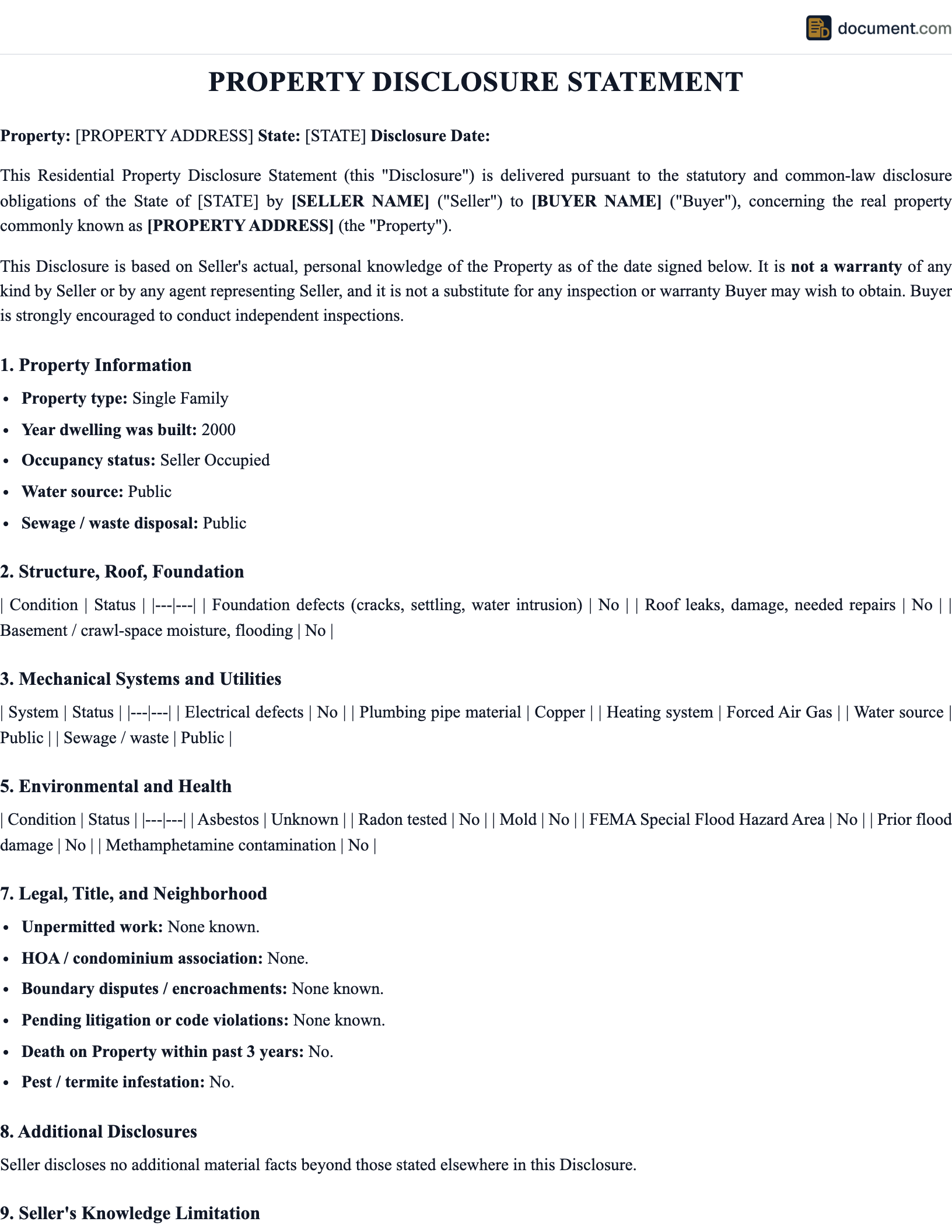



Oklahoma Disclosure Statement Overview
Oklahoma's mandatory Property Condition Disclosure Statement is governed by 60 O.S. Sections 831-839. Every seller of residential property must complete this form and deliver it to the buyer before the buyer signs a purchase contract. The form covers the seller's actual knowledge of the property's condition across a wide range of categories, from structural soundness and mechanical systems to environmental hazards and subsurface conditions.
Oklahoma has unique disclosure considerations that reflect the state's geography and economy. Oil and gas activity on or near a property is a required area of disclosure, including subsurface leases, pipelines, and related environmental concerns. Sinkhole risk must be addressed, and sellers in areas affected by injection-well seismic activity should be candid about any known structural damage. Sellers who misrepresent or omit known conditions face potential fraud and misrepresentation claims after closing.
$18
Recording fee
$0.75 per $500
Transfer tax
Required
Notarization
0
Witnesses required
Oklahoma Requirements
Under the Oklahoma Residential Property Condition Disclosure Act, the seller's disclosure obligation is specific: you must deliver the completed form to the buyer before the buyer executes a purchase contract. The disclosure is seller-to-buyer, not filed with any government office. There is no notarization requirement for the disclosure form itself, and no recording fee applies.
Oklahoma-Specific Disclosure Items
Oklahoma sellers must specifically address oil and gas leases, surface use agreements, and pipelines affecting the property. Sinkhole presence and any known seismic damage are also required disclosures. Buyers have 5 calendar days after receiving the form to rescind the contract. The disclosure obligation cannot be waived in an AS-IS sale.
What the Disclosure Form Must Cover
- Structural Condition: Foundation, walls, roof, and any known past repairs or damage
- Mechanical Systems: HVAC, plumbing, electrical, water heater, and appliances
- Environmental Hazards: Asbestos, lead paint, mold, underground storage tanks, and contaminated soil or water
- Oil and Gas Activity: Subsurface leases, pipelines, wells, and related surface use agreements
- Sinkholes and Seismic: Known sinkhole activity or structural damage from seismic events
- Water and Drainage: Known flooding, drainage problems, well condition, and septic system status
How to Deliver the Disclosure in Oklahoma
Oklahoma's disclosure process is seller-to-buyer. There is no government filing involved. The goal is to ensure the buyer has complete, accurate information about the property before they are legally committed to the purchase.
Complete the Disclosure Form Honestly
Answer every question on the Oklahoma Property Condition Disclosure Statement based on your actual knowledge. Do not leave items blank, and do not use unknown as a default when you do have information about the condition.
Address Oklahoma-Specific Items
Make sure you have addressed oil and gas leases or activity, sinkhole conditions, and any known structural damage. These are areas where Oklahoma differs from other states and where sellers are most often caught off guard.
Deliver to the Buyer Before Contract Signing
Hand the completed form to the buyer or their agent before the buyer signs any purchase contract. Delivery can be in person, by mail, or electronically if both parties agree. Document the date and method of delivery.
Obtain the Buyer's Signed Acknowledgment
Have the buyer sign and date an acknowledgment that they received the disclosure. This starts the 5-day rescission clock and creates a clear record that disclosure occurred before contract execution.
Keep Copies Through Closing and Beyond
Retain a copy of the signed disclosure form in your transaction records. If the buyer later claims you concealed a defect, the signed disclosure is your primary documentation that you met your statutory obligations.
Oklahoma Fees & Costs
Typical costs for filing in Oklahoma. Actual fees may vary by county.
| Fee / Tax | Amount |
|---|---|
| Recording Fee | $18 |
| Transfer Tax | $0.75 per $500 |
| Notarization | $5 - $25 per signature |
| Certified Copy | $1 - $10 per page |
| Attorney Review (optional) | $150 - $500 |
Seller Liability for Non-Disclosure in Oklahoma
Oklahoma sellers who fail to disclose known defects face significant legal exposure. A buyer who discovers a concealed defect after closing can bring claims for fraudulent misrepresentation, negligent misrepresentation, or violation of the Residential Property Condition Disclosure Act. These claims can survive closing, and courts have allowed buyers to recover repair costs, diminished property value, and in some cases punitive damages where the concealment was deliberate.
The oil and gas disclosure obligation deserves particular attention. If a seller fails to disclose a subsurface lease that limits the buyer's rights to the land, or conceals environmental contamination related to oil field activity, the legal consequences can be severe. Oklahoma courts take mineral and surface rights issues seriously, and undisclosed encumbrances of this type tend to produce complex and expensive litigation.
AS-IS clauses do not shield sellers from non-disclosure claims. Oklahoma courts have consistently held that selling in AS-IS condition does not excuse a seller from disclosing what they actually know. The risk of post-closing liability is best managed by being thorough and honest on the disclosure form, not by relying on contract language to paper over concealed problems.
Sample Oklahoma Disclosure Statement
Preview of our Oklahoma-specific template. Your document will include all fields required for recording in any Oklahoma county.
PROPERTY DISCLOSURE STATEMENT
STATE OF OKLAHOMA
Legal Document
PARTY INFORMATION
Name: [Full Legal Name]
Address: [Oklahoma Address]
County: [County]
PROPERTY DESCRIPTION
County: [County] State: Oklahoma
Legal Description: [Per Recorded Plat]
Parcel No.: [APN]
Oklahoma Disclosure Statement FAQ
Common questions about filing in Oklahoma, including requirements, fees, and tax implications.
Official Oklahoma Resources
Official state resources for verifying requirements and finding your local recording office.
Important Considerations for Oklahoma Sellers
If your property sits in an area with a history of oil and gas activity, do your homework before filling out the disclosure form. Pull county records to confirm whether there are any active subsurface leases, pipeline easements, or surface use agreements tied to the property. These items are not always obvious, and discovering them after a buyer has moved in tends to lead to disputes that could have been avoided with a simple title search beforehand.
Sellers in central and northern Oklahoma should give genuine thought to the seismic activity question. The state has seen a notable increase in earthquake frequency in certain areas. If the home has experienced any cracking, settling, or structural movement that could plausibly be linked to seismic events, disclose it. Trying to attribute visible damage to normal settling when the property is in a known earthquake-affected area is a risk most sellers should not take.
Sinkhole disclosure is another area where Oklahoma sellers occasionally underestimate the importance of accuracy. Even if a sinkhole is off the property but nearby, buyers in rural areas and areas with karst geology deserve to know what you know. When in doubt about whether something qualifies as a required disclosure, err toward disclosure.
Oklahoma Seller Tip
Have an Oklahoma real estate attorney review your completed disclosure form before delivery, particularly if the property has oil and gas history, known structural issues, or environmental concerns. The cost of a review is small compared to the potential cost of post-closing litigation. Oklahoma attorneys familiar with real property transactions can spot disclosure gaps that sellers commonly overlook.
Related Documents
Depending on your situation, you may need additional documents alongside this one. Below are commonly related documents that are frequently used together in real estate transactions.
Working With Oklahoma Real Estate Professionals
Oklahoma real estate agents are familiar with the disclosure form and can help guide sellers through the process, but the legal responsibility for accuracy rests entirely with the seller. Your agent can help you understand what the form is asking, but they cannot fill it out for you or substitute their knowledge of the property for yours.
If you have had repairs done to the property during your ownership, particularly for foundation issues, roof leaks, water intrusion, or any oil and gas related environmental work, gather those records before completing the disclosure. Prior repairs are generally disclosable, and having documentation of the work that was done can actually strengthen your position by showing you addressed problems responsibly.
Buyers in Oklahoma have access to their own inspectors and may also commission oil and gas searches and environmental assessments. A thorough buyer will likely uncover issues you did not disclose. Getting ahead of those findings through honest disclosure is almost always the better strategy than hoping the buyer's inspector misses something.
Oklahoma Documentation Checklist
Before completing your disclosure form, collect any repair receipts, inspection reports, pest control records, oil and gas lease documents, and warranty paperwork you have for the property. These records help you answer the disclosure questions accurately and serve as evidence that your disclosures were made in good faith.
Related Documents
Depending on your situation, you may need additional documents alongside this one. Below are commonly related documents that are frequently used together in real estate transactions.
Create your Oklahoma Property Disclosure Statement in under 5 minutes.
Answer a few questions and download a Oklahoma-compliant document, ready for the state agency.