



Ohio Disclosure Statement Overview
Ohio Revised Code Section 5302.30 requires sellers of residential real property to provide a written disclosure statement to the buyer before the purchase contract is signed. Ohio's form is widely regarded as one of the most detailed in the country, reflecting the state's commitment to giving buyers meaningful information before they commit to a purchase. The disclosure is a private document delivered from seller to buyer and is not filed with the county recorder or any state agency.
What makes Ohio stand out is the breadth of its required disclosures. In addition to the structural, mechanical, and environmental categories found in most state forms, Ohio specifically asks whether the property has ever been used for methamphetamine production. The state also requires detailed disclosure of roof, wall, and foundation conditions, underground storage tanks, and water intrusion issues. Buyers get 3 business days after receiving the disclosure to cancel the contract without penalty. Sellers who misrepresent or omit known conditions face civil liability that an as-is clause will not eliminate.
$28
Recording fee
$1 per $1,000
Transfer tax
Required
Notarization
0
Witnesses required
Ohio Requirements
Ohio sellers must complete the state-mandated disclosure form under ORC 5302.30 and deliver it to the buyer before a purchase contract is executed. The form must be answered based on the seller's actual knowledge. Sellers of property they have never occupied, such as heirs selling an estate property, may have limited knowledge on some questions but must still complete the form and answer honestly where they do have information. The disclosure is not notarized and is not recorded with any government office.
Ohio Specific Note
Ohio's disclosure form is more detailed than those in most other states. Pay particular attention to the sections on roof condition, foundation and walls, water and moisture intrusion, underground storage tanks, and methamphetamine production history. The buyer has 3 business days after receiving the form to cancel the contract. Make sure all sellers on the deed sign the disclosure before delivery.
Key Categories Ohio's Form Covers
- Roof, walls, and foundation: Specific questions about known problems with each component, not just general structural condition
- Water and moisture: Basement, crawlspace, or interior water intrusion, drainage problems, and flooding history
- Methamphetamine production: Whether the property has been used for manufacturing methamphetamine to the seller's knowledge
- Underground storage tanks: Known presence of buried tanks, whether active or previously removed
- Mechanical systems: HVAC, plumbing, electrical, water heater, and other major systems included in the sale
- Environmental hazards: Hazardous materials on the property or in the neighborhood that the seller is aware of
How to Deliver the Disclosure in Ohio
Ohio's disclosure process is entirely between seller and buyer. The form is not filed with any county or state office. Here is how delivery typically works in an Ohio residential transaction.
Complete the State Form Carefully
Ohio's form is detailed. Work through every section deliberately, paying close attention to roof, foundation, water intrusion, underground storage tanks, and the methamphetamine question. If you are uncertain about a condition, note that uncertainty rather than guessing or leaving it blank.
Have All Sellers Sign
Every seller listed on the deed must sign the disclosure form. The form does not require notarization. Make sure joint owners, co-sellers, or estate representatives all review and sign before delivery.
Deliver Before the Purchase Contract is Signed
Provide the signed disclosure to the buyer or their agent before the purchase agreement is executed. Delivery through the listing agent with email confirmation is common in Ohio. Record the exact date of delivery to mark the start of the 3-business-day rescission window.
Allow the Buyer 3 Business Days
The buyer has 3 business days from receipt to walk away from the contract without penalty. Business days exclude weekends and legal holidays. Do not rush the buyer through this period. If questions come up, answer them directly.
Maintain Copies in the Closing File
Both parties should retain copies of the signed disclosure. Your real estate agent and closing company will include it in the transaction file. Keep your copy indefinitely. Ohio disclosure litigation sometimes arises years after closing when a latent defect surfaces.
Ohio Fees & Costs
Typical costs for filing in Ohio. Actual fees may vary by county.
| Fee / Tax | Amount |
|---|---|
| Recording Fee | $28 |
| Transfer Tax | $1 per $1,000 |
| Notarization | $5 - $25 per signature |
| Certified Copy | $1 - $10 per page |
| Attorney Review (optional) | $150 - $500 |
Seller Liability for Non-Disclosure in Ohio
Ohio sellers who fail to disclose known defects face civil liability for fraud, negligent misrepresentation, and breach of statutory duty. Because Ohio's form is so detailed, sellers cannot easily claim ignorance when a specific defect is addressed by a question they left unanswered or answered inaccurately. Courts have found sellers liable even when the buyer conducted a home inspection, reasoning that a buyer cannot be expected to discover deliberately concealed conditions through a routine inspection.
The methamphetamine disclosure question is one that Ohio courts take seriously. Properties used for meth production often have chemical contamination requiring professional remediation that can cost tens of thousands of dollars. Buyers who discover this contamination after closing and can show the seller knew about prior drug activity on the property typically have compelling fraud claims. Sellers who lived through a prior tenant or owner's drug use and fail to disclose it are in a precarious position.
Ohio buyers may also bring claims against real estate agents who knew about a material condition and stayed quiet. Ohio's agency law imposes independent duties on agents to disclose known material facts to buyers, even when those facts were not volunteered by the seller. This means both seller and agent can be co-defendants in a disclosure lawsuit when the agent had knowledge of the problem.
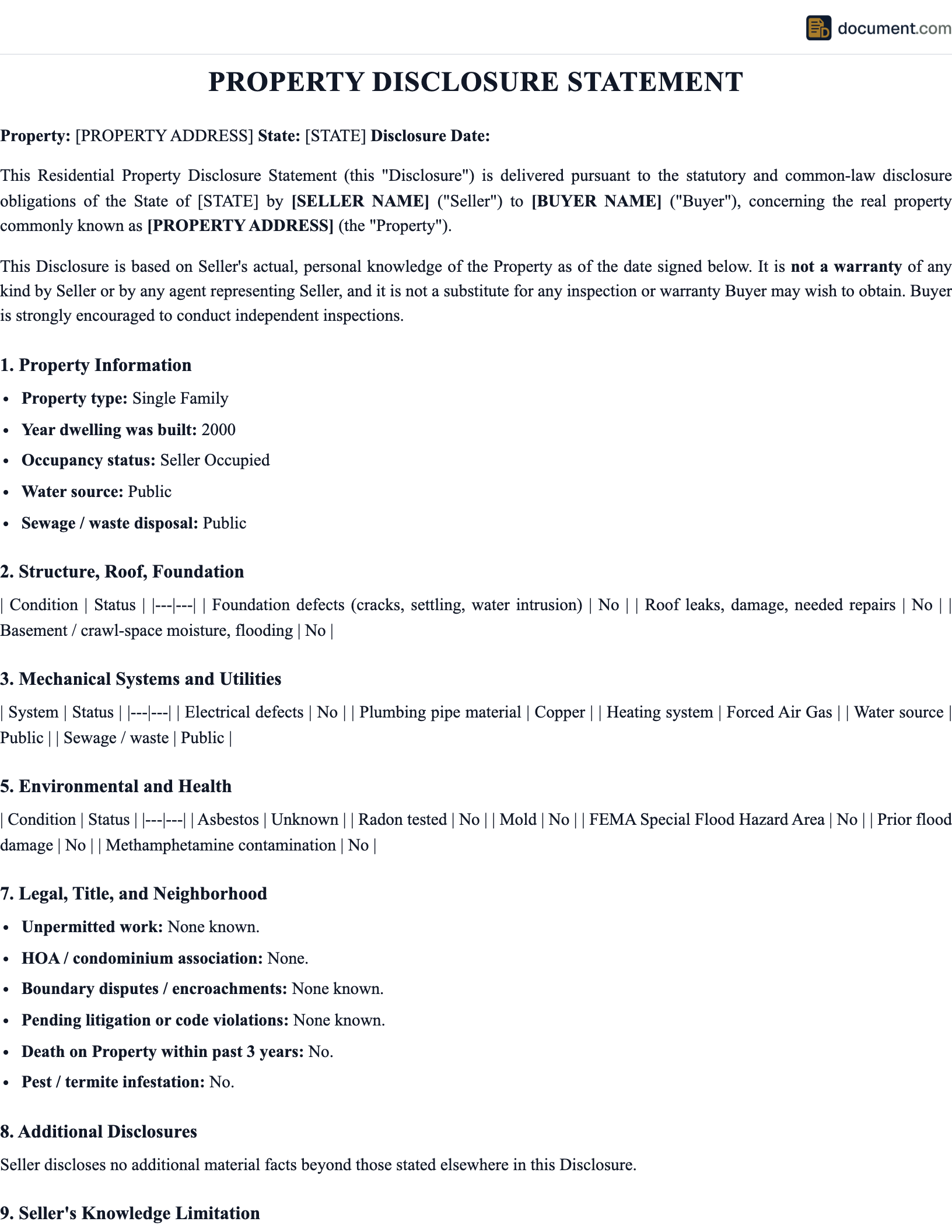
Sample Ohio Disclosure Statement
Preview of our Ohio-specific template. Your document will include all fields required for recording in any Ohio county.
PROPERTY DISCLOSURE STATEMENT
STATE OF OHIO
Legal Document
PARTY INFORMATION
Name: [Full Legal Name]
Address: [Ohio Address]
County: [County]
PROPERTY DESCRIPTION
County: [County] State: Ohio
Legal Description: [Per Recorded Plat]
Parcel No.: [APN]
Ohio Disclosure Statement FAQ
Common questions about filing in Ohio, including requirements, fees, and tax implications.
Official Ohio Resources
Official state resources for verifying requirements and finding your local recording office.
Important Considerations for Ohio Sellers
Ohio sellers often underestimate how specific the state's disclosure form is. The form asks detailed questions about the roof, walls, and foundation separately rather than bundling them into a general structural category. If your roof is nearing the end of its useful life or has had prior repairs, that belongs on the form. Sellers who answer no to roof problems and then face a buyer who discovers recent patching or shingle damage are in a difficult position at mediation.
Water intrusion is another area that causes frequent litigation in Ohio, particularly in older homes with basement drainage issues or properties in areas with high clay content soils that shift seasonally. If the basement has ever taken on water, that needs to go on the disclosure. Sellers who encapsulate a wet basement and then fail to disclose the underlying drainage issue are prime candidates for a post-closing fraud claim.
Estate sellers and corporate sellers who have limited firsthand knowledge of the property should still complete the form to the best of their ability and note where their knowledge is limited. A good-faith disclosure with honest acknowledgments of unknown conditions is far more defensible than a form with blanket denials of conditions the seller had no way of verifying.
Seller Tip
Ohio sellers who have owned their property for many years should pull together repair receipts, warranty documents, inspection reports, and insurance claims before completing the disclosure. The form is detailed enough that having records in hand makes the process more accurate and protects you if a buyer later challenges your answers. A disclosure prepared from clear records is much easier to defend than one prepared from memory alone.
Related Documents
Depending on your situation, you may need additional documents alongside this one. Below are commonly related documents that are frequently used together in real estate transactions.
Important Considerations
Before proceeding with your document, there are several important factors to consider. Each real estate transaction is unique, and understanding the specific requirements and implications of your situation will help ensure a smooth and legally compliant process.
Real estate laws and regulations are subject to change, and local requirements may differ from state-level rules. It is always advisable to verify current requirements with your local recording office before submitting any documents for recording.
If your transaction involves complex circumstances such as multiple parties, commercial properties, trusts, estates, or interstate elements, consulting with a licensed real estate attorney is strongly recommended. An attorney can provide guidance specific to your situation and help you avoid potential legal issues.
Keep copies of all documents related to your real estate transaction in a safe place. Recorded documents become part of the public record, but having your own copies ensures you can reference the terms and conditions at any time. Digital copies stored securely are also recommended as a backup.
Professional Recommendation
While our templates are designed to be comprehensive and legally compliant, we recommend having your completed document reviewed by a licensed attorney before recording, especially for high-value transactions or complex situations. Many attorneys offer flat-fee document review services that provide peace of mind at a reasonable cost.
Related Documents
Depending on your situation, you may need additional documents alongside this one. Below are commonly related documents that are frequently used together in real estate transactions.
Create your Ohio Property Disclosure Statement in under 5 minutes.
Answer a few questions and download a Ohio-compliant document, ready for the state agency.