



North Carolina Disclosure Statement Overview
North Carolina law requires residential sellers to complete and deliver the Residential Property and Owners' Association Disclosure Statement before the purchase contract is signed. This obligation flows from NC General Statutes Chapter 47E and is one of the more comprehensive disclosure regimes in the Southeast. The form is not recorded at the register of deeds. It moves from seller to buyer as a private transactional document, and it must be signed by the seller and acknowledged by the buyer.
North Carolina's RPOADS form covers the structural and mechanical conditions buyers expect, but it also goes further. HOA membership, mineral rights, oil and gas activity, zoning violations, and known encroachments are all on the form. Buyers get 3 days after receiving the disclosure to walk away from the contract without penalty. Sellers who fail to disclose known material conditions face civil liability and potential action from the NC Real Estate Commission if a licensed agent is involved.
$26
Recording fee
$1 per $500
Transfer tax
Required
Notarization
0
Witnesses required
North Carolina Requirements
Sellers must complete the state-approved RPOADS form and deliver it to the buyer before the purchase contract is signed. The form must be answered honestly based on the seller's actual knowledge. Sellers are not required to investigate or hire inspectors to complete the form, but they cannot conceal conditions they already know about. The disclosure is not notarized and is not filed with any government office.
North Carolina Specific Note
North Carolina's RPOADS form includes HOA disclosure requirements that are often overlooked. Sellers must disclose whether the property is subject to a property owners association, the amount of current dues, and any known pending special assessments. Buyers have 3 days from receiving the disclosure to cancel the contract without penalty. Zoning violations and known encroachments must also be disclosed.
What the RPOADS Form Covers
- Structural conditions: Roof, foundation, walls, floors, and any known moisture or structural damage
- Mechanical systems: Heating, cooling, plumbing, electrical, and septic or well systems
- HOA information: Association membership, dues, special assessments, and any known violations of HOA rules
- Mineral rights and oil and gas: Severed mineral rights, existing leases, and any known extraction activity
- Zoning and legal violations: Any known violations of zoning ordinances, building codes, or other local regulations
- Environmental hazards: Hazardous materials, underground storage tanks, and known contamination
How to Deliver the Disclosure in North Carolina
The North Carolina disclosure statement is delivered from the seller directly to the buyer. It is not filed with the register of deeds or any government agency. Here is how the process unfolds in a typical transaction.
Complete the RPOADS Form
Fill out the state-approved Residential Property and Owners' Association Disclosure Statement based on your actual knowledge. Address all sections including structural, mechanical, HOA, mineral rights, and environmental conditions.
Sign the Form
All sellers on the deed must sign the disclosure. If the property is jointly owned, all owners must sign. The form is not notarized, but signatures confirm the seller's good-faith answers to each question.
Deliver to the Buyer Before Contract
Provide the completed form to the buyer or buyer's agent before the purchase contract is signed. Delivery can be in person, through the listing agent, or by email. Record the exact date of delivery to establish the start of the 3-day rescission period.
Obtain the Buyer's Acknowledgment
Ask the buyer to sign an acknowledgment confirming receipt of the disclosure. This acknowledgment is part of the standard RPOADS form and protects the seller in any later dispute about when disclosure was made.
Keep Signed Copies
Retain a complete copy of the signed disclosure form. Your real estate agent will maintain a copy in the transaction file, and your attorney should receive one as well. Keep your copy for at least three years after closing.
North Carolina Fees & Costs
Typical costs for filing in North Carolina. Actual fees may vary by county.
| Fee / Tax | Amount |
|---|---|
| Recording Fee | $26 |
| Transfer Tax | $1 per $500 |
| Notarization | $5 - $25 per signature |
| Certified Copy | $1 - $10 per page |
| Attorney Review (optional) | $150 - $500 |
Seller Liability for Non-Disclosure in North Carolina
North Carolina sellers who misrepresent or conceal material conditions on the RPOADS form face civil liability for fraud, negligent misrepresentation, and breach of contract. A buyer who later discovers an undisclosed defect can sue for the cost of repairs, diminished property value, and in cases of intentional misrepresentation, additional damages reflecting the harm caused. North Carolina courts have held that sellers cannot use an as-is clause to shield themselves from fraud claims.
Real estate agents have independent disclosure duties in North Carolina. Under the NC Real Estate License Law, agents must disclose all material facts affecting the property even when the seller has not volunteered them. An agent who knows about a hidden defect and stays silent can face license revocation and personal civil liability alongside the seller.
Sellers in North Carolina should take the mineral rights and HOA sections of the RPOADS seriously. These are areas where buyers routinely discover surprises after closing, and they generate a disproportionate share of disclosure-related litigation in the state. If there is any uncertainty about whether mineral rights have been severed or whether an HOA assessment is pending, err on the side of disclosure and let the buyer investigate further.
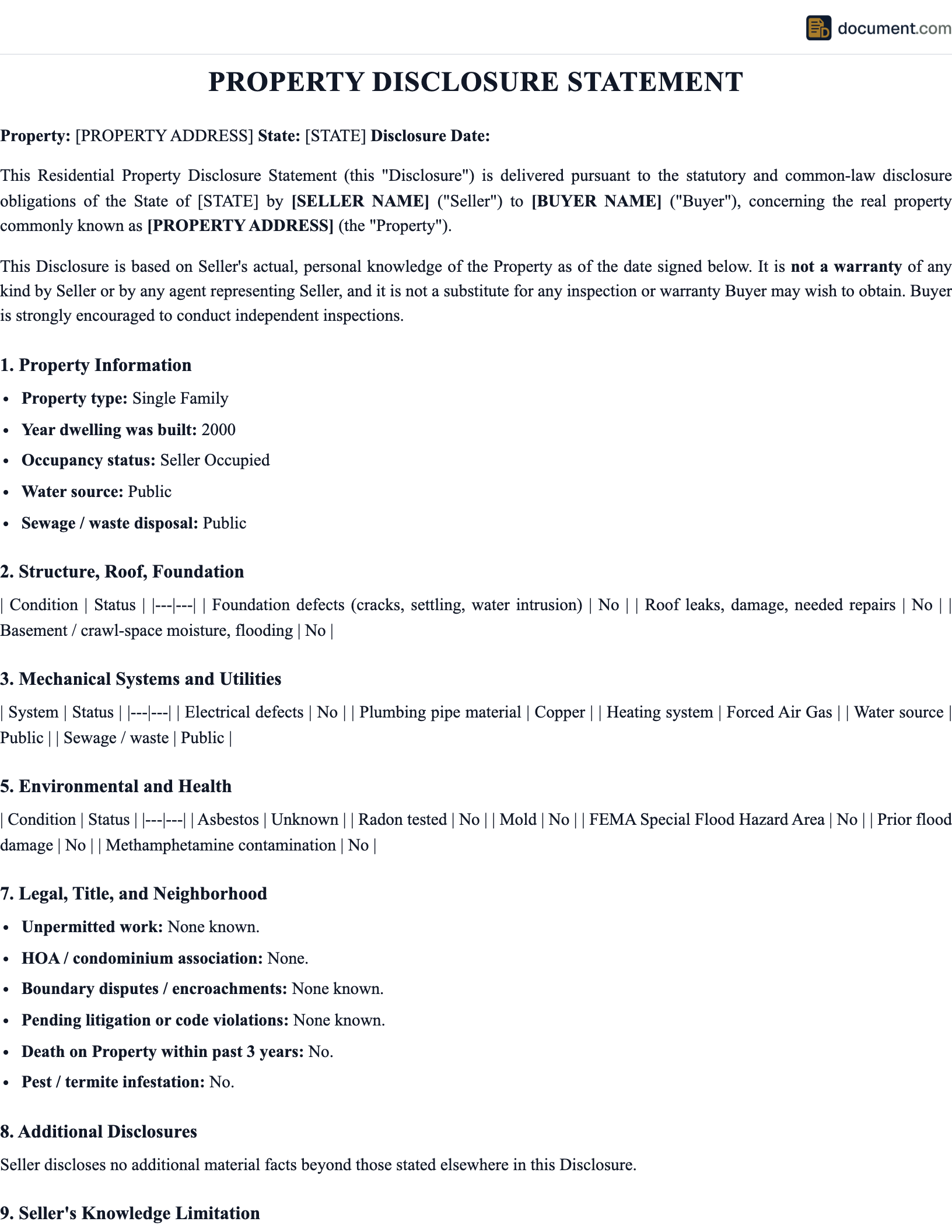
Sample North Carolina Disclosure Statement
Preview of our North Carolina-specific template. Your document will include all fields required for recording in any North Carolina county.
PROPERTY DISCLOSURE STATEMENT
STATE OF NORTH CAROLINA
Legal Document
PARTY INFORMATION
Name: [Full Legal Name]
Address: [North Carolina Address]
County: [County]
PROPERTY DESCRIPTION
County: [County] State: North Carolina
Legal Description: [Per Recorded Plat]
Parcel No.: [APN]
North Carolina Disclosure Statement FAQ
Common questions about filing in North Carolina, including requirements, fees, and tax implications.
Official North Carolina Resources
Official state resources for verifying requirements and finding your local recording office.
Important Considerations for North Carolina Sellers
The HOA section of the RPOADS form trips up more North Carolina sellers than any other part. Sellers sometimes forget to disclose pending special assessments or underestimate the relevance of HOA rule violations. Buyers who discover after closing that a sizable assessment was approved before they bought the property typically have a strong claim against the seller. If you know an assessment vote is scheduled, disclose it.
Mineral rights deserve careful attention in North Carolina, particularly in mountain communities and rural counties where prior deed chains may have split surface and subsurface ownership. If your title shows anything unusual about mineral rights, have your attorney explain it before completing the disclosure form. Buyers in these areas often inquire specifically about subsurface rights during due diligence.
Zoning violations are another category where sellers sometimes inadvertently omit important information. Unpermitted additions, converted garages used as living space, or short-term rental activity that violates local ordinances all fall within the spirit of what North Carolina sellers are expected to disclose. When in doubt, err on the side of disclosure.
Seller Tip
North Carolina sellers who have owned their property for many years sometimes struggle to remember the full repair history of the home. Before completing the RPOADS form, pull together any inspection reports, repair invoices, insurance claims, and permit records. A documented repair is not a disqualifying defect. It is evidence of responsible ownership, and full disclosure of past issues paired with proof of resolution often builds buyer confidence rather than undermining it.
Related Documents
Depending on your situation, you may need additional documents alongside this one. Below are commonly related documents that are frequently used together in real estate transactions.
Important Considerations
Before proceeding with your document, there are several important factors to consider. Each real estate transaction is unique, and understanding the specific requirements and implications of your situation will help ensure a smooth and legally compliant process.
Real estate laws and regulations are subject to change, and local requirements may differ from state-level rules. It is always advisable to verify current requirements with your local recording office before submitting any documents for recording.
If your transaction involves complex circumstances such as multiple parties, commercial properties, trusts, estates, or interstate elements, consulting with a licensed real estate attorney is strongly recommended. An attorney can provide guidance specific to your situation and help you avoid potential legal issues.
Keep copies of all documents related to your real estate transaction in a safe place. Recorded documents become part of the public record, but having your own copies ensures you can reference the terms and conditions at any time. Digital copies stored securely are also recommended as a backup.
Professional Recommendation
While our templates are designed to be comprehensive and legally compliant, we recommend having your completed document reviewed by a licensed attorney before recording, especially for high-value transactions or complex situations. Many attorneys offer flat-fee document review services that provide peace of mind at a reasonable cost.
Related Documents
Depending on your situation, you may need additional documents alongside this one. Below are commonly related documents that are frequently used together in real estate transactions.
Create your North Carolina Property Disclosure Statement in under 5 minutes.
Answer a few questions and download a North Carolina-compliant document, ready for the state agency.