



New York Disclosure Statement Overview
New York's Property Condition Disclosure Act, codified at NY RPL Sections 462-465, gives residential sellers a choice that few other states allow: complete the disclosure form or pay the buyer $500 at closing. In New York City, most sellers pay the credit and skip the form entirely, making full disclosure the exception rather than the rule in that market. Upstate and suburban sellers are more likely to complete the form, particularly in transactions where buyers are demanding it or where the property has a complicated history.
Choosing the credit does not make a seller immune from liability. Sellers who know about material defects and say nothing, or who make false representations during the negotiation process, remain exposed to misrepresentation claims regardless of whether they paid the $500. The Property Condition Disclosure Act is delivered directly to the buyer and is not recorded with any government office. Flood zone status, structural conditions, and environmental hazards are all addressed on the form, along with any known violations or unpermitted work.
$40
Recording fee
$2 per $500
Transfer tax
Required
Notarization
0
Witnesses required
New York Requirements
Sellers in New York must either complete the state's Property Condition Disclosure form and deliver it to the buyer before a contract is signed, or credit the buyer $500 at closing. The disclosure form itself covers a broad range of conditions and must be answered truthfully based on the seller's actual knowledge. The form is not notarized and is not filed with any county or state office.
New York Specific Note
New York is one of the few states that allows sellers to pay a $500 credit in lieu of completing the disclosure form. Most NYC sellers choose this option. However, this credit does not protect against liability for fraudulent concealment of known defects. Sellers in flood-prone areas face additional scrutiny and should disclose flood history carefully.
What the Form Covers
- Structural conditions: Roof, foundation, walls, and any known settlement or water infiltration
- Mechanical systems: Heating, cooling, plumbing, electrical, and appliances included in the sale
- Flood zone status: Whether the property is in a flood hazard area and any history of flooding
- Environmental hazards: Lead paint, asbestos, underground storage tanks, and contamination
- Unpermitted work: Alterations, additions, or improvements made without required permits
- Zoning violations: Any known violations, notices, or orders from local authorities
How to Deliver the Disclosure in New York
New York sellers must choose between completing the disclosure form and delivering it to the buyer, or paying the $500 credit at closing. If you choose to complete the form, here is how the delivery process works.
Decide Whether to Complete the Form or Pay the Credit
NYC sellers often pay the $500 credit. Upstate and suburban sellers frequently complete the form. Discuss the choice with your real estate attorney before listing the property.
Complete the Form Accurately
If completing the form, answer every question based on your actual knowledge of the property. Address structural, mechanical, flood history, and environmental conditions. Do not guess or leave sections blank.
Deliver to the Buyer Before Contract Signing
Hand the signed disclosure to the buyer or their agent before the purchase contract is executed. Document the date and method of delivery. The buyer should sign an acknowledgment of receipt.
If Paying the Credit, Note It in the Contract
When paying the $500 credit instead of completing the form, confirm this arrangement is reflected in the purchase agreement. The credit is typically applied at the closing statement as a reduction in the buyer's costs.
Keep Copies Throughout the Transaction
Retain signed copies of the disclosure and any acknowledgment of receipt. Your real estate attorney will include the disclosure in the closing file. These records matter if questions arise after the sale.
New York Fees & Costs
Typical costs for filing in New York. Actual fees may vary by county.
| Fee / Tax | Amount |
|---|---|
| Recording Fee | $40 |
| Transfer Tax | $2 per $500 |
| Notarization | $5 - $25 per signature |
| Certified Copy | $1 - $10 per page |
| Attorney Review (optional) | $150 - $500 |
Seller Liability for Non-Disclosure in New York
The $500 credit option is often misunderstood as a liability shield. It is not. New York courts have consistently held that a seller who pays the credit and then conceals a known material defect can still face claims for fraud, misrepresentation, and breach of contract. The credit is simply the statutory alternative to completing the form, not a release from the duty of honest dealing.
Buyers who discover undisclosed defects in New York can pursue rescission of the sale, monetary damages for repair costs and lost value, and in cases of deliberate concealment, punitive damages. Real estate brokers also have disclosure obligations under New York law and can be held independently liable if they knew about a material condition and failed to disclose it.
New York City presents particular complications. Cooperative and condominium transactions are governed by board approval processes and offering plans that create additional disclosure expectations. Sellers in co-ops and condos should consult with their attorney about what disclosures are required beyond the state Property Condition Disclosure Act.
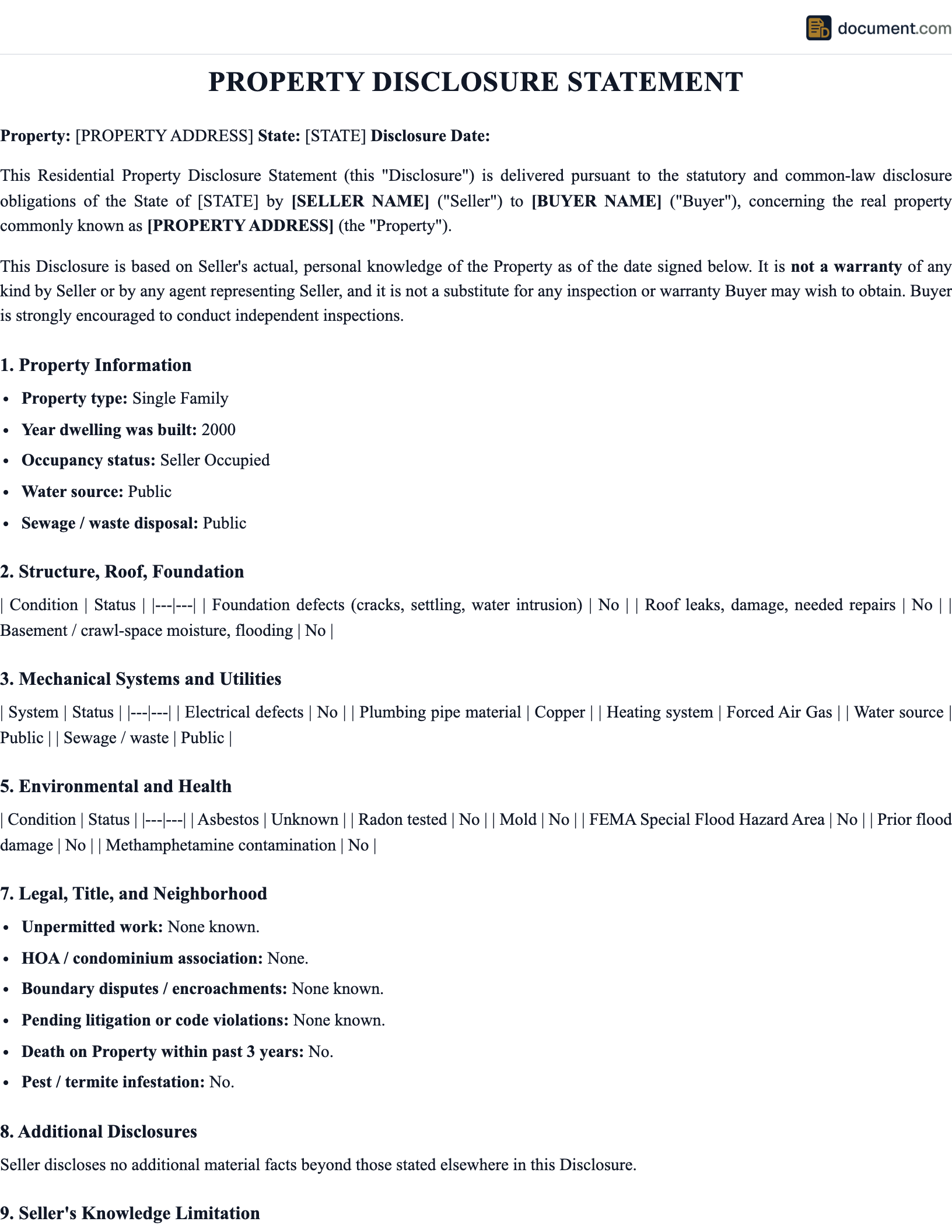
Sample New York Disclosure Statement
Preview of our New York-specific template. Your document will include all fields required for recording in any New York county.
PROPERTY DISCLOSURE STATEMENT
STATE OF NEW YORK
Legal Document
PARTY INFORMATION
Name: [Full Legal Name]
Address: [New York Address]
County: [County]
PROPERTY DESCRIPTION
County: [County] State: New York
Legal Description: [Per Recorded Plat]
Parcel No.: [APN]
New York Disclosure Statement FAQ
Common questions about filing in New York, including requirements, fees, and tax implications.
Official New York Resources
Official state resources for verifying requirements and finding your local recording office.
Important Considerations for New York Sellers
The decision to complete the disclosure form or pay the credit should not be made casually. In upstate markets and suburban areas, buyers increasingly expect the completed form and may view a seller who opts for the credit with suspicion. In those markets, providing a thorough, honest disclosure can actually help a sale move smoothly by giving buyers confidence in what they are purchasing.
Flood history is a particularly sensitive issue in New York after the storm damage experienced in coastal communities and parts of New York City. Sellers who know their property has flooded and fail to disclose that history are taking a serious legal risk. Buyers in flood-prone areas are increasingly sophisticated and often obtain flood elevation certificates or pull FEMA flood maps as part of their due diligence.
Unpermitted work is another area that causes problems in New York transactions. Additions, finished basements, or electrical upgrades done without permits can cloud title and create closing delays. Sellers who know about unpermitted work should disclose it and consider getting retroactive permits before listing if possible.
Seller Tip
New York real estate transactions almost always involve attorneys on both sides. If you are selling in New York and have questions about what to disclose or whether the $500 credit makes sense for your situation, your attorney is the right person to ask. Getting that guidance before you list will save you from more complicated conversations after an offer comes in.
Related Documents
Depending on your situation, you may need additional documents alongside this one. Below are commonly related documents that are frequently used together in real estate transactions.
Important Considerations
Before proceeding with your document, there are several important factors to consider. Each real estate transaction is unique, and understanding the specific requirements and implications of your situation will help ensure a smooth and legally compliant process.
Real estate laws and regulations are subject to change, and local requirements may differ from state-level rules. It is always advisable to verify current requirements with your local recording office before submitting any documents for recording.
If your transaction involves complex circumstances such as multiple parties, commercial properties, trusts, estates, or interstate elements, consulting with a licensed real estate attorney is strongly recommended. An attorney can provide guidance specific to your situation and help you avoid potential legal issues.
Keep copies of all documents related to your real estate transaction in a safe place. Recorded documents become part of the public record, but having your own copies ensures you can reference the terms and conditions at any time. Digital copies stored securely are also recommended as a backup.
Professional Recommendation
While our templates are designed to be comprehensive and legally compliant, we recommend having your completed document reviewed by a licensed attorney before recording, especially for high-value transactions or complex situations. Many attorneys offer flat-fee document review services that provide peace of mind at a reasonable cost.
Related Documents
Depending on your situation, you may need additional documents alongside this one. Below are commonly related documents that are frequently used together in real estate transactions.
Create your New York Property Disclosure Statement in under 5 minutes.
Answer a few questions and download a New York-compliant document, ready for the state agency.