



New Jersey Disclosure Statement Overview
New Jersey takes a different approach to property disclosure than most states. Rather than a single mandated statutory disclosure form, New Jersey's disclosure obligations are rooted in the New Jersey Consumer Fraud Act and the administrative regulations governing real estate licensees. The practical result is that sellers disclose known material conditions that affect property value, and agents are required to provide the Consumer Information Statement (CIS) to all parties. Sellers work from a disclosure form provided by their agent or real estate attorney.
New Jersey's disclosure framework emphasizes the agent's role. Because NJ agents carry significant disclosure duties, sellers who work with a licensed agent will typically receive a property condition disclosure form as part of the listing process. The form is delivered to the buyer and their agent as part of the transaction package. It is not recorded at any county office. For coastal and flood-prone areas, flood zone status and prior flood damage are required disclosures, which is particularly important given New Jersey's extensive coastline and history of storm events.
$35
Recording fee
Varies by value
Transfer tax
Required
Notarization
0
Witnesses required
New Jersey Requirements
New Jersey sellers must disclose all known conditions that materially affect the property's value or the buyer's willingness to purchase. The disclosure obligation comes from the New Jersey Consumer Fraud Act rather than a single disclosure statute, which means there is no uniform state-mandated form. Sellers and their agents use forms developed by the New Jersey Association of Realtors or their brokerage, which are widely accepted across the state.
New Jersey Specific Note
New Jersey requires sellers to disclose flood zone status and any prior flood damage. This is especially important for properties in Shore communities, bayfront areas, or anywhere in a FEMA-designated Special Flood Hazard Area. Failing to disclose known flood history is one of the most common bases for post-closing misrepresentation claims in New Jersey.
What Must Be Disclosed
- Structural and Mechanical Conditions: Foundation, roof, water intrusion, HVAC, plumbing, and electrical systems
- Flood Zone Status and Flood History: FEMA flood zone designation and any prior flood damage or insurance claims
- Coastal Hazard Areas: Proximity to coastal high-hazard areas, V-zones, or properties subject to erosion or wave action
- Environmental Hazards: Lead paint, radon, asbestos, underground storage tanks, or any known contamination
- Water and Sewer: Whether the property is on public sewer, a private septic system, or a shared system, and any known issues
- Legal and Title Matters: Known easements, encroachments, zoning violations, or pending municipal assessments
How to Deliver the Disclosure in New Jersey
New Jersey sellers provide the disclosure directly to the buyer as part of the transaction. There is no filing with any government office. Because New Jersey uses an attorney review period rather than a formal rescission window, timing the disclosure relative to the contract and attorney review period is important.
Complete the Property Condition Disclosure Form
Fill out the disclosure form honestly. Pay particular attention to the flood section and any prior damage, repairs, or insurance claims. For Shore and bayfront properties, coastal hazard and flood history sections are especially important.
Provide the Disclosure to the Buyer's Agent or Attorney
Deliver the completed form to the buyer through their agent or directly to their attorney. In New Jersey, it is common practice to include the disclosure as part of the initial contract package.
Allow the Attorney Review Period to Run
New Jersey purchase contracts typically include a 3-business-day attorney review period during which either party can cancel for any reason. The buyer's attorney will review the disclosure during this time and may raise questions or request additional information.
Update If New Material Information Arises
If you discover a new defect or receive information that changes your disclosures before closing, update the form and provide it to the buyer promptly. New Jersey law requires ongoing good faith disclosure of material conditions.
Retain Signed Copies with Your Closing Documents
Keep the signed disclosure along with all other closing documents. New Jersey buyers can bring Consumer Fraud Act claims with significant remedies. Your signed disclosure is your primary defense if a buyer asserts you concealed a known defect.
New Jersey Fees & Costs
Typical costs for filing in New Jersey. Actual fees may vary by county.
| Fee / Tax | Amount |
|---|---|
| Recording Fee | $35 |
| Transfer Tax | Varies by value |
| Notarization | $5 - $25 per signature |
| Certified Copy | $1 - $10 per page |
| Attorney Review (optional) | $150 - $500 |
Seller Liability and Legal Consequences in New Jersey
New Jersey's Consumer Fraud Act is one of the strongest consumer protection statutes in the country. A seller who makes a false or misleading statement in a real estate disclosure can face treble damages and attorneys' fees under this law. This is not theoretical: New Jersey courts have applied Consumer Fraud Act remedies in real estate disclosure cases, and the potential exposure for a seller who conceals a known defect is substantially higher in New Jersey than in most other states.
Flood damage is one of the most common categories of post-closing disclosure litigation in New Jersey. Sellers who have received flood insurance payouts or have knowledge of prior flooding but do not disclose it face serious legal risk. FEMA records of prior flood insurance claims are accessible to buyers, and a buyer who discovers a seller collected flood insurance on a property that was sold without disclosing flood damage has a compelling case.
Real estate agents in New Jersey carry significant independent disclosure obligations under the state administrative code. An agent who knowingly participates in a misleading disclosure can face license suspension or revocation by the New Jersey Real Estate Commission in addition to civil liability alongside the seller.
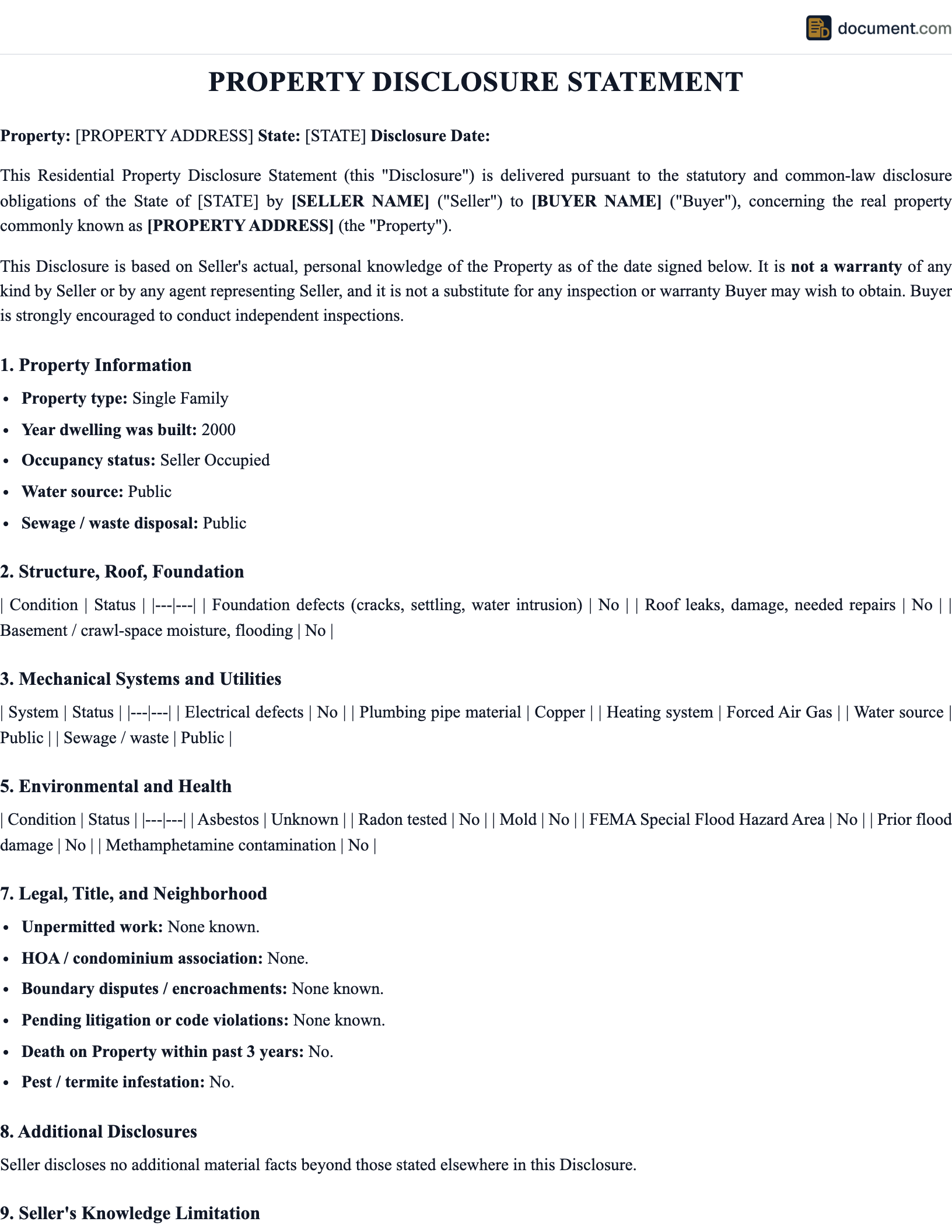
Sample New Jersey Disclosure Statement
Preview of our New Jersey-specific template. Your document will include all fields required for recording in any New Jersey county.
PROPERTY DISCLOSURE STATEMENT
STATE OF NEW JERSEY
Legal Document
PARTY INFORMATION
Name: [Full Legal Name]
Address: [New Jersey Address]
County: [County]
PROPERTY DESCRIPTION
County: [County] State: New Jersey
Legal Description: [Per Recorded Plat]
Parcel No.: [APN]
New Jersey Disclosure Statement FAQ
Common questions about filing in New Jersey, including requirements, fees, and tax implications.
Official New Jersey Resources
Official state resources for verifying requirements and finding your local recording office.
Important Considerations for New Jersey Sellers
New Jersey sellers near the coast or in flood-prone areas should pull their prior flood insurance history and FEMA records before completing the disclosure. If the property has received flood insurance payouts, disclose the amounts and the nature of the damage. Buyers increasingly research prior claims through the National Flood Insurance Program, and inconsistency between what a seller discloses and what FEMA records show is a serious problem.
Because New Jersey does not have a single mandatory state form, sellers should use the form provided by their agent or attorney, which is typically the New Jersey Association of Realtors standard form. If you are selling without an agent, consult a real estate attorney to ensure the disclosure form you use is comprehensive and appropriate for the type of property and transaction.
The attorney review period in New Jersey is a standard part of every residential contract. During those 3 business days, the buyer's attorney will review the disclosure, the contract, and any other documents. Be prepared to respond promptly to disclosure-related questions that arise during attorney review, as unresolved questions can delay or kill a deal.
New Jersey's Consumer Fraud Act Exposure
New Jersey sellers should understand that the Consumer Fraud Act allows successful plaintiffs to recover three times their actual damages plus attorneys' fees. This means a concealed defect that costs $30,000 to repair could result in a $90,000 judgment plus legal fees. Full and honest disclosure at the outset protects sellers from this exposure and is always the better choice.
Related Documents
Depending on your situation, you may need additional documents alongside this one. Below are commonly related documents that are frequently used together in real estate transactions.
Important Considerations for New Jersey Sellers
New Jersey sellers near the coast or in flood-prone areas should pull their prior flood insurance history and FEMA records before completing the disclosure. If the property has received flood insurance payouts, disclose the amounts and the nature of the damage. Buyers increasingly research prior claims through the National Flood Insurance Program, and inconsistency between what a seller discloses and what FEMA records show is a serious problem.
Because New Jersey does not have a single mandatory state form, sellers should use the form provided by their agent or attorney, which is typically the New Jersey Association of Realtors standard form. If you are selling without an agent, consult a real estate attorney to ensure the disclosure form you use is comprehensive and appropriate for the type of property and transaction.
The attorney review period in New Jersey is a standard part of every residential contract. During those 3 business days, the buyer's attorney will review the disclosure, the contract, and any other documents. Be prepared to respond promptly to disclosure-related questions that arise during attorney review, as unresolved questions can delay or kill a deal.
New Jersey's Consumer Fraud Act Exposure
New Jersey sellers should understand that the Consumer Fraud Act allows successful plaintiffs to recover three times their actual damages plus attorneys' fees. This means a concealed defect that costs $30,000 to repair could result in a $90,000 judgment plus legal fees. Full and honest disclosure at the outset protects sellers from this exposure and is always the better choice.
Related Documents
Depending on your situation, you may need additional documents alongside this one. Below are commonly related documents that are frequently used together in real estate transactions.
Create your New Jersey Property Disclosure Statement in under 5 minutes.
Answer a few questions and download a New Jersey-compliant document, ready for the state agency.