



New Hampshire Disclosure Statement Overview
New Hampshire law under RSA 477:4-c requires sellers of residential property to provide a written disclosure statement before any purchase contract is signed. The seller gives the form directly to the buyer. It does not go to the register of deeds or any other government office. It is a seller-to-buyer communication, not a recorded document.
New Hampshire has a few disclosure angles that set it apart from other New England states. The state's granite geology creates naturally elevated radon concentrations in many basements and crawl spaces, making radon testing and disclosure particularly important here even though there is no separate radon statute. Heating oil remains common in New Hampshire homes, and the condition and leak history of oil storage tanks is a material disclosure item. One well-known aspect of New Hampshire law is the statutory exemption for deaths on the property: sellers in New Hampshire are not required to disclose whether someone has died or been murdered at the address.
$26
Recording fee
$7.50 per $1,000
Transfer tax
Required
Notarization
0
Witnesses required
New Hampshire Requirements
New Hampshire sellers must complete the disclosure form and deliver it to the buyer before executing a purchase contract. Once the buyer has it, they have 5 days to rescind. The disclosure must reflect what the seller actually knows. Sellers are not required to hire inspectors, but they cannot choose to ignore known problems and simply not mention them.
New Hampshire Specific Note
New Hampshire's granite geology creates elevated radon risk across much of the state. If a seller has tested for radon and found elevated levels, that information is material and should be disclosed. Oil tank condition and history is also a common disclosure issue in New Hampshire, given how many homes use heating oil. Sellers with buried oil tanks should disclose their location, age, and any known leak history.
What Must Be Disclosed
- Structural Conditions: Foundation, framing, roof, and any known water damage or settling
- Water and Septic Systems: Private well condition, septic system age and condition, any known failures or pumping history
- Oil Storage Tanks: Location, age, and any known leaks from aboveground or underground heating oil tanks
- Radon and Environmental Hazards: Known radon test results, lead paint, asbestos, and other environmental conditions on the property
- Mechanical Systems: HVAC, plumbing, and electrical conditions and any known deficiencies
- Legal and Title Issues: Known easements, encroachments, zoning violations, or pending assessments affecting the property
How to Deliver the Disclosure in New Hampshire
In New Hampshire, property disclosure is a seller-to-buyer transaction. No government filing is required. The process is about completing the form accurately, delivering it before the contract is signed, and documenting the exchange.
Complete the Disclosure Form Thoroughly
Answer every question about the property. For New Hampshire properties, give careful attention to the well and septic sections, the oil tank section, and any environmental testing that has been done including radon or lead.
Deliver the Form to the Buyer Before Contract
Hand the completed form to the buyer or buyer's agent before any purchase agreement is signed. Under RSA 477:4-c, the buyer has 5 days to rescind after receiving it.
Get a Signed Receipt from the Buyer
Document the delivery with a signed acknowledgment noting the date. This confirms when the 5-day rescission window began and protects you if the buyer later claims they never received the disclosure.
Update the Disclosure If Conditions Change
If you discover a new defect or learn new material information before closing, amend the disclosure and re-deliver it. The 5-day period resets with each amended delivery.
Retain Your Copy Indefinitely
Keep the signed disclosure and acknowledgment. New Hampshire sellers can face misrepresentation claims years after closing. The signed disclosure is your documentation of what you disclosed and when.
New Hampshire Fees & Costs
Typical costs for filing in New Hampshire. Actual fees may vary by county.
| Fee / Tax | Amount |
|---|---|
| Recording Fee | $26 |
| Transfer Tax | $7.50 per $1,000 |
| Notarization | $5 - $25 per signature |
| Certified Copy | $1 - $10 per page |
| Attorney Review (optional) | $150 - $500 |
Seller Liability and Legal Consequences in New Hampshire
New Hampshire sellers who omit known material defects from the disclosure can face claims for misrepresentation after closing. Both fraudulent misrepresentation (intentional concealment) and negligent misrepresentation (failure to exercise reasonable care in completing the form) can give rise to buyer claims. Remedies may include repair cost damages, diminution of value, or in serious cases, contract rescission.
Oil tank leaks are a recurring source of post-closing disputes in New Hampshire. A seller who knows a buried tank has leaked and does not disclose it faces a high risk of liability when the buyer discovers contamination during a refinance inspection or home improvement project. Remediation costs in New Hampshire can be substantial depending on the extent of soil contamination.
Sellers should also be aware that licensed real estate agents in New Hampshire have independent obligations under their license. An agent who assists in preparing a disclosure the agent knows to be incomplete or false may face disciplinary action by the New Hampshire Real Estate Commission in addition to civil exposure.
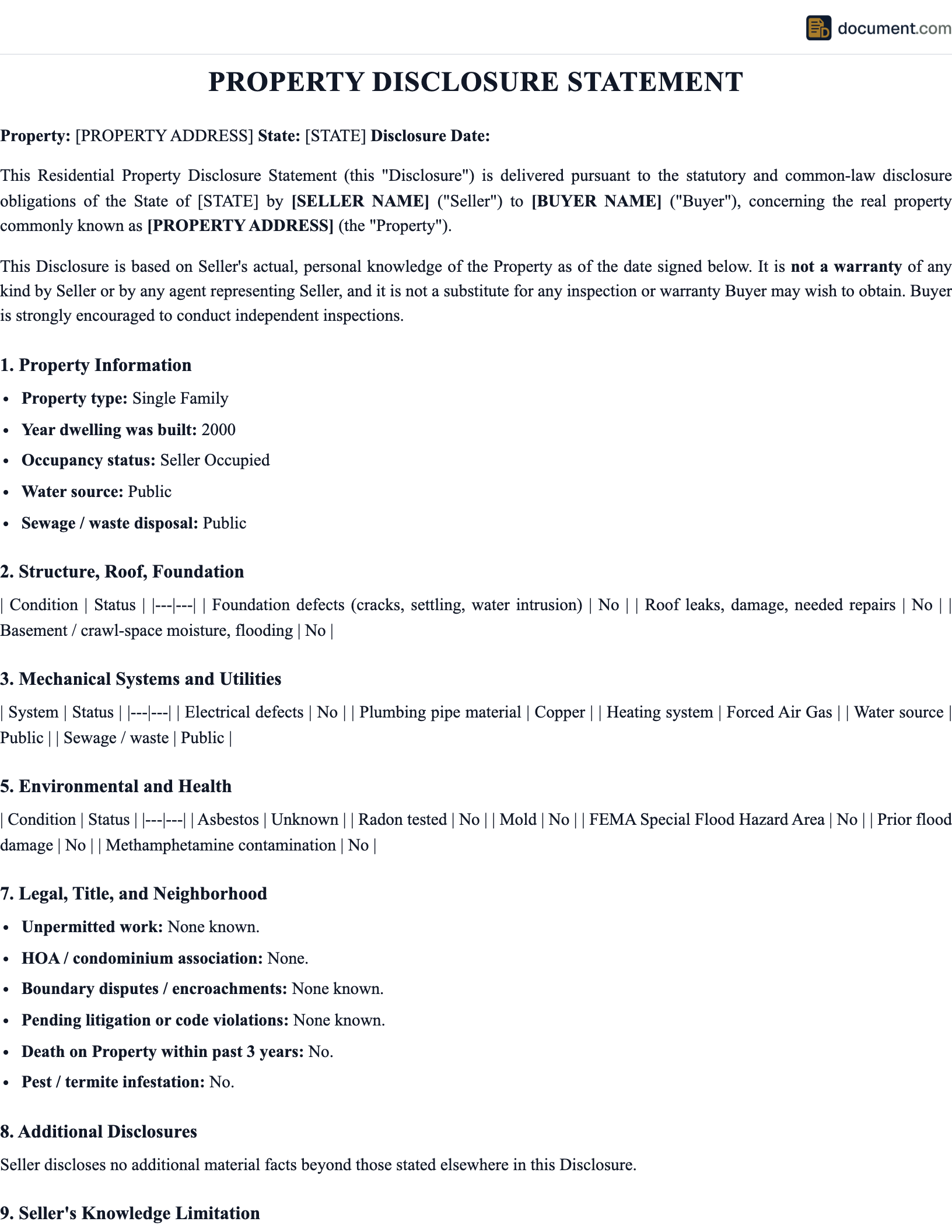
Sample New Hampshire Disclosure Statement
Preview of our New Hampshire-specific template. Your document will include all fields required for recording in any New Hampshire county.
PROPERTY DISCLOSURE STATEMENT
STATE OF NEW HAMPSHIRE
Legal Document
PARTY INFORMATION
Name: [Full Legal Name]
Address: [New Hampshire Address]
County: [County]
PROPERTY DESCRIPTION
County: [County] State: New Hampshire
Legal Description: [Per Recorded Plat]
Parcel No.: [APN]
New Hampshire Disclosure Statement FAQ
Common questions about filing in New Hampshire, including requirements, fees, and tax implications.
Official New Hampshire Resources
Official state resources for verifying requirements and finding your local recording office.
Important Considerations for New Hampshire Sellers
If your home has never been tested for radon, consider testing before you list. New Hampshire consistently ranks among the top states for elevated residential radon levels. A test that comes back low is a selling point. A test that reveals elevated levels needs to be disclosed and addressed. Getting ahead of this before listing is far better than having it surface during a buyer's inspection and derail the transaction.
For homes heated with oil, locate your oil tank and determine whether it is aboveground or underground. If underground, find out when it was last inspected, whether it has a liner, and whether there is any leak history. Buyers and their lenders take buried oil tanks seriously in New Hampshire, and an old unlined tank can make a property difficult to finance.
Septic systems are a common issue in New Hampshire's rural and suburban markets. If you know the system has failed or is operating close to its design capacity, disclose it. Replacement costs for a failed septic system can run into five figures, and a buyer who discovers this after closing will have a legitimate claim if the seller had knowledge and said nothing.
Death on the Property in New Hampshire
New Hampshire law specifically exempts sellers from any obligation to disclose that a death or murder has occurred at the property. If a buyer wants to know this, they need to ask directly. Sellers who choose not to disclose a death are within their legal rights under New Hampshire statute.
Related Documents
Depending on your situation, you may need additional documents alongside this one. Below are commonly related documents that are frequently used together in real estate transactions.
Important Considerations for New Hampshire Sellers
If your home has never been tested for radon, consider testing before you list. New Hampshire consistently ranks among the top states for elevated residential radon levels. A test that comes back low is a selling point. A test that reveals elevated levels needs to be disclosed and addressed. Getting ahead of this before listing is far better than having it surface during a buyer's inspection and derail the transaction.
For homes heated with oil, locate your oil tank and determine whether it is aboveground or underground. If underground, find out when it was last inspected, whether it has a liner, and whether there is any leak history. Buyers and their lenders take buried oil tanks seriously in New Hampshire, and an old unlined tank can make a property difficult to finance.
Septic systems are a common issue in New Hampshire's rural and suburban markets. If you know the system has failed or is operating close to its design capacity, disclose it. Replacement costs for a failed septic system can run into five figures, and a buyer who discovers this after closing will have a legitimate claim if the seller had knowledge and said nothing.
Death on the Property in New Hampshire
New Hampshire law specifically exempts sellers from any obligation to disclose that a death or murder has occurred at the property. If a buyer wants to know this, they need to ask directly. Sellers who choose not to disclose a death are within their legal rights under New Hampshire statute.
Related Documents
Depending on your situation, you may need additional documents alongside this one. Below are commonly related documents that are frequently used together in real estate transactions.
Create your New Hampshire Property Disclosure Statement in under 5 minutes.
Answer a few questions and download a New Hampshire-compliant document, ready for the state agency.