



Nebraska Disclosure Statement Overview
Nebraska requires sellers of residential property to provide a written property disclosure statement under Neb. Rev. Stat. 76-2,120. Sellers complete the form and deliver it directly to the buyer before any purchase contract is signed. It goes to the buyer, not to any county recorder or state agency.
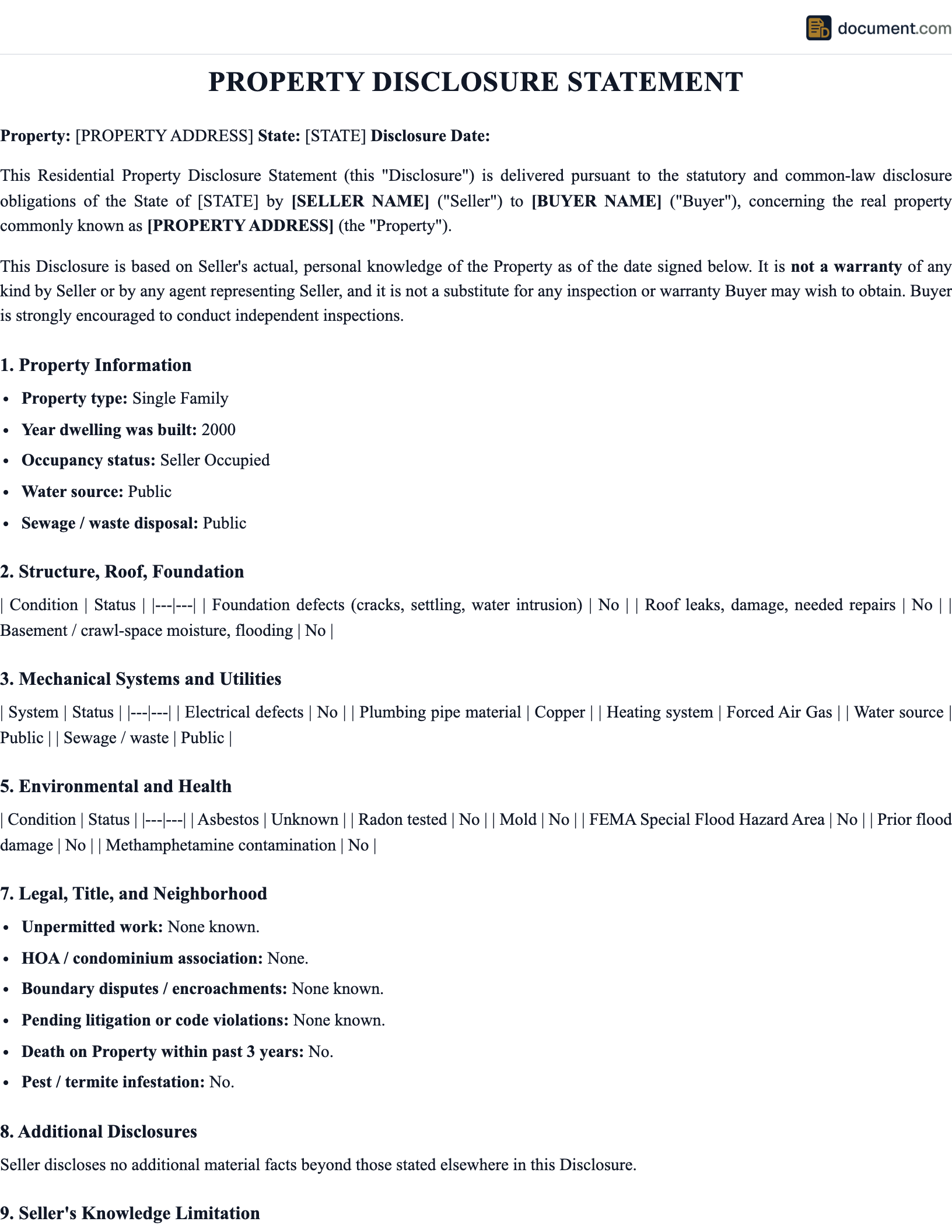
The Nebraska disclosure form covers structural integrity, mechanical systems, water and drainage, environmental hazards, and other conditions that affect the property's value or safety. One area where Nebraska stands apart from many states is the specific requirement to disclose known methamphetamine contamination. This is a distinct statutory obligation that applies regardless of when the contamination occurred. For rural properties, well condition and groundwater quality are also material disclosure items that buyers expect to see addressed in full.
$10
Recording fee
$2.25 per $1,000
Transfer tax
Required
Notarization
0
Witnesses required
Nebraska Requirements
Nebraska sellers must complete the disclosure and deliver it to the buyer before signing a purchase agreement. Once the buyer receives the disclosure, they have 5 business days to cancel the contract. Sellers must disclose conditions they actually know about; they are not expected to conduct inspections, but they cannot hide problems they are already aware of.
Nebraska Specific Note
Nebraska is one of a small number of states with an explicit requirement to disclose known methamphetamine contamination. If the property has ever been used as a meth lab or has been identified as contaminated, this must be disclosed. Failing to do so is not merely a civil matter; it may constitute fraud and potentially implicate criminal statutes depending on the circumstances.
What Must Be Disclosed
- Structural Defects: Foundation cracks, roof leaks, water damage, or any known settling issues
- Mechanical Systems: Heating, cooling, plumbing, and electrical conditions known to the seller
- Methamphetamine Contamination: Any known history of meth production or contamination on the property
- Well and Water Conditions: Private well location, condition, last test results, and any known groundwater concerns
- Environmental Hazards: Lead paint, radon, asbestos, or underground storage tanks on the property
- Legal and Title Issues: Easements, encroachments, zoning violations, or pending assessments the seller is aware of
How to Deliver the Disclosure in Nebraska
Nebraska sellers deliver the disclosure directly to the buyer. There is no government filing involved. The process is about communication and timing, not recording fees or notarization.
Complete the Nebraska Disclosure Form
Answer all questions about the property's known condition. Pay particular attention to the methamphetamine contamination section and, for rural properties, the well and groundwater section.
Deliver the Form to the Buyer Before Contracting
Give the disclosure to the buyer or their agent before the purchase contract is signed. The buyer's 5-business-day rescission clock starts on the date of delivery, not the date of the contract.
Get a Written Acknowledgment
Have the buyer sign and date an acknowledgment of receipt. This creates a clear record of when the disclosure was delivered and when the rescission period began.
Amend Promptly If Conditions Change
If you learn of a new defect or a previously undisclosed condition before closing, update the disclosure immediately and re-deliver it. The buyer receives another 5 business days to rescind.
Keep Copies Through Closing and Beyond
Retain a copy of the signed disclosure and acknowledgment. Nebraska buyers have brought misrepresentation claims years after closing. Your signed disclosure is the primary evidence of what you disclosed and when.
Nebraska Fees & Costs
Typical costs for filing in Nebraska. Actual fees may vary by county.
| Fee / Tax | Amount |
|---|---|
| Recording Fee | $10 |
| Transfer Tax | $2.25 per $1,000 |
| Notarization | $5 - $25 per signature |
| Certified Copy | $1 - $10 per page |
| Attorney Review (optional) | $150 - $500 |
Seller Liability and Legal Consequences in Nebraska
Nebraska sellers who omit or misrepresent material information on the disclosure form face civil liability for misrepresentation. A buyer who discovers after closing that the seller knew about a defect and did not disclose it can pursue damages to cover repair costs, or in serious cases, seek to rescind the entire transaction. Courts look at whether the seller actually knew about the condition, not just whether the defect existed.
Methamphetamine contamination cases have resulted in particularly serious liability in Nebraska because the cleanup costs can be substantial, and the contamination can render a property effectively unusable until remediated. Sellers who know about meth contamination and fail to disclose it face a high likelihood of a fraud claim.
Real estate agents in Nebraska are also exposed to liability if they were aware of conditions the seller did not disclose. Buyers who can show that an agent had actual knowledge of a defect may assert claims against both the seller and the agent. This means agents working on Nebraska transactions have a strong interest in ensuring the disclosure is complete and accurate.
Sample Nebraska Disclosure Statement
Preview of our Nebraska-specific template. Your document will include all fields required for recording in any Nebraska county.
PROPERTY DISCLOSURE STATEMENT
STATE OF NEBRASKA
Legal Document
PARTY INFORMATION
Name: [Full Legal Name]
Address: [Nebraska Address]
County: [County]
PROPERTY DESCRIPTION
County: [County] State: Nebraska
Legal Description: [Per Recorded Plat]
Parcel No.: [APN]
Nebraska Disclosure Statement FAQ
Common questions about filing in Nebraska, including requirements, fees, and tax implications.
Official Nebraska Resources
Official state resources for verifying requirements and finding your local recording office.
Important Considerations for Nebraska Sellers
Nebraska sellers should not treat the methamphetamine contamination section as a formality. If there is any possibility the property was used for drug manufacturing, even by a previous owner, a seller who has knowledge of that history is required to disclose it. The better approach is to get a professional inspection and share those results with the buyer as part of the disclosure package.
For properties with private wells, disclose the date of the last water quality test and attach the results if available. Nebraska buyers purchasing rural properties are often relying on that well as their only water source. A seller who knows the water contains elevated nitrates or bacteria and does not disclose it is taking on real legal risk.
Agricultural sellers should note that while the statutory disclosure requirements are reduced for pure agricultural land, if the parcel includes a farm home, outbuildings used for any residential purpose, or a rural residential lot, the full residential disclosure requirements likely apply to those structures.
Nebraska Water Quality Note
Nebraska's Department of Environment and Energy provides well testing resources and maintains records on known groundwater contamination areas. Sellers of rural properties are encouraged to check whether their county is in a designated groundwater management area and disclose any relevant information to buyers upfront.
Related Documents
Depending on your situation, you may need additional documents alongside this one. Below are commonly related documents that are frequently used together in real estate transactions.
Important Considerations for Nebraska Sellers
Nebraska sellers should not treat the methamphetamine contamination section as a formality. If there is any possibility the property was used for drug manufacturing, even by a previous owner, a seller who has knowledge of that history is required to disclose it. The better approach is to get a professional inspection and share those results with the buyer as part of the disclosure package.
For properties with private wells, disclose the date of the last water quality test and attach the results if available. Nebraska buyers purchasing rural properties are often relying on that well as their only water source. A seller who knows the water contains elevated nitrates or bacteria and does not disclose it is taking on real legal risk.
Agricultural sellers should note that while the statutory disclosure requirements are reduced for pure agricultural land, if the parcel includes a farm home, outbuildings used for any residential purpose, or a rural residential lot, the full residential disclosure requirements likely apply to those structures.
Nebraska Water Quality Note
Nebraska's Department of Environment and Energy provides well testing resources and maintains records on known groundwater contamination areas. Sellers of rural properties are encouraged to check whether their county is in a designated groundwater management area and disclose any relevant information to buyers upfront.
Related Documents
Depending on your situation, you may need additional documents alongside this one. Below are commonly related documents that are frequently used together in real estate transactions.
Create your Nebraska Property Disclosure Statement in under 5 minutes.
Answer a few questions and download a Nebraska-compliant document, ready for the state agency.