



Montana Disclosure Statement Overview
Montana sellers are required to give buyers a written property disclosure statement before a purchase contract is executed. This obligation comes from MCA 37-51-306 and applies to residential real estate sales statewide. The disclosure goes directly to the buyer, not to any county or state office. It is a private document between the parties, not a recorded instrument.
Montana's disclosure form covers a wide range of property conditions: structural integrity, roofing, foundation, plumbing, electrical, HVAC, and environmental issues. What makes Montana stand out is the mandatory attention given to water rights and irrigation rights. In a state where ranching and agriculture are central to property value, a buyer needs to know exactly what water rights transfer with the land. Sellers should also address whether mineral rights or coal rights have been severed, as this is common in many Montana counties.
$12
Recording fee
None
Transfer tax
Required
Notarization
0
Witnesses required
Montana Requirements
Montana sellers must complete the disclosure form and deliver it to the buyer before the purchase contract is signed. Once the buyer receives it, they have 3 calendar days to rescind the contract if they choose not to proceed. Sellers must disclose what they actually know; they are not required to investigate conditions they are unaware of, but they cannot deliberately hide problems.
Montana Specific Note
Montana requires disclosure of water rights, irrigation rights, and mineral or coal rights because these can be severed from surface ownership. Do not assume a buyer understands that water or mineral rights may not transfer with the property. Spell out exactly what is included and what is not.
What Must Be Disclosed
- Structural Conditions: Foundation, framing, roof, and any known settling or movement
- Mechanical Systems: Plumbing, electrical, HVAC, well, and septic conditions
- Environmental Hazards: Lead paint, asbestos, underground storage tanks, and known radon conditions
- Water and Irrigation Rights: All water rights appurtenant to the property, including irrigation ditches and water shares
- Mineral and Coal Rights: Whether subsurface rights are severed or retained, and any existing mining leases
- Easements and Encumbrances: Access easements, shared driveways, or other third-party interests
How to Deliver the Disclosure in Montana
Montana's disclosure process is straightforward. The seller completes the form, delivers it to the buyer before contract signing, and keeps a signed copy as evidence. There is no filing with any government agency.
Complete the Disclosure Form
Answer every question about the property's condition honestly. Include water rights, irrigation rights, mineral rights, and any known environmental conditions such as radon or septic issues.
Deliver to the Buyer Before Contract
Hand the completed form to the buyer or their agent before any purchase agreement is signed. Timing matters: the buyer's 3-day rescission window starts when they receive the disclosure.
Get a Signed Acknowledgment
Ask the buyer to sign and date a receipt or acknowledgment section confirming they received the disclosure. This protects the seller if the delivery date is ever disputed.
Update If New Issues Surface
If you discover a new material defect after delivering the original disclosure but before closing, you must amend the form and re-deliver it. The 3-day rescission clock resets with each amendment.
Retain Copies for Your Records
Keep the signed disclosure and acknowledgment with your closing documents. Montana sellers have faced post-closing misrepresentation claims years after the transaction; your copy of the signed disclosure is your primary defense.
Montana Fees & Costs
Typical costs for filing in Montana. Actual fees may vary by county.
| Fee / Tax | Amount |
|---|---|
| Recording Fee | $12 |
| Transfer Tax | None |
| Notarization | $5 - $25 per signature |
| Certified Copy | $1 - $10 per page |
| Attorney Review (optional) | $150 - $500 |
Seller Liability and Legal Consequences in Montana
Montana sellers who provide inaccurate or incomplete disclosures face real legal exposure. A buyer who discovers after closing that the seller knew about a material defect and failed to disclose it can bring a claim for misrepresentation under Montana law. Remedies can include contract rescission, repair cost damages, or both, and attorneys' fees may also be at issue depending on the theory of recovery.
Water rights misrepresentation is a recurring issue in Montana real estate litigation. Sellers who overstate or mischaracterize the nature of water rights appurtenant to a property have faced significant damages claims. Given how central water is to Montana agricultural property, buyers pay close attention to this portion of the disclosure.
Licensed real estate agents also have duties under MCA 37-51-321. An agent who participates in preparing a disclosure they know to be false or misleading can face disciplinary action by the Montana Board of Realty Regulation in addition to civil liability. Sellers working with agents should ensure the disclosure reflects the seller's actual knowledge, not what the agent thinks will be easiest to accept.
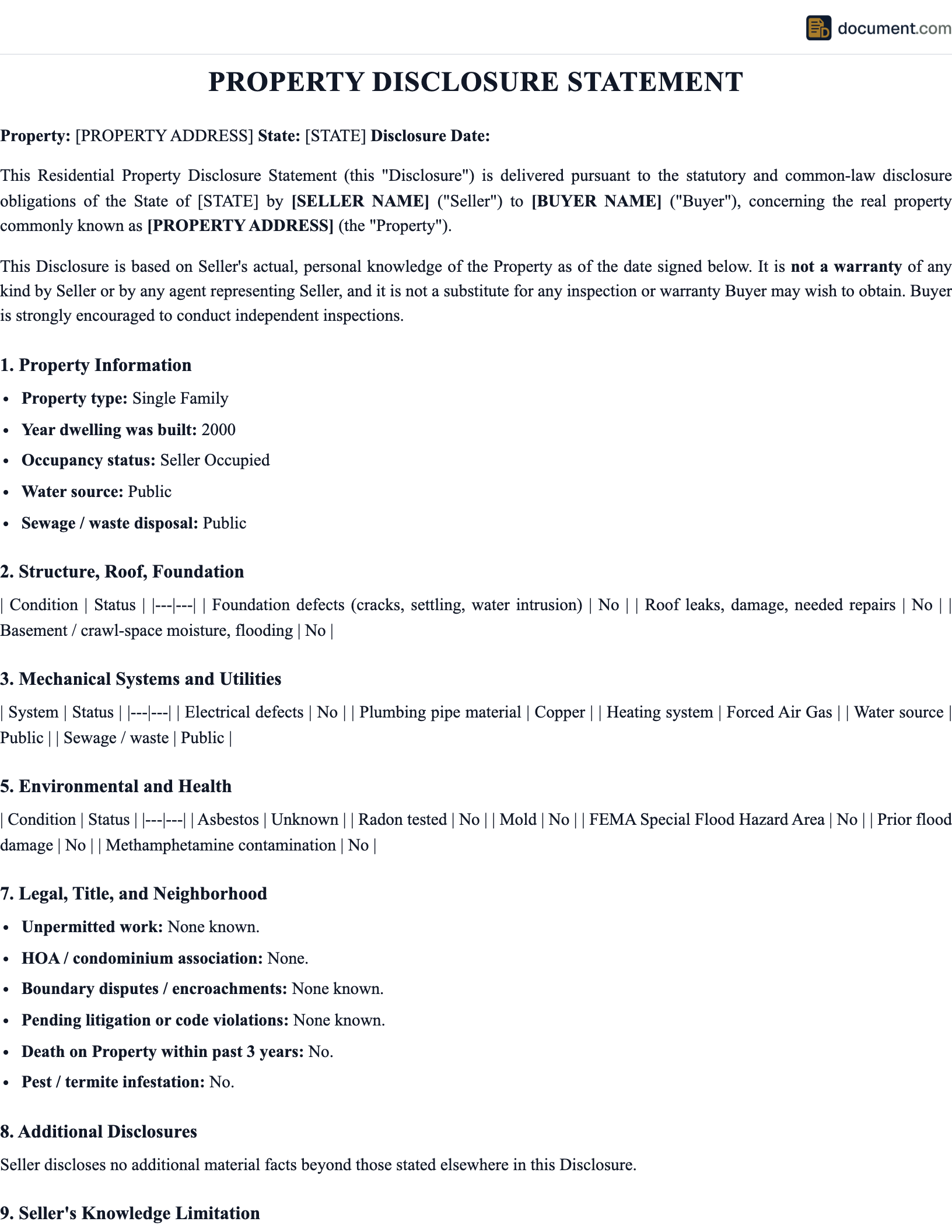
Sample Montana Disclosure Statement
Preview of our Montana-specific template. Your document will include all fields required for recording in any Montana county.
PROPERTY DISCLOSURE STATEMENT
STATE OF MONTANA
Legal Document
PARTY INFORMATION
Name: [Full Legal Name]
Address: [Montana Address]
County: [County]
PROPERTY DESCRIPTION
County: [County] State: Montana
Legal Description: [Per Recorded Plat]
Parcel No.: [APN]
Montana Disclosure Statement FAQ
Common questions about filing in Montana, including requirements, fees, and tax implications.
Official Montana Resources
Official state resources for verifying requirements and finding your local recording office.
Important Considerations for Montana Sellers
Montana sellers dealing in rural or agricultural property should take extra care with the water rights and irrigation sections of the disclosure. These are not formalities. Buyers of ranch and farm properties often rely heavily on irrigation systems and water shares, and a vague or incomplete water rights disclosure is one of the most common triggers for post-closing disputes in Montana.
Radon testing is worth completing before listing, especially in western Montana where granite geology creates elevated radon conditions in basements and crawl spaces. If you test and the results are elevated, disclose them. A test result is not a liability in itself; it becomes a liability only when a seller knows about it and says nothing.
If the property sits on land where past mining activity has occurred, check whether there are any reclamation obligations or access rights held by mining companies. Montana has a complex history of mineral extraction, and sellers of rural properties should clarify the mineral rights situation before the disclosure is delivered.
A Note on Montana Agricultural Properties
If the property includes irrigation infrastructure, water shares in a ditch company, or decreed water rights, attach any supporting documentation to the disclosure. Copies of water right decrees, ditch company certificates, or irrigation agreements give buyers a clearer picture and reduce the risk of misunderstanding after closing.
Related Documents
Depending on your situation, you may need additional documents alongside this one. Below are commonly related documents that are frequently used together in real estate transactions.
Important Considerations for Montana Sellers
Montana sellers dealing in rural or agricultural property should take extra care with the water rights and irrigation sections of the disclosure. These are not formalities. Buyers of ranch and farm properties often rely heavily on irrigation systems and water shares, and a vague or incomplete water rights disclosure is one of the most common triggers for post-closing disputes in Montana.
Radon testing is worth completing before listing, especially in western Montana where granite geology creates elevated radon conditions in basements and crawl spaces. If you test and the results are elevated, disclose them. A test result is not a liability in itself; it becomes a liability only when a seller knows about it and says nothing.
If the property sits on land where past mining activity has occurred, check whether there are any reclamation obligations or access rights held by mining companies. Montana has a complex history of mineral extraction, and sellers of rural properties should clarify the mineral rights situation before the disclosure is delivered.
A Note on Montana Agricultural Properties
If the property includes irrigation infrastructure, water shares in a ditch company, or decreed water rights, attach any supporting documentation to the disclosure. Copies of water right decrees, ditch company certificates, or irrigation agreements give buyers a clearer picture and reduce the risk of misunderstanding after closing.
Related Documents
Depending on your situation, you may need additional documents alongside this one. Below are commonly related documents that are frequently used together in real estate transactions.
Create your Montana Property Disclosure Statement in under 5 minutes.
Answer a few questions and download a Montana-compliant document, ready for the state agency.