
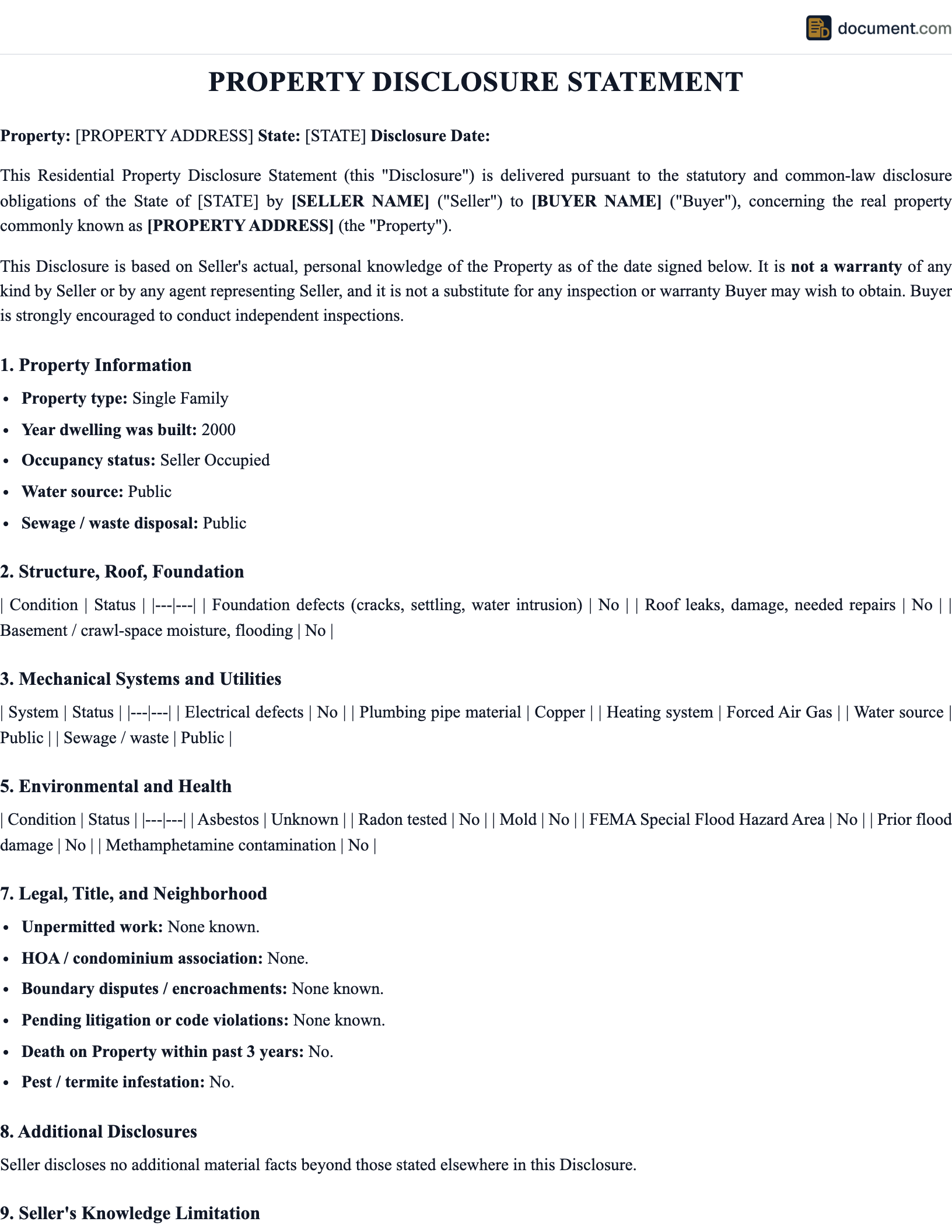



Missouri Disclosure Statement Overview
Missouri's residential seller disclosure requirement under RSMo 339.730 is a practical tool that benefits both sellers and buyers when used honestly. Sellers who complete the form carefully protect themselves from post-closing fraud claims. Buyers who receive an accurate disclosure can make informed decisions and calibrate their inspection process accordingly. The form is not filed with any government office; it travels from seller to buyer as part of the pre-contract package.
One aspect of Missouri's disclosure landscape that sets the state apart is the sinkhole and karst topography issue. Missouri has significant karst geology in the Ozarks and surrounding counties, where limestone and dolomite formations can dissolve over time and create subsurface voids. Sellers in affected areas who know of ground settlement, collapsed areas, or prior geotechnical concerns have a clear obligation to disclose them. Buyers in these regions should ask specifically about sinkhole history even if the disclosure form does not raise it prominently.
$24
Recording fee
None
Transfer tax
Required
Notarization
0
Witnesses required
Missouri Requirements
Missouri's disclosure statute sets out the categories of information sellers must address. Understanding each category helps sellers complete the form accurately and reduces the risk of omissions that could lead to claims later.
Missouri Specific Note
Missouri sellers must disclose any pending assessments or special improvement district charges that could affect future property costs, as well as any ongoing litigation involving the property. These disclosures are easy to overlook but matter significantly to buyers who are evaluating the total cost of ownership. Check with your title company if you are unsure whether any pending charges or claims affect your property.
What Missouri Sellers Must Disclose
- Structural and System Defects: Known issues with the roof, foundation, basement, walls, plumbing, electrical, and HVAC systems
- Sinkhole and Ground Stability: Known sinkholes, subsidence, or karst topography issues, particularly relevant in the Ozarks and other carbonate rock regions
- Pending Assessments and Litigation: Special improvement district charges, planned infrastructure assessments, homeowner association disputes, or any pending legal claims involving the property
- Water and Drainage: Known flooding, water intrusion, or drainage problems on the property or affecting the home
- Environmental Conditions: Hazardous substances, lead paint for pre-1978 homes, underground storage tanks, or other known environmental hazards
How to File in Missouri
The Missouri disclosure form is delivered directly to the buyer, not submitted to any government office. The goal is to get accurate information into the buyer's hands before they commit to a purchase. Here is how to handle the process correctly.
Complete the Form Before Listing or Accepting Offers
Work through every section based on your actual knowledge of the property. Gather any relevant records before you start, including prior inspection reports, repair receipts, and any assessments or notices you have received affecting the property.
Address Sinkhole and Ground Stability Questions Carefully
If the property is in a karst-prone area of Missouri, review the sinkhole and ground stability section with extra care. If you are unsure about the geology of your property, the Missouri Geological Survey has county-level karst maps that can help you understand the risk profile of your area.
Deliver to Buyer Before the Purchase Contract is Signed
Provide the completed form to the buyer before they sign anything. This removes the 5-business-day rescission window that applies when delivery occurs after contract signing. Have the buyer acknowledge receipt in writing and keep that acknowledgment.
Provide the Lead Paint Disclosure Separately for Pre-1978 Homes
Complete the federal lead paint disclosure form and provide the EPA pamphlet for homes built before 1978. This is a separate federal requirement with its own penalties and is not satisfied by the Missouri disclosure form alone.
Update Disclosures if New Material Facts Come to Light Before Closing
If something changes or you learn new information about the property's condition between signing and closing, update your disclosure. Notifying the buyer of new material facts before closing is a legal obligation and is far preferable to having the buyer discover the information after closing.
Missouri Fees & Costs
Typical costs for filing in Missouri. Actual fees may vary by county.
| Fee / Tax | Amount |
|---|---|
| Recording Fee | $24 |
| Transfer Tax | None |
| Notarization | $5 - $25 per signature |
| Certified Copy | $1 - $10 per page |
| Attorney Review (optional) | $150 - $500 |
Seller Liability for Non-Disclosure in Missouri
Missouri sellers who fail to disclose known material defects face exposure under RSMo 339.730 as well as common law fraud and the Missouri Merchandising Practices Act. Courts in Missouri have held sellers liable for substantial damages where they knew about a condition, failed to disclose it, and the buyer later incurred costs to address it. The 5-business-day rescission right that applies to late delivery is evidence of how seriously Missouri law takes the pre-contract disclosure obligation.
Pending assessments and litigation are an area where Missouri sellers sometimes make mistakes. A seller who is aware of a planned special improvement district project, a pending HOA special assessment, or an unresolved boundary dispute and does not disclose it is leaving the buyer to discover these costs after closing. Missouri buyers who find undisclosed assessments have successfully sued sellers for the additional financial burden imposed.
The sinkhole and karst issue is a Missouri-specific liability that sellers in affected regions cannot ignore. If a seller knows that a portion of their land has subsided, that a void exists under a structure, or that a prior owner dealt with sinkhole activity, failing to disclose that is a clear basis for a post-closing fraud claim. Missouri's geological survey resources can help sellers understand whether their property sits in an area where this disclosure deserves extra attention.
Sample Missouri Disclosure Statement
Preview of our Missouri-specific template. Your document will include all fields required for recording in any Missouri county.
PROPERTY DISCLOSURE STATEMENT
STATE OF MISSOURI
Legal Document
PARTY INFORMATION
Name: [Full Legal Name]
Address: [Missouri Address]
County: [County]
PROPERTY DESCRIPTION
County: [County] State: Missouri
Legal Description: [Per Recorded Plat]
Parcel No.: [APN]
Missouri Disclosure Statement FAQ
Common questions about filing in Missouri, including requirements, fees, and tax implications.
Official Missouri Resources
Official state resources for verifying requirements and finding your local recording office.
Important Considerations for Missouri Sellers
The sinkhole question is the one disclosure item that distinguishes Missouri from most other states. If you are selling property in the Ozarks, in the limestone belt running through central Missouri, or in any county where karst topography is documented, review that section of the disclosure form with particular care. A buyer who later discovers a sinkhole that the seller knew about has a strong fraud claim regardless of what else the disclosure said.
Pending assessments deserve specific attention before you complete the form. Contact your municipality, county, and any homeowner or improvement district to ask whether any assessments have been approved or are in planning stages for your property or your neighborhood. A seller who was notified of a planned road improvement district assessment and did not mention it on the disclosure form has a difficult argument to make in court.
Missouri's 5-business-day rescission window is meaningful in a competitive market. Sellers who deliver the disclosure form after a buyer has already signed an offer are handing that buyer a clean exit from the deal for five business days. In a tight market where finding a committed buyer is valuable, sellers should complete the form before going on the market and present it as part of the listing package.
Keep complete records of every disclosure document, every signed acknowledgment, and every piece of supporting documentation such as repair records and inspection reports that informed your answers. These records are your primary defense against post-closing claims and should be preserved for several years after the sale.
Seller Tip
Missouri's disclosure form is a legal document, not a marketing document. Write accurate answers to every question, not optimistic ones. Buyers and their attorneys read disclosures carefully, and an answer that seems designed to minimize or obscure a known issue can be treated as evidence of intent to deceive if a dispute arises later.
Related Documents
Depending on your situation, you may need additional documents alongside this one. Below are commonly related documents that are frequently used together in real estate transactions.
Important Considerations for Missouri Sellers
The sinkhole question is the one disclosure item that distinguishes Missouri from most other states. If you are selling property in the Ozarks, in the limestone belt running through central Missouri, or in any county where karst topography is documented, review that section of the disclosure form with particular care. A buyer who later discovers a sinkhole that the seller knew about has a strong fraud claim regardless of what else the disclosure said.
Pending assessments deserve specific attention before you complete the form. Contact your municipality, county, and any homeowner or improvement district to ask whether any assessments have been approved or are in planning stages for your property or your neighborhood. A seller who was notified of a planned road improvement district assessment and did not mention it on the disclosure form has a difficult argument to make in court.
Missouri's 5-business-day rescission window is meaningful in a competitive market. Sellers who deliver the disclosure form after a buyer has already signed an offer are handing that buyer a clean exit from the deal for five business days. In a tight market where finding a committed buyer is valuable, sellers should complete the form before going on the market and present it as part of the listing package.
Keep complete records of every disclosure document, every signed acknowledgment, and every piece of supporting documentation such as repair records and inspection reports that informed your answers. These records are your primary defense against post-closing claims and should be preserved for several years after the sale.
Seller Tip
Missouri's disclosure form is a legal document, not a marketing document. Write accurate answers to every question, not optimistic ones. Buyers and their attorneys read disclosures carefully, and an answer that seems designed to minimize or obscure a known issue can be treated as evidence of intent to deceive if a dispute arises later.
Related Documents
Depending on your situation, you may need additional documents alongside this one. Below are commonly related documents that are frequently used together in real estate transactions.
Create your Missouri Property Disclosure Statement in under 5 minutes.
Answer a few questions and download a Missouri-compliant document, ready for the state agency.